Are Electric Toothbrushes Better Than Manual?
Powered brushes win by a modest, evidence-backed margin — but technique, your tongue, and cleaning between teeth matter far more.
- In head-to-head trials, powered toothbrushes remove modestly more plaque and leave gums slightly healthier than manual brushes — but the gap is smaller than the marketing suggests, and technique matters more than the motor.
- A Cochrane review of 51 trials found powered brushes cut plaque by about 11% in the short term and 21% over three months, with a comparable edge for gum health.
- For fresh breath specifically the benefit is indirect: less plaque means fewer of the sulfur-producing bacteria behind odour — but no brush, powered or manual, reaches the tongue coating or between the teeth where much of that smell begins.
- Rotation-oscillation heads (the small round ones that pulse and rotate) have the strongest evidence; other powered styles are less studied.
- A well-used manual brush beats a carelessly-used electric one. The best brush is the one you will actually use for a full two minutes, twice a day, with a soft head and a light hand.
Powered toothbrushes do remove a little more plaque and leave gums slightly healthier than manual brushes, according to a large Cochrane review — roughly an 11% short-term drop in plaque. For fresh breath the benefit is real but modest, because the bigger levers are spending two careful minutes and cleaning your tongue and between your teeth, whichever brush you hold.
How a toothbrush actually affects your breath
Most everyday bad breath is made in the mouth, not the stomach. A film of bacteria — dental plaque — coats the teeth and gumline, and within it live anaerobic species that break down proteins and release volatile sulfur compounds, the gases responsible for that rotten-egg or sour smell. The microbiology of oral malodour points to these sulfur-producing anaerobes as the main culprits, and the more biofilm they have to live in, the more odour they can generate. A toothbrush works by physically disrupting that film: the bristles rake plaque off the tooth surface so it never matures into a thick, entrenched community. A powered brush adds thousands of small oscillations or rotations per minute, which can loosen plaque a little more efficiently than the hand manages — especially for people who brush too fast or too gently. That is the whole mechanism behind the electric brush's edge. It is not magic and it is not a mouthwash; it is simply a more consistent way of doing the same mechanical job. Which is why, when researchers put the two side by side, the powered brush wins — but only by a modest, measurable margin.
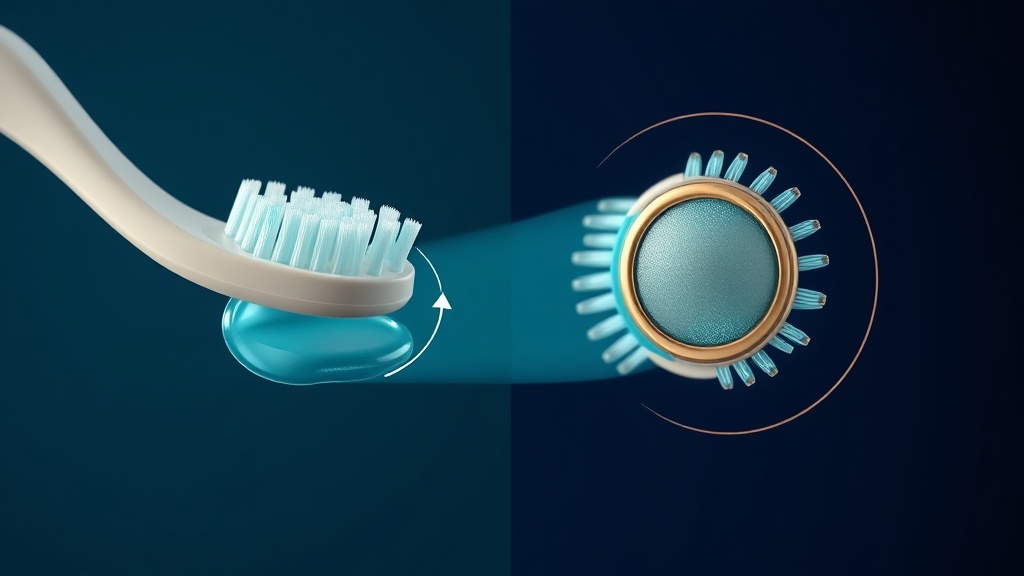
Both brushes do the same job — physically raking plaque off the tooth. A powered head simply adds more strokes per minute.
What the research actually shows
Every claim below maps to a named, peer-reviewed source in the Sources section. According to PubMed.
| Claim | Evidence | Source |
|---|---|---|
| Powered toothbrushes reduced plaque about 11% more than manual brushes in the short term and 21% more over three-plus months (moderate-quality evidence). | Systematic review of 51 trials, 4,624 participants. | Yaacob et al., 2014 (Cochrane) |
| Powered brushes also reduced gingivitis (early gum inflammation) more than manual brushes at both short and long term. | Meta-analysis across 44 gingivitis trials. | Yaacob et al., 2014 (Cochrane) |
| Rotation-oscillation heads had the largest and most consistent body of evidence among powered brush types. | 27 rotation-oscillation trials versus fewer for other styles. | Yaacob et al., 2014 (Cochrane) |
| No toothbrush cleans between the teeth; adding floss or an interdental brush reduces gingivitis beyond brushing alone. | Systematic review of 35 interdental-cleaning trials. | Worthington et al., 2019 (Cochrane) |
| Oral malodour is driven mainly by sulfur-producing anaerobic bacteria in plaque and tongue coating, so lowering total bacterial load supports fresher breath. | Review of the microbiology and management of halitosis. | Loesche & Kazor, 2002 |
Electric versus manual, honestly
| Factor | Electric | Manual |
|---|---|---|
| Plaque removed | Modestly more (~11-21% edge) | Very good with proper technique |
| Gum inflammation | Slightly lower in trials | Good; depends on gentleness |
| Built-in timer / pressure sensor | Common, helps consistency | None — you self-time |
| Reaches tongue and between teeth | No — same blind spots | No — same blind spots |
| Cost and upkeep | Higher; needs charging and heads | Low; replace every 3 months |
| Best for | Rushed or heavy-handed brushers, braces, limited dexterity | Anyone who brushes carefully for a full two minutes |
Why the brush is only half the breath equation
Here is the part the electric-versus-manual debate usually misses: for bad breath, the brush is not even the main event. A large share of the odour-producing bacteria live not on the smooth tooth surfaces a brush can reach, but on the rough back of the tongue and in the tight contacts between teeth. Cochrane evidence shows that gently cleaning the tongue reduces the sulfur gases behind malodour more than brushing the teeth alone does, and that adding floss or an interdental brush lowers gum inflammation beyond what any toothbrush achieves by itself. So a person with a top-of-the-line electric brush who skips their tongue and never cleans between their teeth will often have worse breath than someone with a basic manual brush who does both. This is why upgrading the motor delivers diminishing returns: it improves the one job the brush was already doing reasonably well, while leaving the two biggest odour reservoirs untouched. The honest takeaway is that the electric-versus-manual choice is real but secondary. What actually moves breath is the full routine — brush thoroughly, clean the tongue, clear between the teeth, and stay hydrated so saliva can do its own rinsing.
Evidence you can act on.
Occasional emails — new research, new protocols, no noise.
How to get the most from whichever brush you own
None of this treats a disease; it simply keeps the mouth's odour-producing bacteria in check. The routine matters more than the hardware.
- 1
Brush the full two minutes
2 min, twice dailyMost people brush for well under a minute and assume it is longer. Whether powered or manual, cover all surfaces slowly. An electric brush's built-in timer is genuinely useful here; with a manual brush, watch a clock.
- 2
Let a powered brush do the work — or ease off a manual one
ongoingWith an electric brush, guide it tooth to tooth without scrubbing; pressing hard fights the motor and can irritate gums. With a manual brush, use short, gentle strokes at the gumline rather than a hard sawing motion.
- 3
Clean your tongue
under a minuteThe back of the tongue is the single biggest reservoir of odour bacteria. A gentle scrape or brush of the tongue does more for breath than any upgrade in brush type.
- 4
Clear between your teeth once a day
1-2 min dailyFloss or an interdental brush reaches the contacts no toothbrush can. This is where trapped debris ferments into odour and where gum inflammation quietly starts.
- 5
Replace the head on time
every 3 monthsFrayed, splayed bristles clean poorly whatever the price of the handle. Swap manual brushes and powered heads roughly every three months, or sooner if they look worn.
The routine around the brush — tongue, floss, hydration — moves breath more than the choice of brush itself.
If your breath stays bad despite thorough brushing, tongue cleaning and daily interdental cleaning, see a dentist. Persistent odour can signal gum inflammation, a cracked filling, or a build-up of tartar that only a professional clean can remove — and lasting bad breath with bleeding gums, loose teeth or a bad taste always deserves an in-person assessment rather than a new gadget.
Frequently asked questions
Sources
- 1.
- 2.
- 3.
- 4.
- 5.

Fix your breath at the source.
The complete science-backed protocol — engineered to eliminate volatile sulfur compounds at the biological source.
Start the Breath Protocol →Related reading
Educational purposes only. The content on this page is not medical advice and is not a substitute for consultation with a qualified dental or medical professional.
More from the library
 Comparisons8 min
Soft vs Medium Toothbrush: Which Should You Use?
Medium bristles scrub off marginally more plaque, but soft protects your gums and enamel — and gentle, thorough brushing is what keeps breath fresh.
Read →→ Best Of8 min
The Best Manual Toothbrush: What Actually Matters
Skip the marketing. The best manual toothbrush is soft-bristled, small-headed, and comfortable enough that you actually brush for the full two minutes.
Read →→ Answers9 min
How to Remove Plaque From Teeth at Home (and When You Can't)
A practical, science-based routine for controlling soft plaque yourself — and an honest line on where home care stops and the dentist begins.
Read →→ Best Of9 min
Best Toothpaste for Bad Breath: What Ingredients Actually Matter
The active ingredient, not the brand on the tube, decides whether a toothpaste actually helps freshen your breath.
Read →→ Guides8 min
How to Get Rid of Bad Breath Permanently: An Evidence-Based Plan
The honest version: "permanently" means ongoing control, not a one-time fix. Here is the daily routine the research actually supports, and when to get help.
Read →→ Guides7 min
Bad Breath Even After Brushing? The Biological Reason (and Fix)
You brushed, flossed and rinsed — and the smell is still there. The reason usually isn't hygiene; it's where the odour-causing bacteria actually live.
Read →→