Tea Tree Oil Mouthwash: How to Use a Rinse Safely
A rinse where dilution and spitting out matter most, weighed honestly against the evidence.

- As a mouthwash, tea tree oil relies on the same antimicrobial and anti-inflammatory activity as the paste, but the make-or-break variable is dilution: essential oils are not water-soluble and must be properly diluted or emulsified.
- The clinical gum evidence comes from a tea tree gel, not a rinse, so applying it to a swished mouthwash is an extrapolation worth being honest about.
- Because a rinse is liquid and swished, the accidental-swallowing risk is higher than with paste, and tea tree oil can be toxic if ingested, so spit it all out.
- It is not a cavity preventer: unlike a fluoride mouthrinse, which has a measurable prevented fraction, a tea tree rinse has no such data.
- Used carefully, well-diluted, swished briefly and spat out, it may serve as a soothing adjunct, but it should not replace a fluoride rinse or good brushing.
Tea tree oil mouthwash uses a diluted plant essential oil for its antimicrobial and anti-inflammatory properties. The gum evidence actually comes from a gel, not a rinse, and there is no cavity-prevention data. Dilution is essential, and because tea tree oil is toxic if swallowed you must swish briefly and spit it all out.
Why dilution is everything in a rinse
Tea tree oil is prized for the antimicrobial and anti-inflammatory activity of its terpene compounds, chiefly terpinen-4-ol, which can disrupt microbial membranes in the laboratory. Turning that into a mouthwash, though, runs straight into basic chemistry: essential oils and water do not mix. Left to itself, tea tree oil simply floats as droplets rather than spreading through a rinse, which is why a proper tea tree mouthwash needs the oil diluted to a low concentration and usually emulsified with a carrier so it disperses evenly. Get this wrong, by tipping neat oil into water, and you have both an ineffective rinse and an irritant strong enough to burn the delicate lining of the mouth. When it is properly made, swishing spreads the diluted oil briefly across the teeth, gums and soft tissues, which is the plausible route to any antimicrobial or soothing effect. It is worth being clear-eyed about the evidence here, because the best human data for tea tree oil in the mouth came from a 2.5 percent gel brushed onto the gums, where it reduced gum bleeding and inflammation but not plaque, rather than from a swished rinse. Extending that gel result to a mouthwash is a reasonable hope, not a proven equivalence, since concentration, contact time and delivery are all different. So a tea tree rinse is best framed honestly: a diluted antimicrobial rinse that some people find freshening or soothing, resting on laboratory activity and gum-gel evidence, not on trial proof that the rinse itself does a specific job.

Essential oil and water do not mix, so a safe tea tree rinse depends on proper dilution and emulsification.
What the research actually shows
Every claim below maps to a named, peer-reviewed source in the Sources section. According to PubMed.
| Claim | Evidence | Source |
|---|---|---|
| Tea tree oil has documented antimicrobial and anti-inflammatory activity, and is toxic if ingested. | Comprehensive review, Clinical Microbiology Reviews. | Carson et al., 2006 |
| A 2.5 percent tea tree oil gel reduced gum inflammation but not plaque; the human evidence is for a gel, not a rinse. | Double-blind randomized trial, 49 adults. | Soukoulis & Hirsch, 2004 |
| Supervised fluoride mouthrinse reduces cavities, with a prevented fraction around 27 percent; a tea tree rinse has no such data. | Cochrane review of fluoride mouthrinses. | Marinho et al., 2016 |
| Fluoride toothpaste's caries-prevented fraction of about 24 percent is a benchmark oral-care benefit tea tree oil does not match. | Cochrane review of 70 trials. | Marinho et al., 2003 |
| The effective anti-cavity fluoride range is about 1,000-1,500 ppm. | Cochrane concentration review. | Walsh et al., 2019 |
Tea tree rinse versus a fluoride rinse
| Feature | Tea tree oil rinse | Fluoride rinse |
|---|---|---|
| Main rationale | Antimicrobial and soothing | Cavity prevention |
| Cavity evidence | None | ~27 percent prevented fraction |
| Needs dilution | Yes, essential oil | No, pre-formulated |
| Swallow? | No, toxic if ingested | No, spit out |
| Whitens teeth | No | No |
The safety case for a rinse specifically
Every safety point that applies to tea tree toothpaste applies more sharply to a mouthwash, because a rinse is a liquid you swish around the whole mouth, which makes accidental swallowing easier than with a paste. Tea tree oil is safe for appropriate topical use but can be toxic when ingested, with reports of drowsiness, unsteadiness and confusion after swallowing, so a tea tree rinse must always be spat out completely and never gargled so deeply that some goes down. This same logic makes storage matter: a pleasant-smelling rinse should be kept well away from children and pets, for whom even a small swallowed amount can be dangerous. The second concern is the mouth lining itself. Essential oils are irritants at high concentration, so a rinse that is too strong, or one made by adding neat oil to water, can burn or inflame the soft tissues rather than soothe them, which is the opposite of the goal. Allergy is the third issue, since tea tree oil is a recognized cause of allergic contact reactions, especially as the oil oxidizes with age, so a patch test and a cautious start are sensible. Finally there is the honest matter of scope. A tea tree rinse has no evidence that it prevents cavities, whereas a fluoride mouthrinse has a measurable cavity-prevention benefit, so a tea tree rinse should be treated as a possible freshening or soothing adjunct rather than a protective one. The safe way to use it is diluted and pre-formulated, swished briefly, spat out entirely, and layered on top of, not in place of, the brushing and fluoride that actually protect your teeth.
Evidence you can act on.
Occasional emails — new research, new protocols, no noise.
How to use a tea tree rinse safely
A tea tree rinse can be part of a routine if you respect the two things that matter most: dilution and spitting out. None of this treats a disease; it is a comfort adjunct while your real protection stays in place.
- 1
Dilute properly, never swish neat oil
before useUse a ready-made, correctly diluted product, or a few drops thoroughly emulsified in a carrier base. Neat essential oil is far too strong for the mouth and can burn the tissue.
- 2
Patch-test and start low
first usesTry a small, brief rinse first and watch for burning, stinging or a rash. Tea tree oil can cause allergic reactions, so stop at the first sign of irritation.
- 3
Swish briefly, then spit it all out
about 30 secondsRinse gently for a short time and spit everything out. Do not gargle deeply or swallow, since ingested tea tree oil can be toxic.
- 4
Keep it away from children and pets
alwaysStore the bottle out of reach. A scented rinse is easy to mistake for something drinkable, and small swallowed amounts can be harmful.
- 5
Do not drop your fluoride rinse or brushing
ongoingA tea tree rinse does not prevent cavities, so keep fluoride and good brushing as your foundation and see a dentist for gum problems that persist.
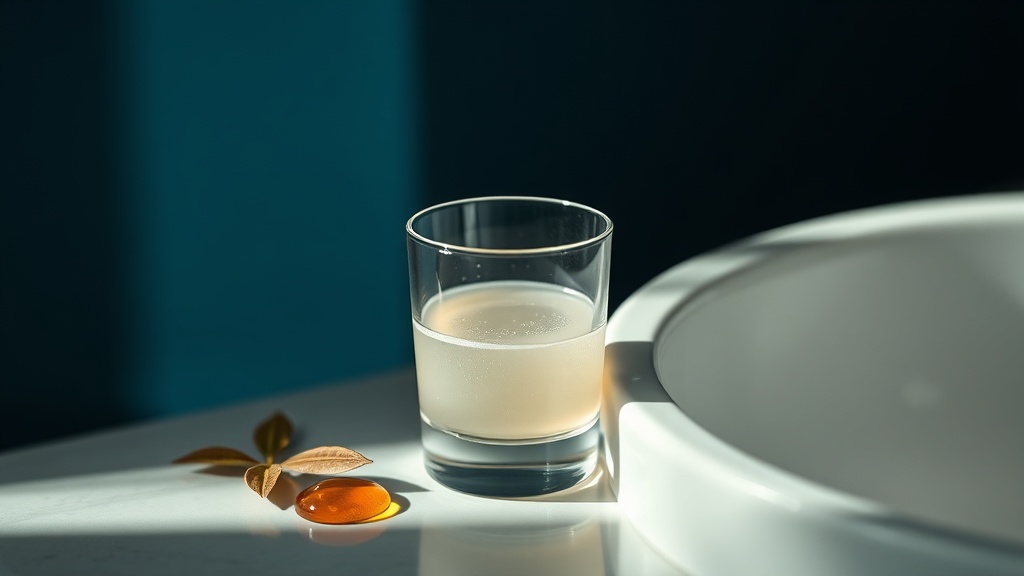
With a rinse the rule is simple: dilute it, swish briefly, and spit every bit of it out.
See a dentist if you are using a tea tree rinse for bleeding gums, persistent bad breath or a bad taste, since these often point to gum disease that a rinse alone will not resolve. Seek medical advice promptly if the rinse is swallowed in more than a trace, particularly by a child, and stop use and consult a clinician if you develop burning, swelling or a rash suggesting an allergic reaction. A dentist can also tell you whether a fluoride rinse would serve your teeth better.
Frequently asked questions
Sources
- 1.
- 2.
- 3.
- 4.
- 5.

Fix your breath at the source.
The complete science-backed protocol — engineered to eliminate volatile sulfur compounds at the biological source.
Start the Breath Protocol →Related reading
Educational purposes only. The content on this page is not medical advice and is not a substitute for consultation with a qualified dental or medical professional.
More from the library
 Ingredients9 min
Tea Tree Oil Toothpaste: Evidence and Safety
A plant essential oil with genuine antimicrobial evidence, honest limits, and safety rules worth knowing.
Read →→ Ingredients8 min
Oil Pulling Benefits: What the Evidence Actually Supports
A traditional practice with a small but real evidence base — and a lot of overclaiming to separate out.
Read →→ Ingredients8 min
Coconut Oil for Teeth: What It Actually Does
The most popular oil for pulling, weighed honestly against the traditional choice and the trial data.
Read →→ Best Of8 min
Best Fluoride Mouthwash: Daily vs Weekly Rinses Explained
The best fluoride mouthwash for most people is an alcohol-free 0.05% daily rinse, with a stronger 0.2% weekly rinse for higher-risk mouths. Use it away from brushing so it adds fluoride, not subtracts it.
Read →→ Answers8 min
How to Get Rid of White Spots on Teeth: Your Options, Ranked
An honest, evidence-based ladder of options, from what you can do at home to what only a dentist can fix.
Read →→ Ingredients8 min
Hydroxyapatite Toothpaste Benefits: What the Evidence Actually Supports
A calm, science-first look at what hydroxyapatite toothpaste can genuinely do for your enamel, and where the evidence stops.
Read →→