
Hydroxyapatite Mouthwash: What a Remineralizing Rinse Does
The rinse form of hydroxyapatite: how a swish delivers mineral where a brush misses, calms bacterial stickiness without a chlorhexidine trade-off, and where the evidence still thins out.
- A hydroxyapatite mouthwash is the rinse form of the same mineral your enamel is built from — it spreads calcium-phosphate over every surface, including the between-teeth areas a brush can miss.
- Its second, better-evidenced role is on bacteria: a hydroxyapatite rinse rivalled chlorhexidine at cutting bacterial adhesion (an estimated ~65% in-situ reduction) without killing off the commensal flora that a harsh antiseptic strips away.
- As a mineral source the rinse is best seen as a supplement to a hydroxyapatite toothpaste, not a replacement — a swish has far shorter contact time than a spit-don''t-rinse film, and the strongest remineralization evidence is for leave-on paste.
- Compared with a fluoride mouthrinse (which cut caries about 27% in supervised programs), the hydroxyapatite rinse evidence is thinner and graded low certainty — it is a reasonable, gentle option, not a proven equal.
- A rinse strengthens and supports enamel on early, non-cavitated surfaces; it does not reverse a cavity, and swishing over an untreated hole does not make it safe to ignore.
A hydroxyapatite mouthwash swishes calcium-phosphate mineral across the whole mouth and reduces how stickily bacteria adhere — notably without the collateral damage to good flora that chlorhexidine causes. Think of it as a gentle supplement to a hydroxyapatite toothpaste rather than a standalone fix: useful for coverage and freshness, but shorter contact time and thinner evidence than the paste.
What a hydroxyapatite rinse actually does
A hydroxyapatite mouthwash works on two fronts, and it helps to keep them separate. The first is mineral coverage. Suspended in a rinse, nano-hydroxyapatite particles reach across the whole mouth in one swish — the sides of teeth, the gumline, and the tight contacts between teeth that a brush head skims past — and settle a thin layer of the same calcium-phosphate mineral enamel is made of onto those surfaces. That distributes mineral more widely than a brush can, which is the appeal. The second front is the biofilm. Here the evidence is actually more interesting: a hydroxyapatite rinse has been shown to reduce how readily bacteria stick to the tooth surface, rivalling chlorhexidine — the traditional gold-standard antiseptic — at cutting bacterial adhesion, but doing it by physically occupying binding sites rather than by killing bacteria. That distinction matters, because chlorhexidine also wipes out the beneficial commensal flora and can stain teeth, whereas the hydroxyapatite approach leaves the healthy ecosystem largely intact. So a hydroxyapatite rinse is less an antiseptic and more a surface-conditioning, mineral-spreading swish — a gentler tool with a gentler mechanism.
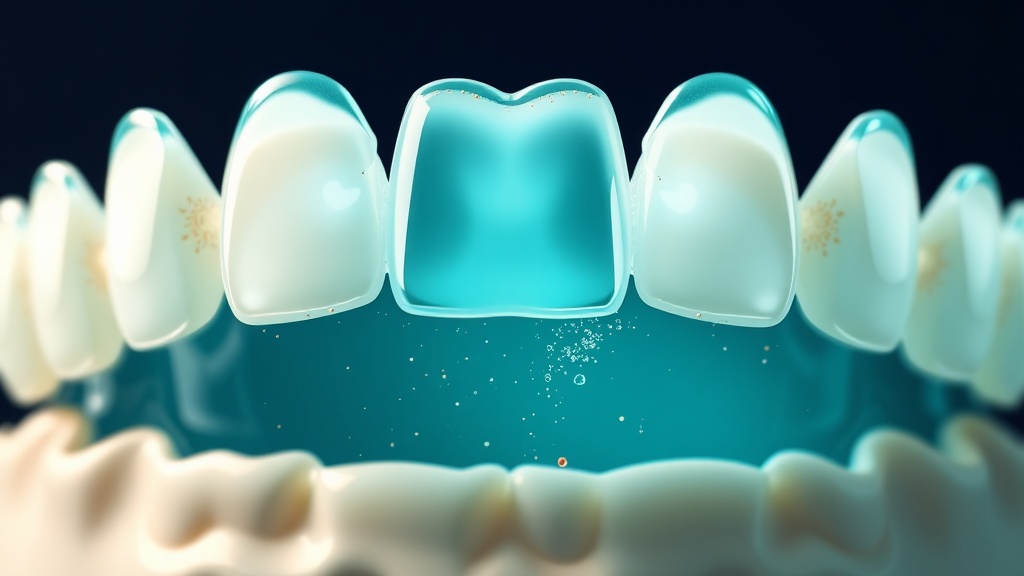
A rinse spreads a thin mineral layer across surfaces a brush skims past — its main advantage over paste is coverage, not contact time.
What the research actually shows
Every claim below maps to a named, peer-reviewed source in the Sources section. According to PubMed.
| Claim | Evidence | Source |
|---|---|---|
| A hydroxyapatite rinse rivalled chlorhexidine at reducing bacterial adhesion — an estimated ~65% in-situ bacterial-load reduction — without killing the commensal flora. | Narrative review of hydroxyapatite dentifrices and rinses. | O''Hagan-Wong et al., 2022 |
| Pooled analysis found hydroxyapatite clearly beats placebo but only numerically (not significantly) edges fluoride — the honest ceiling for hydroxyapatite products, rinse included. | Systematic review and meta-analysis. | Pawinska et al., 2024 |
| The most rigorous review rated hydroxyapatite evidence very low certainty and found it did not resist demineralization under acid the way fluoride does. | Systematic review and meta-analysis. | Wierichs et al., 2022 |
| A supervised fluoride mouthrinse cut caries about 27% — the established rinse benchmark a hydroxyapatite rinse is measured against. | Cochrane systematic review of fluoride mouthrinses. | Marinho et al., 2016 |
| Saliva keeps enamel bathed in a supersaturated calcium-phosphate reservoir; statherin is ~66× more potent than whole saliva at holding that mineral in solution — the system a rinse supplements, not replaces. | In-vitro study of salivary mineral inhibition. | Tamaki et al., 2002 |
How it compares with other rinses
| Rinse type | What it mainly does | The trade-off |
|---|---|---|
| Hydroxyapatite rinse | Spreads mineral; curbs bacterial adhesion gently | Short contact time; thinner, low-certainty evidence |
| Fluoride mouthrinse | Cuts caries about 27% in supervised use; more acid-resistant surface | Contains fluoride, which some prefer to avoid |
| Chlorhexidine rinse | Strong antibacterial for short-term clinical use | Kills good flora too; can stain; not for daily long-term use |
| Plain water swish | Clears debris and dilutes acid briefly | No mineral or lasting antibacterial effect |
Rinse or paste — where the rinse fits
The most common question is whether a hydroxyapatite mouthwash can stand in for the toothpaste, and the honest answer is no — it complements it. The reason is contact time. The strongest remineralization result in the whole hydroxyapatite literature came from leaving a mineral film on the teeth after brushing rather than rinsing it away, which is the opposite of a quick swish that mostly runs off in seconds. A paste you spit but do not rinse leaves a lingering layer; a mouthwash gives broad but brief coverage. That makes the rinse a supplement with two sensible jobs: reaching surfaces the brush misses, and offering a gentle, flora-friendly alternative to an antiseptic rinse for people who want one. It also pairs naturally with saliva, the body''s own remineralization system, which keeps enamel bathed in a supersaturated mineral reservoir; a rinse tops that up rather than doing anything saliva cannot. It is worth being clear-eyed about the evidence gap, too. Fluoride mouthrinses have decades of trial data behind a roughly 27% caries reduction, while the hydroxyapatite rinse evidence is thinner and graded low certainty. That does not make it pointless — the anti-adhesion and coverage benefits are real — but it does mean a rinse belongs alongside good brushing, not instead of it.
Evidence you can act on.
Occasional emails — new research, new protocols, no noise.
How to use a hydroxyapatite mouthwash well
A rinse rewards a light touch and good timing. None of this treats a disease — it supports the surface and the ecosystem.
- 1
Use it as a supplement, not a substitute
once or twice dailyKeep a hydroxyapatite toothpaste as your main mineral source and let the rinse extend coverage. Swapping the paste for a rinse trades away the leave-on contact time that drives most of the benefit.
- 2
Swish thoroughly, then do not eat or drink for a while
30–60 secondsGive the particles time to reach every surface, then leave the mouth undisturbed for a stretch so the thin mineral layer is not immediately washed away.
- 3
Consider it after brushing, or midday
as it suits youA rinse after your spit-don''t-rinse brushing can extend coverage, or a midday swish can refresh and re-coat surfaces between brushings when you cannot brush.
- 4
Choose it over an antiseptic for daily use
ongoingIf you want a gentle daily rinse, hydroxyapatite spares the beneficial flora that chlorhexidine strips. Save antiseptic rinses for the short, specific courses a dentist recommends.
- 5
Do not rely on it for an untreated tooth
alwaysA rinse over a visible hole or a diagnosed cavity does not make it safe to postpone care. Get it staged; swishing is support, not treatment.
Best as a supplement to a hydroxyapatite toothpaste — broad coverage and a gentle, flora-friendly alternative to antiseptic rinses.
A remineralizing rinse is a supportive daily habit, not a diagnosis. See a dentist if you notice a persistent white, brown or chalky spot, a visible pit or hole, a rough surface you can catch with a fingernail, bleeding gums, or new sensitivity. Only an exam can tell an early, remineralizable spot from a cavitated tooth — and relying on a swish over an untreated hole can let decay progress unseen.
Frequently asked questions
Sources
- 1.
- 2.
- 3.
- 4.
- 5.
- 6.
- 7.
- 8.

Fix your breath at the source.
The complete science-backed protocol — engineered to eliminate volatile sulfur compounds at the biological source.
Start the Breath Protocol →Related reading
Educational purposes only. The content on this page is not medical advice and is not a substitute for consultation with a qualified dental or medical professional.
More from the library
 Ingredients8 min
Hydroxyapatite Toothpaste: How It Remineralizes and Strengthens Enamel
The mineral your enamel is already made of, in a tube: what nano-hydroxyapatite does to the tooth surface, what the evidence shows, and where it stops.
Read →→ Guides8 min
Does Hydroxyapatite Toothpaste Work? What the Evidence Shows
The fluoride-free ingredient dentists keep debating, measured against the actual clinical trials.
Read →→ Answers8 min
Is Nano-Hydroxyapatite Toothpaste Safe?
The nanoparticle worry, answered by the actual toxicology reviews rather than the headlines.
Read →→ Best Of8 min
Best Hydroxyapatite Toothpaste for Enamel: How to Pick
If your goal is specifically to strengthen and rebuild enamel, a few features matter more than others — here is how to pick for the surface, not the slogan.
Read →→ Answers8 min
How to Get Rid of White Spots on Teeth: Your Options, Ranked
An honest, evidence-based ladder of options, from what you can do at home to what only a dentist can fix.
Read →→ Ingredients8 min
Hydroxyapatite Toothpaste Benefits: What the Evidence Actually Supports
A calm, science-first look at what hydroxyapatite toothpaste can genuinely do for your enamel, and where the evidence stops.
Read →→