How Long Should You Oil Pull? Duration and Frequency Explained
How many minutes, how often, and how long before you notice anything — the timing of oil pulling, grounded in what the trials actually did.

- The traditional target is around 10 to 20 minutes per session, but the practical goal is simply to swish until the oil turns thin and milky — the sign it has emulsified.
- Once a day is enough. In the trials that showed a benefit, participants oil pulled a single time daily, usually in the morning before brushing.
- You do not need marathon sessions. If a full 15 to 20 minutes is uncomfortable, five to ten minutes done consistently is far better than a long session you abandon.
- In studies, changes in salivary bacteria and gum measures showed up over roughly one to six weeks of daily use, not overnight — timing is about a habit, not a quick fix.
- More is not better: over-long or over-forceful swishing mainly buys you a sore jaw, and oil pulling still cannot remineralize enamel or replace fluoride or hydroxyapatite brushing.
Aim to oil pull for about 10 to 20 minutes, once a day, ideally in the morning before you brush. In practice, swish gently until the oil goes thin and milky, which signals it has emulsified. If that feels too long, five to ten minutes done consistently is fine — regularity matters more than squeezing out extra minutes.
Why the classic figure is 10 to 20 minutes
The familiar advice to oil pull for 15 or 20 minutes comes from the Ayurvedic tradition rather than from a precise clinical dose-finding study. What the modern trials share is not an exact number of minutes but a shared logic: you swish long enough for the oil to emulsify — to break up with saliva into a thin, milky fluid — because that emulsification is what is thought to lift fat-loving bacteria out of the mouth. That process begins within the first few minutes and continues as you keep going, which is why a rough window rather than a stopwatch-perfect figure is the honest guide. It also explains why chasing very long sessions has diminishing returns: once the oil has fully emulsified and you have moved it thoroughly between the teeth, extra minutes add little beyond fatigue. So treat 10 to 20 minutes as a comfortable ceiling to aim toward over time, and use the milky change in the oil as your real finish line rather than a rigid count.

Start short and build toward 10 to 20 minutes; the oil turning thin and milky is the cue that it has emulsified.
What the trials actually did
Every claim below maps to a named, peer-reviewed source in the Sources section. According to PubMed.
| Claim | Evidence | Source |
|---|---|---|
| A triple-blind trial had participants oil pull with sesame oil once daily in the morning before brushing; over a 10-day period this reduced plaque, gum and bacterial-count measures. | Randomized, controlled, triple-blind study (n=20), 10-day protocol. | Asokan et al., 2009 |
| Across 25 trials, oil-pulling interventions ran from 7 to 45 days, with a probable benefit for gum health emerging over those durations and overall certainty graded very low. | Systematic review and meta-analysis (25 trials, 1,184 participants). | Jong et al., 2023 |
| Pooling nine randomized trials, oil pulling significantly lowered salivary bacterial counts, while plaque and gingival index scores did not differ significantly from controls. | Meta-analysis of 9 RCTs. | Peng et al., 2022 |
| An Oxford review of five randomized trials lasting between 10 and 45 days found limited evidence of benefit over the short periods studied. | Systematic review of 5 RCTs (160 participants). | Gbinigie et al., 2016 |
| Coconut-oil trials lasting just 7 to 14 days already showed reductions in salivary bacteria and plaque scores, though the evidence was limited and at high risk of bias. | Systematic review of RCTs (coconut oil). | Woolley et al., 2020 |
Duration and frequency at a glance
| Question | Sensible answer | What the studies did |
|---|---|---|
| Minutes per session | About 10 to 20, or until milky | Sessions varied; the oil emulsifies within minutes |
| Times per day | Once | Once daily in the trials that showed benefit |
| Best time of day | Morning, before brushing | Commonly morning, before food and brushing |
| Days before you notice anything | Roughly 1 to 6 weeks | Trials ran 7 to 45 days |
| Can you overdo it? | Yes — stop if your jaw aches | No added benefit shown from very long sessions |
How long until you see a difference — and how long to keep going
If you are hoping for an overnight change, oil pulling is the wrong tool. In the trials, the measurable shifts in salivary bacteria and gum scores appeared over days to weeks of consistent daily use — the shortest coconut-oil studies ran a week or two, while the broader reviews pooled interventions of up to about six weeks. That tells you two useful things. First, judge it over a month or so, not a single session. Second, because any effect depends on continuing the habit, oil pulling is not something you finish; it is something you maintain, in the same way you would keep using a mouthwash rather than expecting a one-off rinse to last. It is worth repeating the honest limit here: none of this duration builds enamel back. Oil pulling cannot remineralize a white-spot lesion or close a cavity no matter how many weeks you keep at it, so the timeline that really protects your teeth is the daily one you spend brushing with fluoride or hydroxyapatite and the regular one you spend in the dentist chair.
Evidence you can act on.
Occasional emails — new research, new protocols, no noise.
A sensible timing routine
This is about building a comfortable, repeatable habit — not enduring the longest possible session. Keep it gentle.
- 1
Start with five minutes
week oneIf you are new to it, begin with about five minutes so your jaw and patience adjust. A short session you actually repeat beats an ambitious one you quit after two days.
- 2
Build toward 10 to 20 minutes
over a couple of weeksAdd a few minutes as it becomes comfortable, aiming for the traditional 10-to-20-minute window. There is no prize for going longer once the oil has emulsified.
- 3
Do it once a day, in the morning
dailyOnce daily is what the supportive trials used, typically first thing in the morning before eating and before brushing. Anchoring it to an existing morning habit helps it stick.
- 4
Use the milky cue, not just the clock
per sessionStop when the oil has turned thin and milky and you have moved it thoroughly between the teeth. That change, rather than a rigid stopwatch number, is the practical finish line.
- 5
Review after about a month
ongoingGive it three to four weeks before judging whether it is worth keeping, and remember it only holds any benefit while you keep it up. Never let it crowd out brushing or a dental visit.
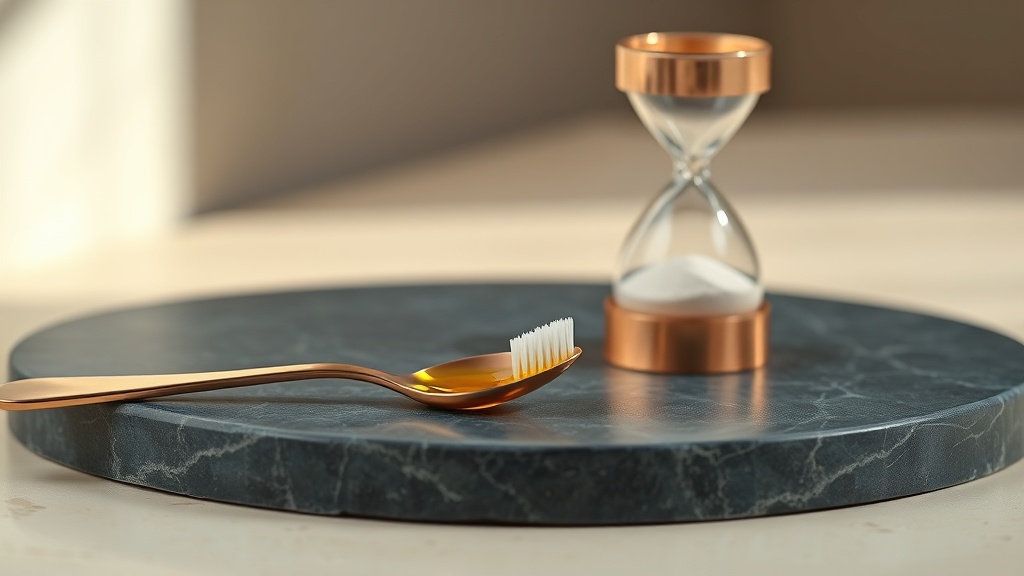
The supported rhythm is simple: once a day, in the morning, before brushing with a remineralizing toothpaste.
No amount of oil-pulling time is a substitute for care. If you have a toothache, a visible hole or dark spot, bleeding gums that persist, ongoing bad breath, or a sore or lump lasting more than two weeks, see a dentist. Extending your sessions or your weeks will not fix these, and delay only makes an early problem harder to treat.
Frequently asked questions
Sources
- 1.
- 2.
- 3.
- 4.
- 5.
- 6.
- 7.

Fix your breath at the source.
The complete science-backed protocol — engineered to eliminate volatile sulfur compounds at the biological source.
Start the Breath Protocol →Related reading
Educational purposes only. The content on this page is not medical advice and is not a substitute for consultation with a qualified dental or medical professional.
More from the library
 Ingredients8 min
How to Oil Pull: The Complete Step-by-Step Method
The full technique — which oil, how much, how to swish and spit safely, and where oil pulling honestly fits alongside a proven remineralizing routine.
Read →→ Guides8 min
Does Hydroxyapatite Toothpaste Work? What the Evidence Shows
The fluoride-free ingredient dentists keep debating, measured against the actual clinical trials.
Read →→ Answers8 min
Is Nano-Hydroxyapatite Toothpaste Safe?
The nanoparticle worry, answered by the actual toxicology reviews rather than the headlines.
Read →→ Best Of8 min
How to Choose the Best Hydroxyapatite Toothpaste
Skip the marketing and pick on the three things the research says actually matter.
Read →→ Answers8 min
How to Get Rid of White Spots on Teeth: Your Options, Ranked
An honest, evidence-based ladder of options, from what you can do at home to what only a dentist can fix.
Read →→ Ingredients8 min
Hydroxyapatite Toothpaste Benefits: What the Evidence Actually Supports
A calm, science-first look at what hydroxyapatite toothpaste can genuinely do for your enamel, and where the evidence stops.
Read →→