How Fluoride Toothpaste Remineralizes Teeth
The chemistry behind fluoride's remineralizing power, and the honest line between the early lesions it can rebuild and the cavities it cannot.
- Fluoride does not coat teeth or kill decay directly. It works chemically: when saliva is redepositing calcium and phosphate into a softened enamel surface, trace fluoride steers that rebuild toward a tougher, more acid-resistant mineral.
- The rebuilt surface is genuinely stronger than the enamel it replaced. Mineral laid down with fluoride present resists the next acid attack better than the original crystal did.
- Concentration matters. Toothpaste in the 1,000 to 1,500 ppm range is the evidence-backed range; below about 500 ppm the measurable benefit largely disappears.
- Fluoride remineralizes early, non-cavitated lesions, the chalky white spots, not holes. Once enamel cavitates the surface is broken and no toothpaste can rebuild it; that needs a dentist.
- Remineralization is a daily tug-of-war, not a one-time repair. The benefit comes from a low, constant supply of fluoride at the tooth surface, which is why twice-daily brushing beats occasional heavy use.
Fluoride toothpaste remineralizes teeth by tipping enamel''s constant demineralization and remineralization balance in your favour. As saliva redeposits calcium and phosphate into a softened surface, fluoride guides the rebuild into a harder, more acid-resistant mineral. It works on early white-spot lesions only; cavitated holes cannot be rebuilt at home and need a dentist.
How fluoride actually rebuilds enamel
Enamel is not a static shell. Every day its surface loses a little mineral when the mouth turns acidic and regains it when conditions calm down. When plaque bacteria ferment sugar, the surface pH can fall below roughly 5.5, the point at which enamel mineral starts to dissolve, and calcium and phosphate leach out into the surrounding fluid. As saliva clears the acid and the pH climbs back up, that same fluid is supersaturated with calcium and phosphate and begins to redeposit them onto the softened crystals. This is remineralization, and it is happening in your mouth many times a day without you noticing. Fluoride does not create this process; it improves it. When even a trace of fluoride is present at the surface during the rebuild, it is drawn into the growing mineral and nudges it toward a fluorapatite-like structure that is denser and dissolves at a lower pH than the original enamel. In other words, the patch is tougher than the wall around it. That is why the mechanism is described as topical, not systemic: it is fluoride sitting at the tooth surface, not fluoride swallowed, that does the work.
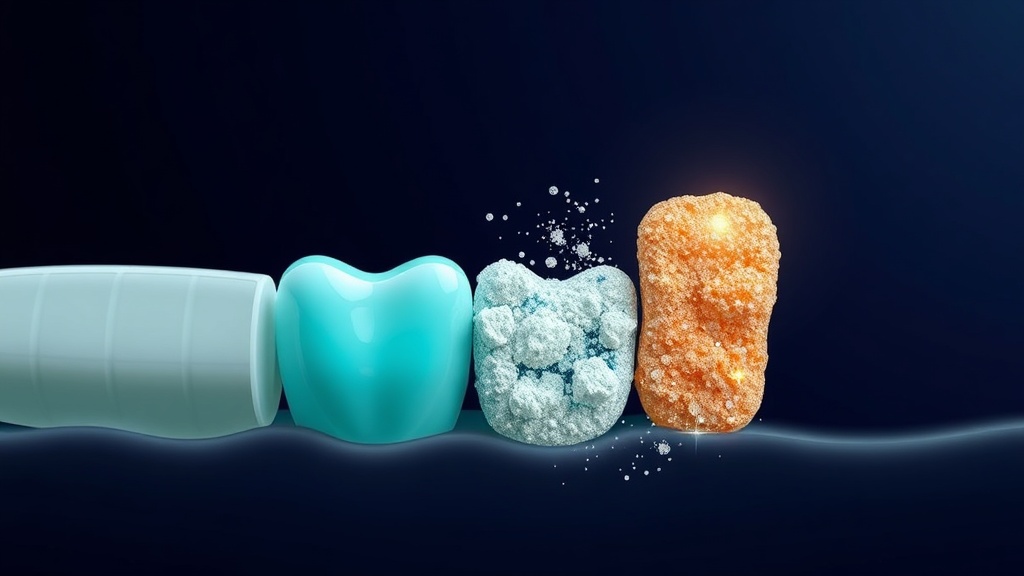
Fluoride works during the rebuild: as saliva returns calcium and phosphate to a softened surface, fluoride steers it into a tougher, more acid-resistant mineral.
What the research actually shows
Every claim below maps to a named, peer-reviewed source in the Sources section. According to PubMed.
| Claim | Evidence | Source |
|---|---|---|
| Fluoride toothpaste reduces caries increment versus non-fluoride toothpaste, with a pooled prevented fraction of about 24 percent, a benefit the authors call firmly established over more than half a century. | Cochrane review, 70 trials, ~42,300 children. | Marinho et al., 2003 |
| The benefit follows a dose-response by concentration; 1,000 to 1,500 ppm is effective while fluoride below about 500 ppm shows no significant benefit. | Cochrane review of fluoride toothpastes of different concentrations. | Walsh et al., 2019 |
| Enamel remineralized in the presence of fluoride forms a mineral that is more acid-resistant than the original enamel. | Mechanistic review of fluoride action. | Buzalaf et al., 2011 |
| The demineralization process and early lesions can be prevented or reversed by protective factors including salivary calcium and phosphate and fluoride; the reversal is of the early lesion, not of a cavity. | Foundational caries-balance paper. | Featherstone, 1999 |
| Once cavitation occurs the developed enamel cannot repair itself, because enamel is acellular and the broken surface will not remineralize back to sound tooth. | Materials-science review of enamel repair. | Liu et al., 2022 |
How much fluoride, and for what
| Fluoride source and level | What the evidence shows | Best for |
|---|---|---|
| Below ~500 ppm | No significant caries benefit measured | Not enough to rely on for remineralization |
| 1,000 to 1,500 ppm standard paste | Proven caries reduction with a clear dose-response | Everyday remineralization support |
| Daily fluoride mouthrinse (~225 ppm) | Adds roughly a 27 percent prevented fraction on top of brushing | Extra help between brushings for higher-risk teeth |
| Professional varnish (dentist-applied) | Prevented fraction around 43 percent in permanent teeth | Targeting specific early white spots under supervision |
Why the early lesion is the whole opportunity
A white-spot lesion looks like a chalky, matte patch, and under the surface it is exactly that: mineral has been dissolved out of the layers just beneath an intact outer skin of enamel. Because that outer skin is still whole, fluoride and saliva can diffuse in and rebuild the mineral underneath. This is the sweet spot where a toothpaste genuinely earns its keep. The moment the surface collapses into a physical hole, the situation changes completely. The lesion is now a plaque trap that no brush can keep clean, and progression can only be arrested when clinically plaque-free conditions are obtained, which a cavitated surface structurally prevents. That is the honest boundary of everything on this page: fluoride toothpaste is a powerful tool against the chalky early lesion and a poor one against the hole. It is also why a new white spot is worth showing to a dentist. Trained examiners still misclassify early lesions, and only an in-person exam can tell an arrestable watch-spot from one that has already broken through and needs restorative care.
Evidence you can act on.
Occasional emails — new research, new protocols, no noise.
How to get the most remineralization from fluoride
Fluoride only remineralizes when it is present at the tooth surface, at a low steady level, while saliva does the mineral delivery. These steps make that happen. None of them treats decay as a disease; they simply support the surface.
- 1
Brush twice daily with 1,000 to 1,500 ppm fluoride paste
2 minutes, twice dailyTwo exposures a day keep a low background level of fluoride at the surface, which is what the dose-response evidence rewards. A standard-strength paste is enough for most adults; higher-strength pastes are a prescription decision for higher-risk mouths.
- 2
Spit, do not rinse
right after brushingRinsing with water immediately washes the fluoride away. Spitting out the excess and leaving a thin film behind keeps the surface reservoir topped up so remineralization can continue between brushings.
- 3
Reduce how often you eat sugar, not just how much
every dayEach sugar exposure drops surface pH below the point where enamel dissolves. Fewer acid dips per day give the remineralization side of the balance more time to win, which is the single most effective dietary lever.
- 4
Protect your saliva
all daySaliva is what actually carries the calcium and phosphate back to the tooth; fluoride only steers it. Sip water, and treat a persistently dry mouth as a real risk factor worth raising with a clinician.
- 5
Have any new white spot staged by a dentist
as neededOnly an in-person exam can tell an arrestable early lesion from a cavitated one. Getting it staged early is what keeps a remineralizable spot from quietly becoming a filling.
Spit, do not rinse: leaving a thin film keeps a low, steady level of fluoride at the surface so remineralization can continue between brushings.
Remineralization at home is for early, chalky white spots on otherwise sound teeth. See a dentist if a spot turns brown or develops a soft or broken surface, if you can feel a catch or a hole with your tongue or floss, if a tooth becomes sensitive or painful, or if white spots are spreading. A dentist can stage the lesion, apply professional-strength fluoride to the right teeth, and tell you honestly which spots can still be rebuilt and which need restoring.
Frequently asked questions
Sources
- 1.
- 2.
- 3.
- 4.
- 5.
- 6.
- 7.
- 8.
- 9.

Fix your breath at the source.
The complete science-backed protocol — engineered to eliminate volatile sulfur compounds at the biological source.
Start the Breath Protocol →Related reading
Educational purposes only. The content on this page is not medical advice and is not a substitute for consultation with a qualified dental or medical professional.
More from the library
 Comparisons8 min
Hydroxyapatite vs Fluoride: Which Toothpaste Is Right for You?
Two ways to strengthen enamel, one big difference in how much evidence stands behind each.
Read →→ Answers8 min
How to Remineralize Teeth: An Honest, Practical Guide
The practical routine that supports enamel remineralization, and the clear line between the early lesions it can rebuild and the decay it cannot.
Read →→ Guides8 min
Does Hydroxyapatite Toothpaste Work? What the Evidence Shows
The fluoride-free ingredient dentists keep debating, measured against the actual clinical trials.
Read →→ Best Of8 min
How to Choose the Best Hydroxyapatite Toothpaste
Skip the marketing and pick on the three things the research says actually matter.
Read →→ Answers8 min
How to Get Rid of White Spots on Teeth: Your Options, Ranked
An honest, evidence-based ladder of options, from what you can do at home to what only a dentist can fix.
Read →→ Ingredients8 min
Hydroxyapatite Toothpaste Benefits: What the Evidence Actually Supports
A calm, science-first look at what hydroxyapatite toothpaste can genuinely do for your enamel, and where the evidence stops.
Read →→