Baking Soda Mouthwash: What a DIY Rinse Can and Cannot Do
How a simple baking-soda rinse buffers acid, why it is not a plaque-buster, and how to mix and use it without overdoing it.
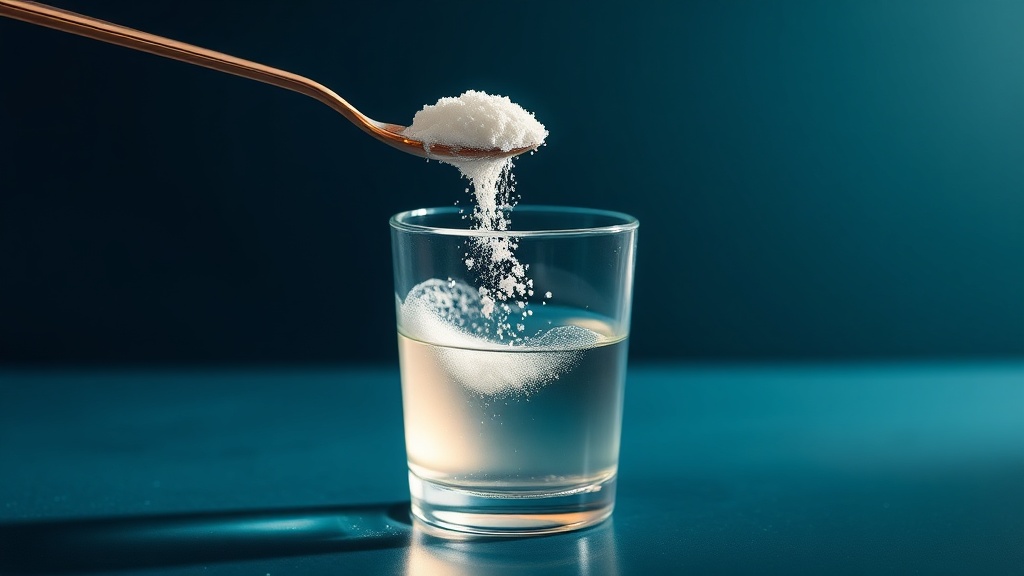
- A baking soda mouthwash is just sodium bicarbonate dissolved in water; its real, evidence-backed job is to buffer acid — raising the mouth pH after sugary or acidic food and blunting the acid attack on enamel.
- It is not a plaque remover. Baking soda neutralises acid but has been shown not to inhibit plaque growth or gingivitis, so it complements brushing rather than replacing it.
- There is no magic pH threshold. The idea of a specific pH 7.5 healing zone is a marketing construct; the critical pH at which enamel dissolves is not a fixed number and varies from person to person.
- Dissolved as a rinse it is essentially non-abrasive — the abrasion worry applies to scrubbing teeth with dry, gritty baking soda paste, especially on exposed roots.
- A rinse does not remineralize enamel. Keep a fluoride or hydroxyapatite toothpaste as your protective base, and use a baking soda rinse as an occasional acid-buffering extra.
A baking soda mouthwash is half a teaspoon of sodium bicarbonate dissolved in a glass of warm water. Its proven role is buffering: it raises mouth pH and neutralises acids after eating, which can ease the acid attack on enamel. It does not remove plaque, remineralize teeth or replace brushing, so use it as an occasional adjunct to a fluoride or hydroxyapatite routine.
What a baking soda rinse actually does
Sodium bicarbonate is a mild alkaline salt, and its whole usefulness in the mouth comes from one property: it buffers acid. When you eat sugar, the bacteria in plaque ferment it and pour out acid, dropping the pH at the tooth surface and pulling minerals out of enamel. Baking soda dissolved in water pushes back against that swing — studies show it raises resting plaque pH and neutralises plaque acids, softening the depth and duration of the post-sugar acid dip. That is a genuine, measurable effect, and it is the honest reason a baking soda rinse can have a place. But it is worth being precise about the boundary of that effect. Buffering acid is not the same as controlling the bacteria that make it: baking soda does not inhibit plaque or gingivitis, so it does nothing to reduce the biofilm itself. It is best understood as a fast-acting antacid for your mouth — helpful for smoothing out an acid spike, powerless against the sticky colony producing the acid in the first place.

After sugar, plaque acid drops the pH toward the danger zone; a baking soda rinse buffers that swing back toward neutral.
What the research actually shows
Every claim below maps to a named, peer-reviewed source in the Sources section. According to PubMed.
| Claim | Evidence | Source |
|---|---|---|
| Baking soda is an effective buffering agent that raises resting plaque pH and neutralises plaque acids after a sugar challenge. | Clinical plaque-pH study of bicarbonate buffering. | Blake-Haskins et al., 1997 |
| While it buffers acid, baking soda does not inhibit plaque growth or gingivitis — it does not act on the biofilm itself. | Clinical trial of a bicarbonate dentifrice on plaque and gingivitis. | Ozanich et al., 1993 |
| The critical pH below which enamel begins to dissolve is around 5.5 but is not a fixed constant — it depends on the calcium and phosphate in plaque and saliva, so a single healing pH target is not clinically real. | Review of enamel erosion and critical pH. | Lussi et al., 2011 |
| Enamel remineralized with trace fluoride is more acid-resistant than the original mineral — the protective mechanism a buffering rinse alone cannot provide. | Review of the mechanisms of fluoride action. | Buzalaf et al., 2011 |
| Fluoride toothpaste at 1,000 to 1,500 ppm reduces cavities with a dose-response by concentration — the proven remineralizing base a rinse should complement, not replace. | Cochrane systematic review of fluoride toothpaste concentrations. | Walsh et al., 2019 |
What a baking soda rinse can and cannot do
| Job | Verdict | Why |
|---|---|---|
| Buffer mouth acid after eating | Yes | Raises pH and neutralises plaque acids |
| Freshen breath mildly | Yes | Neutralising acids can reduce some odour |
| Remove or inhibit plaque | No | Shown not to inhibit plaque growth or gingivitis |
| Reach a magic pH 7.5 healing zone | No | No evidence for a fixed healing-pH threshold |
| Remineralize enamel or reverse a cavity | No | A rinse deposits no protective mineral; enamel loss is not reversed at home |
| Replace fluoride or hydroxyapatite | No | It is an acid-buffering adjunct, not a protective base |
The pH and abrasivity honesty
Two claims deserve straight talk. The first is the pH story. You will see baking soda sold as a way to reach a pH 7.5 healing zone, but there is no evidence for a specific healing-pH threshold. The point below which enamel dissolves sits near 5.5 as a rough guide, yet even that is not a fixed constant — it shifts with the calcium and phosphate around the tooth and differs between people. Nudging your mouth back toward neutral after an acid hit is helpful; hitting a precise magic number is a fiction. The second is abrasivity. Baking soda has a reputation as harsh, but that reputation comes from using it as a dry, gritty scrubbing paste, which can wear at softer surfaces such as exposed root dentin. Fully dissolved in water as a rinse, it is essentially non-abrasive, because there are no undissolved crystals to grind against the tooth — so the abrasivity concern is really a warning about how you use it, not about a swished solution. The honest summary is that a dissolved baking soda rinse is a gentle, occasional acid buffer, and nothing about pH or grit turns it into a treatment.
Evidence you can act on.
Occasional emails — new research, new protocols, no noise.
How to make and use a baking soda rinse safely
This is a simple acid-buffering adjunct, not a treatment. Keep it dissolved, occasional, and secondary to your real routine.
- 1
Dissolve about half a teaspoon in water
under a minuteStir roughly half a teaspoon of plain baking soda into a glass of warm water until it is fully dissolved. Dissolving it completely is what keeps it non-abrasive — you never want gritty, undissolved crystals in the mix.
- 2
Swish for about 30 seconds, then spit
30 secondsRinse it gently around your mouth and spit it out. Do not swallow large amounts, since the sodium and alkalinity are not meant to be drunk.
- 3
Use it after acidic meals or drinks
as neededThe most logical moment is after something acidic or sugary, to help buffer the acid. If anything, wait a short while after very acidic drinks before any vigorous brushing, and let the rinse help neutralise first.
- 4
Do not overuse it
occasionalThere is no benefit to constant use, and it is not a substitute for brushing or flossing. An occasional buffering rinse is the sensible dose; daily heavy use offers no proven advantage.
- 5
Keep your remineralizing base
twice dailyBrush with a fluoride or hydroxyapatite toothpaste as your protective foundation. The rinse buffers acid; the toothpaste is what actually strengthens the enamel surface.
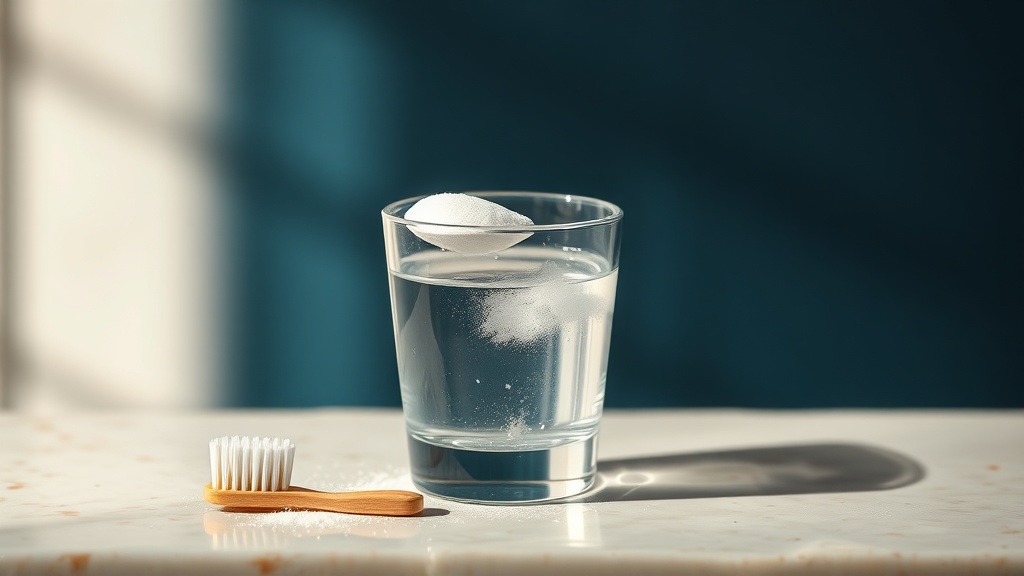
Fully dissolved in water, a baking soda rinse is gentle and non-abrasive — an occasional buffer, not a scrub.
A baking soda rinse cannot treat decay or gum disease. See a dentist if you have a toothache, a visible hole or dark spot, gums that bleed or stay swollen, tooth sensitivity that worsens, or a sore lasting more than two weeks. Buffering acid may make your mouth feel fresher, but it does not diagnose or fix an underlying problem — and delay makes early problems harder to manage.
Frequently asked questions
Sources
- 1.
- 2.
- 3.
- 4.
- 5.
- 6.

Fix your breath at the source.
The complete science-backed protocol — engineered to eliminate volatile sulfur compounds at the biological source.
Start the Breath Protocol →Related reading
Educational purposes only. The content on this page is not medical advice and is not a substitute for consultation with a qualified dental or medical professional.
More from the library
 Guides8 min
Does Hydroxyapatite Toothpaste Work? What the Evidence Shows
The fluoride-free ingredient dentists keep debating, measured against the actual clinical trials.
Read →→ Comparisons8 min
Hydroxyapatite vs Fluoride: Which Toothpaste Is Right for You?
Two ways to strengthen enamel, one big difference in how much evidence stands behind each.
Read →→ Best Of8 min
How to Choose the Best Hydroxyapatite Toothpaste
Skip the marketing and pick on the three things the research says actually matter.
Read →→ Answers8 min
Is Nano-Hydroxyapatite Toothpaste Safe?
The nanoparticle worry, answered by the actual toxicology reviews rather than the headlines.
Read →→ Answers8 min
How to Get Rid of White Spots on Teeth: Your Options, Ranked
An honest, evidence-based ladder of options, from what you can do at home to what only a dentist can fix.
Read →→ Ingredients8 min
Hydroxyapatite Toothpaste Benefits: What the Evidence Actually Supports
A calm, science-first look at what hydroxyapatite toothpaste can genuinely do for your enamel, and where the evidence stops.
Read →→