Silver Diamine Fluoride for Kids Teeth
A dentist-applied liquid that can halt early tooth decay without a drill - and the honest trade-off it comes with: a permanent black stain on the treated spot.

- Silver diamine fluoride (SDF) is a liquid a dentist paints on a tooth in seconds - no drill, no needle, no numbing - to halt an active cavity in a baby or young tooth.
- Its honest trade-off is colour: wherever SDF arrests decay, that spot turns permanently black. This is how the treatment works, not a side effect gone wrong.
- SDF stabilises a cavity but does not fill the hole or regrow tooth structure; it buys time and can delay or avoid drilling, which is especially valuable for very young or anxious children.
- The evidence supports SDF for arresting decay in baby teeth, but the certainty is rated low and it is a targeted tool - not a routine coating or a replacement for fluoride toothpaste and good habits.
- The choice is always a paediatric dentist decision, weighing the black stain against alternatives like a filling, a sealed crown, or treatment under sedation.
Silver diamine fluoride is a clear liquid a dentist brushes onto a cavity in seconds, with no drilling or numbing, to halt decay that is already there. It works well at stopping small cavities in baby teeth, but it has one honest catch: the treated spot turns permanently black. Whether that trade is worth it depends on the tooth and the child.
What silver diamine fluoride actually is
Silver diamine fluoride - usually shortened to SDF - is a clear liquid a dentist paints onto a tooth in seconds, with no drilling, no needle, and no numbing. It combines two ingredients that have been used in dentistry for decades: silver, which is antibacterial and disrupts the bacteria driving a cavity, and fluoride, which hardens the softened enamel and dentin so the decay stops advancing. Together they do something quite specific - they arrest an active cavity, halting a lesion that is already there and turning its soft, progressing surface into a hard, sealed one. It is worth being precise about what that means. SDF does not regrow lost tooth structure, and it is not a filling; the hole stays, but it is stabilised so it stops eating into the tooth. Cavities in baby teeth are extremely common - close to half of preschoolers worldwide have had early childhood caries - so a gentle way to stabilise a small one has real value. In the largest Cochrane review to date, SDF was found to arrest decay in baby teeth, though the certainty of that evidence was rated low and the studies varied. That is an honest picture, not a miracle: SDF shines as a low-cost, painless way to buy time on a cavity in a wriggly toddler who could never sit through a drill.
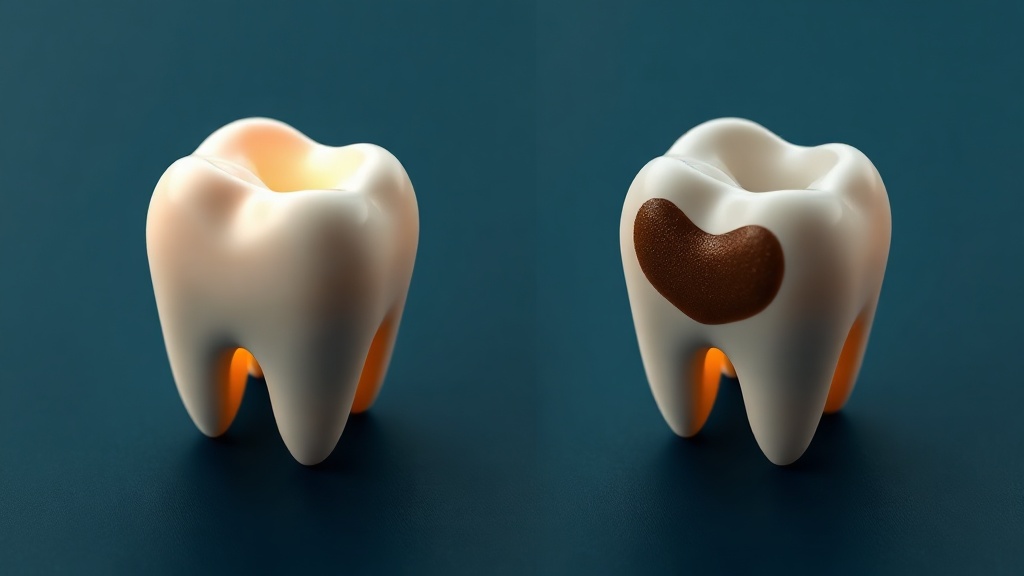
How SDF looks in practice: a soft, active spot of decay (left) is halted and hardened into a sealed dark patch (right). The darkening is the treatment working, not a flaw.
What the research actually shows
Every claim below maps to a named, peer-reviewed source in the Sources section. According to PubMed.
| Claim | Evidence | Source |
|---|---|---|
| SDF arrested caries in baby teeth, though Cochrane rated the certainty low and noted that staining was poorly reported in the trials. | Systematic review of SDF trials in primary teeth (MD 0.86 surfaces). | Worthington et al., Cochrane 2024 |
| A high-quality meta-analysis found SDF arrested about 89% of treated cavities in baby teeth, more effectively than comparators or placebo. | GRADE-high meta-analysis of arrest outcomes. | Chibinski et al., 2017 |
| 38% SDF applied twice a year arrested more cavities than 12% applied yearly (75.7% vs 55.2%), so concentration and frequency both matter. | Randomised controlled trial with before-and-after arrest data. | Fung et al., 2018 |
| The treated spot turns permanently black; parents accepted this far more readily on back teeth than front (67.5% vs 29.7%), and acceptance rose to 60-68% when the alternative was general anaesthesia. | Parental-acceptance survey. | Crystal et al., 2017 |
| For children under six, the only professionally applied topical fluoride recommended is 2.26% fluoride varnish - a reminder that SDF is a targeted tool, not a routine coating. | ADA clinical practice guideline. | Weyant et al. (ADA), 2013 |
SDF next to the other options
| Option | What it does | The trade-off |
|---|---|---|
| Silver diamine fluoride (SDF) | Halts an active cavity in seconds, no drill or needle | Stains the treated spot permanently black; the hole remains |
| A traditional filling | Removes decay and rebuilds the tooth shape | Needs drilling and often numbing; hard for very young or anxious kids |
| A sealed crown (Hall Technique) | Caps a decayed baby molar to seal the cavity, no drilling | A silver-coloured crown is visible; best suited to back teeth |
| Fluoride varnish | Hardens enamel and lowers the risk of new decay | Does not arrest an established cavity the way SDF can |
| Watch and improve home care | Monitor a tiny early spot with better brushing and diet | Risk the cavity grows and needs more invasive care later |
The black stain: the honest trade-off
There is no getting around the main drawback, so let us be direct: wherever SDF arrests a cavity, that spot turns dark - usually a permanent black or brown-black. This is not a surprise to discover later; it is how the treatment works, as the silver reacts with the decayed tissue it is hardening. On a back molar, most parents find this an easy trade, and surveys bear that out - acceptance is high for posterior teeth and rises further when the realistic alternative is sedation or general anaesthesia for a drill-and-fill. On a visible front tooth the calculation is different, and far fewer parents are comfortable with a black mark on a child smile. Neither choice is wrong; it depends on the tooth, the child, and the family. What matters is that a dentist walks you through it honestly before the brush touches the tooth, and that you understand the stain is the point, not a mistake. It also helps to know two things: a baby tooth treated with SDF will eventually fall out on its own schedule, taking the stain with it, and a stained, arrested tooth can often be covered with a tooth-coloured crown later if appearance becomes a concern.
Evidence you can act on.
Occasional emails — new research, new protocols, no noise.
What to expect if your dentist recommends SDF
SDF is always a professional decision and a professional application - this is not a home remedy. Here is what the process typically looks like so you can go in informed.
- 1
A dentist confirms it is the right tool
at the examSDF suits small, accessible, active cavities - especially in young or anxious children, or when a drill-and-fill would otherwise mean sedation. Your dentist checks the tooth, weighs it against a filling or crown, and discusses the black stain before recommending it.
- 2
The tooth is isolated and dried
a minute or twoThe dentist gently dries the tooth and protects the lips and gums, since the liquid can temporarily stain skin or gum tissue grey for a day or two. No drilling and no numbing are needed.
- 3
The liquid is painted on
under a minuteA tiny brush dabs the SDF onto the cavity and it is left to absorb. Some children notice a brief metallic taste, but there is no pain, and the whole application takes only seconds per tooth.
- 4
The spot darkens as it works
over the following daysThe treated area turns black as the decay hardens and seals - the visible sign the SDF is doing its job. Healthy tooth structure next to it is not stained.
- 5
You return for review and repeat coats
every 6-12 monthsSDF often works best with more than one application; reviews commonly repeat it every six to twelve months and check that the cavity has stayed arrested. Keep up brushing with fluoride toothpaste and cut back on sugary snacking between visits.
SDF is always applied by a dental professional - the decision, and the brushstroke, belong in the dentist chair.
Silver diamine fluoride is only ever applied by a dental professional, and the decision to use it belongs with your child paediatric dentist. See a dentist promptly if you notice a white, brown, or black spot on your child tooth, if they have tooth pain, facial swelling, or a gum bump, or if a cavity seems to be growing. SDF can be a gentle first step, but pain, infection, or a large cavity may need a filling, a crown, or other care that only a dentist can provide. Every child should have a dental home by their first birthday.
Frequently asked questions
Sources
- 1.
- 2.
- 3.
- 4.
- 5.
- 6.
- 7.

Fix your breath at the source.
The complete science-backed protocol — engineered to eliminate volatile sulfur compounds at the biological source.
Start the Breath Protocol →Related reading
Educational purposes only. The content on this page is not medical advice and is not a substitute for consultation with a qualified dental or medical professional.
More from the library
 Guides8 min
Fluoride Varnish for Kids: What Parents Should Know
A calm, honest look at the sticky coating your dentist paints on your child's teeth - what it does, how safe it really is, and why the temporary yellow tint is nothing to worry about.
Read →→ Guides8 min
Dental Sealants for Kids: Pros, Cons, and Cost
An honest guide to dental sealants for children — how they work, the pros and cons, typical cost, the BPA question, and when a dentist may suggest them.
Read →→ Guides9 min
Early Childhood Caries: Gentle Prevention for Little Smiles
What early childhood caries is, why it happens, and the calm daily habits - diet, bottle routines, brushing, dental visits - that lower a young child's risk.
Read →→ Best Of8 min
Fluoride Toothpaste for Kids: How Much Is Safe (2026)
Fluoride is the best-proven way to protect a child teeth from decay - and using the right small amount for their age is what keeps it both effective and safe.
Read →→ Best Of8 min
Best Teething Gel for Babies: Safer Soothing Options Compared
Why the honest best is non-medicated relief - and why the FDA warns against benzocaine and lidocaine teething gels for babies and toddlers.
Read →→ Best Of8 min
Best Toothbrush for Kids by Age (2026 Buying Guide)
A calm, honest guide to choosing a child toothbrush by age — soft bristles, small head, and the habits that matter more than any brand.
Read →→