How to Restore Tooth Enamel: A Practical, Honest Guide
A realistic daily routine to re-harden early enamel and stop the slide — plus the point where a dentist takes over.
- "Restoring" enamel really means two different things: re-hardening the softened surface you still have (which you can do at home) and replacing enamel that is gone (which only a dentist does).
- The home routine is straightforward: deliver minerals twice a day, keep them on the teeth, protect your saliva, and cut the frequency of acid attacks.
- Fluoride and nano-hydroxyapatite are the two evidence-backed actives; in adults, a hydroxyapatite toothpaste matched 1,450 ppm fluoride over 18 months (89.3% vs 87.4%).
- Frequency beats amount: it is how often acid hits the enamel, not the total, that drives loss — so long acid-free windows are what let the surface re-harden.
- Enamel that has cavitated cannot be re-hardened; a hole, a rough catch, or exposed dentin is a job for professional restoration, not a home routine.
To restore early enamel, re-mineralize its surface: brush twice daily with fluoride or nano-hydroxyapatite, spit but do not rinse, protect your saliva, and reduce how often acidic or sugary items hit your teeth. This re-hardens softened enamel and slows loss. Enamel that is truly gone cannot be re-hardened and is restored by a dentist.
What restoring enamel actually involves
Enamel loss is not a single event but a running balance. Every time the pH at the tooth surface drops below about 5.5 — after a sugary snack, an acidic drink, or a wave of plaque acid — mineral leaves the outer enamel crystals. Every time the pH recovers, minerals from saliva move back in. When the losses outpace the gains, enamel thins and softens; when the gains win, the surface re-hardens. "Restoring" enamel at home is simply tilting that balance back toward gain. You cannot add cells or grow new enamel, because enamel is acellular and biologically inert once the tooth erupts. What you can do is flood the surface with minerals and catalysts and then give it the calm, acid-free time it needs to re-crystallise. Fluoride does this by pulling calcium and phosphate onto the crystal and building a tougher, more acid-resistant mineral; nano-hydroxyapatite does it by depositing ready-made enamel-like mineral into the etched surface. Both act on the outer few microns that remain. That is why the honest scope of "restore" is the surface of early damage — real, valuable, but bounded.
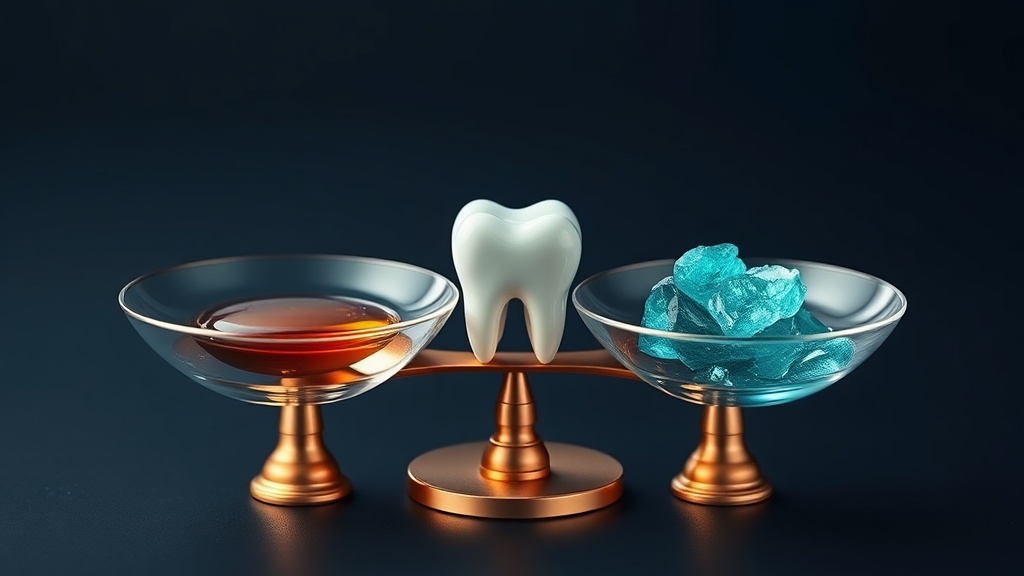
Restoring enamel means tipping the daily balance away from acid loss and toward mineral repair at the surface.
What the research actually shows
Every claim below maps to a named, peer-reviewed source in the Sources section. According to PubMed.
| Claim | Evidence | Source |
|---|---|---|
| Fluoride toothpaste at 1,000–1,500 ppm reduces enamel mineral loss with a dose-response by concentration; below ~500 ppm there is no reliable benefit. | Systematic review of fluoride toothpaste. | Walsh et al., Cochrane 2019 |
| A fluoride-free hydroxyapatite toothpaste matched 1,450 ppm fluoride for prevention in adults over 18 months (89.3% vs 87.4%). | 18-month randomized non-inferiority trial. | Paszynska et al., 2023 |
| Adding a 5% nano-hydroxyapatite leave-on layer after brushing raised remineralization from 37.7% to 58.4% versus placebo. | In-situ randomized crossover study. | Amaechi et al., 2021 |
| Saliva protects and re-mineralizes teeth by buffering acid, clearing debris, and staying supersaturated with calcium and phosphate; dry mouth raises the risk of enamel loss. | Clinical review of dry mouth. | Stoopler et al., 2024 |
| Once enamel cavitates it cannot re-harden itself; a broken surface will not remineralize back to sound tooth. | Materials-science review of enamel repair. | Liu et al., 2022 |
Home routine vs professional restoration
| What you are dealing with | How it is restored | Who does it |
|---|---|---|
| Early white spot / softened surface | Surface remineralization | You, with the daily routine |
| Mild sensitivity, enamel still intact | Re-harden surface, calm symptoms | You, plus a dentist to find the cause |
| A hole or cavity | A filling or bonding replaces lost enamel | Dentist |
| Chipped or worn-down enamel | Bonding, veneer or crown | Dentist |
| Exposed dentin / receding gum line | Manage symptoms; protect surface | Dentist, plus sensitivity care |
Why frequency matters more than amount
The single most useful idea for restoring enamel is that your teeth do not mind sugar or acid nearly as much as they mind how often it arrives. Each acid exposure starts a clock: the surface softens, then, over the following stretch of time, saliva and any leftover toothpaste minerals re-harden it. If the next exposure lands before that recovery finishes, the surface never catches up, and enamel loses ground. This is why sipping an acidic drink slowly across an afternoon, or grazing on snacks, is harder on enamel than the same items taken quickly with a meal — constant sipping keeps the surface stuck in the softened phase with no chance to repair. The practical lever is to protect long, calm, acid-free windows. Group sweet and acidic things into mealtimes, drink water in between, and let the surface spend most of the day above its critical pH where remineralization can win. Do that, keep the mineral supply topped up twice a day, and you have tilted the balance about as far toward restoration as home care can.
Evidence you can act on.
Occasional emails — new research, new protocols, no noise.
A daily routine to restore early enamel
This routine re-hardens the surface you still have and slows further loss. None of it treats a disease — and none of it fixes enamel that is already gone.
- 1
Brush twice a day with an evidence-backed active
twice dailyUse fluoride at 1,000–1,500 ppm or a properly dosed nano-hydroxyapatite toothpaste. These supply the minerals and catalysts the surface needs to re-crystallise.
- 2
Spit, do not rinse
a few secondsLeave a thin film of paste on the teeth so the active has contact time. Rinsing with water straight after brushing washes it away.
- 3
Add a leave-on layer at night if you want more
under a minuteA small amount of n-HA paste or serum left on the teeth before bed is the strongest surface-repair step in the research. Treat it as a bonus, not a substitute for good brushing.
- 4
Protect and boost your saliva
all dayStay hydrated, chew sugar-free gum to stimulate flow after meals, and raise a persistently dry mouth with a professional — saliva is your built-in remineralizing system.
- 5
Cut acid frequency, and wait after acids
ongoingGroup acidic and sugary items into meals rather than grazing. After something acidic, wait 30–60 minutes before brushing so you do not scrub a temporarily softened surface.
- 6
Get early damage checked, and treat the real thing
one visitA dentist distinguishes a re-hardenable white spot from a hole. If enamel is genuinely lost, restoration — a filling, bonding or crown — is the correct, honest fix.
Grouping acids into meals leaves long calm windows — that is when saliva and toothpaste quietly re-harden the surface.
A home routine restores only early, still-intact enamel. See a dentist if you can feel a hole or rough catch, if a spot has turned brown or black, if a tooth is chipped or sensitive in one specific place, or if enamel appears to be wearing quickly. These mean enamel is genuinely lost, and lost enamel is restored with professional materials — not re-hardened at home. Getting it staged early keeps the fix smaller.
Frequently asked questions
Sources
- 1.
- 2.
- 3.
- 4.
- 5.
- 6.

Fix your breath at the source.
The complete science-backed protocol — engineered to eliminate volatile sulfur compounds at the biological source.
Start the Breath Protocol →Related reading
Educational purposes only. The content on this page is not medical advice and is not a substitute for consultation with a qualified dental or medical professional.
More from the library
 Answers8 min
How to Remineralize Teeth: An Honest, Practical Guide
The practical routine that supports enamel remineralization, and the clear line between the early lesions it can rebuild and the decay it cannot.
Read →→ Answers8 min
Can You Rebuild Tooth Enamel? What Is Actually Possible
The honest split: what you can genuinely strengthen at home, and what only a dentist can restore.
Read →→ Best Of8 min
Enamel Repair Toothpaste: How to Choose One That Actually Works
What repair toothpaste can honestly do, the three actives that matter, and how to match one to your teeth.
Read →→ Guides8 min
Eroded Enamel: What to Do (A Calm Action Plan)
What to do first when enamel is eroding — and the honest line between what you can fix and what a dentist must.
Read →→ Answers8 min
How to Get Rid of White Spots on Teeth: Your Options, Ranked
An honest, evidence-based ladder of options, from what you can do at home to what only a dentist can fix.
Read →→ Ingredients8 min
Hydroxyapatite Toothpaste Benefits: What the Evidence Actually Supports
A calm, science-first look at what hydroxyapatite toothpaste can genuinely do for your enamel, and where the evidence stops.
Read →→