Best Teeth Whitening Trays: Boil-and-Bite, Custom and Prefilled Compared
A whitening tray does not bleach; it controls contact time and protects the gums. Fit is what separates even, comfortable results from patchy ones.
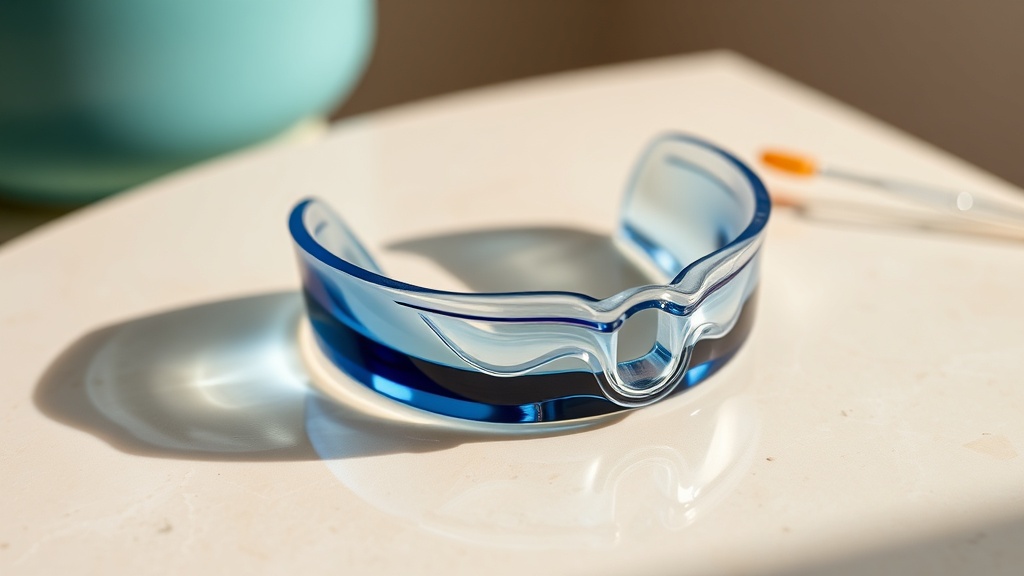
- A whitening tray does not whiten anything on its own: its job is to hold peroxide gel against the enamel for a set time, sealed away from saliva.
- Contact time is the single biggest lever in at-home whitening, and a well-fitting tray is the best way to maximise it evenly across every tooth.
- Fit decides everything: a snug tray gives an even shade and keeps gel off the gums, while a loose one leaves patchy results and stings the gumline.
- Custom dentist trays give the best seal and gum protection, boil-and-bite trays are a solid middle ground, and prefilled trays trade fit for convenience.
- The gel inside matters as much as the tray: a lower-concentration peroxide worn for the full window is gentler and just as effective as a harsh one rushed.
The best whitening tray is the one that fits closely, because the tray only holds the gel; it does not bleach. A custom tray from a dentist gives the best seal and gum protection, a boil-and-bite tray is a good-value middle ground, and prefilled trays are convenient but loose. Pair any tray with a low-to-moderate peroxide gel and worn contact time does the rest.
What a whitening tray is actually for
It is worth being clear from the outset: a whitening tray does not contain anything that changes the colour of your teeth. All of the whitening comes from the peroxide gel you load into it. The tray is simply a delivery device, and its job is to press a thin film of that gel evenly against the front surfaces of your teeth and keep it there, shielded from the saliva and tongue that would otherwise wash it away within minutes. That job turns out to be the most important one in the whole process, because the amount a tooth lightens depends less on how strong the gel is and more on how long the peroxide stays in contact with the enamel. A tray is what makes long, even contact possible. It seals the gel around the tooth so the peroxide can diffuse steadily inward toward the dentin, where the colour lives, for the full wear time. A good tray does a second quiet job as well: by hugging the teeth closely it keeps the gel where you want it and off the soft gum tissue, which is where the sting and irritation of home whitening usually come from. So when you shop for a tray, you are really shopping for two things, even contact and clean containment, and both come down to how well it fits.
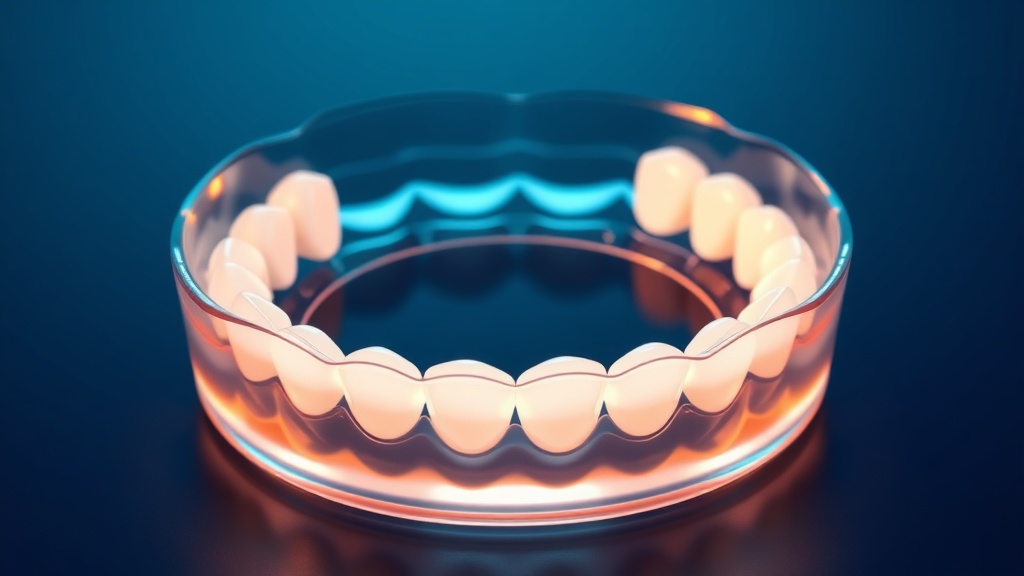
A well-fitting tray seals a thin, even layer of gel against every tooth, so the whole arch lightens together and the gums stay protected.
What the research actually shows
Every claim below maps to a named, peer-reviewed source in the Sources section. According to PubMed.
| Claim | Evidence | Source |
|---|---|---|
| Home whitening delivered in trays and strips is more effective than placebo, and the difference in results tracks the level of active peroxide. | Cochrane systematic review of home-based whitening (25 trials). | Hasson et al., 2006 |
| Contact time is the main lever: 10% carbamide peroxide worn overnight beat a stronger gel worn for just one hour. | Randomised clinical trial of four at-home protocols (n=80). | Lopez Darriba et al., 2017 |
| Tray-delivered carbamide and hydrogen peroxide gave equivalent shade-guide change and the same level of gum irritation. | Systematic review and meta-analysis of at-home tray bleaching. | Luque-Martinez et al., 2016 |
| Dropping to a low or medium peroxide concentration cut sensitivity risk by about a third with no loss of colour change. | Systematic review and meta-analysis of 25 trials. | Maran et al., 2020 |
| Peroxide whitens by diffusing through the enamel to the dentin, and the tray simply holds it in contact long enough to work. | Reference review of the bleaching mechanism. | Joiner, 2006 |
The main types of whitening tray
| Tray type | How it fits | Strengths | Trade-offs |
|---|---|---|---|
| Custom dentist tray | Moulded from a scan or impression of your teeth | Best gel seal, even results and gum protection | Highest cost and a short wait to be made |
| Boil-and-bite tray | Softened in hot water and bitten to shape at home | Cheap, reusable and a decent semi-custom fit | Bulkier; fit varies; can let gel leak onto the gums |
| Prefilled disposable tray | A one-size tray pre-loaded with gel | Convenient, no measuring and good for travel | Loose fit and uneven contact; single use |
| Universal one-size tray | A rigid shared shape meant for any mouth | Lowest price on the shelf | Poor seal, gel escapes and the shade comes out patchy |
Why fit is the whole game
Once you accept that the tray only holds the gel, it becomes obvious why fit is everything. A tray that hugs each tooth keeps a thin, uniform layer of peroxide pressed against the entire arch, so every tooth lightens at a similar rate and you avoid the blotchy result that happens when some surfaces get more gel than others. That same close fit keeps the peroxide off your gums, which is where most of the burning and irritation of home whitening comes from. A loose tray does the opposite on both counts: the gel pools unevenly and squeezes out over the gumline. This is why the tray types line up the way they do. A custom tray, moulded to your own teeth by a dentist, gives the tightest seal and the best protection. A boil-and-bite tray, softened and shaped at home, is a genuine middle ground that fits far better than a rigid universal tray. Prefilled disposable trays are the most convenient but the loosest, so they suit touch-ups more than a serious course. Whichever you choose, the gel still matters: reviews show tray-delivered carbamide and hydrogen peroxide reach an equivalent shade with equal gum irritation, and that a lower concentration cuts sensitivity by about a third without sacrificing colour. The sweet spot is a well-fitting tray, a gentle gel, and enough contact time.
Evidence you can act on.
Occasional emails — new research, new protocols, no noise.
How to whiten well with trays
A tray rewards a little care up front and then makes the whole process easier and more comfortable. None of this treats a medical condition; it simply gets an even cosmetic result while keeping the gums out of harm.
- 1
Get the best fit you can afford
once, at the startA custom tray from a dentist is the gold standard, a boil-and-bite tray is a strong value option, and a prefilled tray is best kept for quick touch-ups. The closer the fit, the more even the result and the kinder it is to your gums.
- 2
Shape it to hug teeth, not gums
5 minutesIf you are using a boil-and-bite tray, take time to mould it snugly, and trim any excess that overlaps the gumline. A tray that stops neatly at the teeth keeps gel where it belongs and off the soft tissue.
- 3
Load a thin ribbon of gel
under a minuteA small dot on the inner front of each tooth well is enough. Overfilling just pushes gel onto the gums and wastes it, so seat the tray, then wipe away anything that squeezes out with a cotton bud or a clean finger.
- 4
Favour contact time over strength
as directedWear the tray for the full recommended window with a low-to-moderate gel rather than a harsh one for a short burst. The research is consistent that time out-performs concentration, and it is gentler on the teeth.
- 5
Clean, store and pace yourself
ongoingRinse the tray in cool water and let it dry between uses, and give your teeth rest days if they start to twinge. A sensitivity toothpaste between sessions keeps a longer course comfortable.
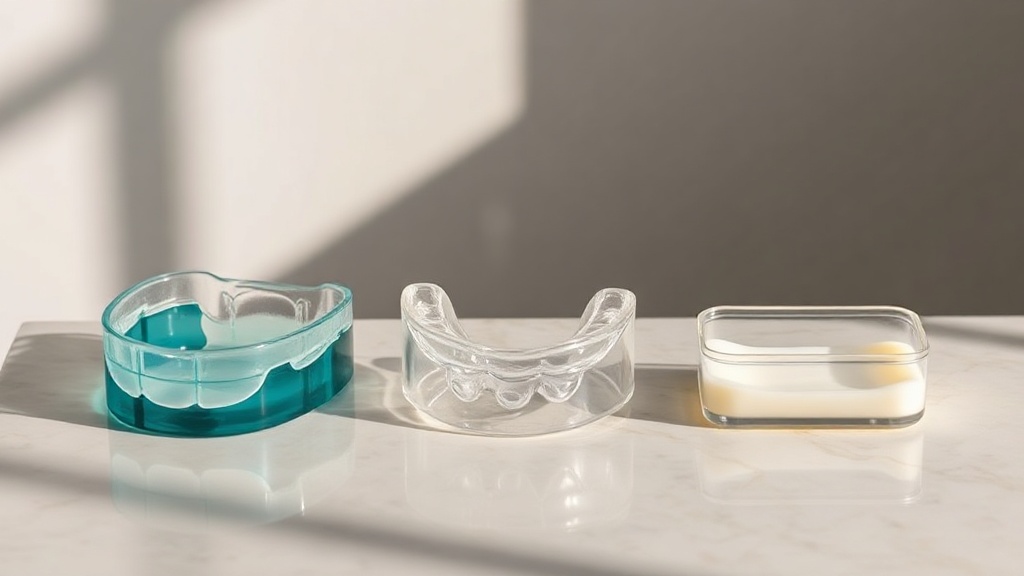
From left to right the fit tightens and the results even out: prefilled is convenient, boil-and-bite is a good middle ground, custom seals best.
Whitening trays are cosmetic and work only on natural teeth. See a dentist if your gums blanch white, burn or feel raw during use, which usually means gel is escaping a poorly fitting tray or the concentration is too high. Book a visit, too, if you have crowns, veneers or fillings on your front teeth, since they will not lighten and a tray can leave them mismatched, or if one tooth is noticeably darker than the rest. A dentist can also make a custom tray, which gives the closest fit, the most even result and the best protection for your gums.
Frequently asked questions
Sources
- 1.
- 2.
- 3.
- 4.
- 5.
- 6.

Fix your breath at the source.
The complete science-backed protocol — engineered to eliminate volatile sulfur compounds at the biological source.
Start the Breath Protocol →Related reading
Educational purposes only. The content on this page is not medical advice and is not a substitute for consultation with a qualified dental or medical professional.
More from the library
 Comparisons8 min
Carbamide Peroxide vs Hydrogen Peroxide for Teeth Whitening: Which Works Better?
An evidence-based comparison of the two whitening peroxides, what actually separates them, and how to choose by format and comfort rather than by the biggest number.
Read →→ Answers9 min
Does Teeth Whitening Hurt? Why It Happens and How to Prevent It
The sting is common but manageable — and the real levers are lower concentration and shorter wear time, not gimmicks.
Read →→ Answers8 min
How Often Should You Whiten Your Teeth? Safe Frequency by Method
A method-by-method guide to how often you can brighten your smile without overdoing it — and why more is rarely better.
Read →→ Answers8 min
Does Teeth Whitening Damage Enamel? The Evidence-Based Answer
The honest, evidence-based answer to whether whitening harms enamel — what peroxide really does to the surface, why sensitivity is not damage, and the DIY methods that actually cause wear.
Read →→ Answers8 min
Does Baking Soda Whiten Teeth? What the Evidence Says
An honest look at what baking soda can and cannot do for a whiter smile.
Read →→ Best Of9 min
Best Fluoride-Free Whitening Toothpaste: An Honest, Evidence-Based Guide (2026)
Which fluoride-free whitening ingredients hold up to the research — and which are marketing. An honest buyer's guide.
Read →→