Best Whitening Mouthwash: Honest Picks and What Actually Works
A whitening mouthwash is a maintenance tool, not a transformation. Here is how the main types really compare, and how to pick one that earns its place.
- A whitening mouthwash is best understood as a maintenance tool: it mainly removes and helps prevent surface stain rather than bleaching the tooth the way strips or professional treatment do.
- Rinsing lasts only thirty to sixty seconds at a low concentration, and whitening depends on both concentration and contact time, so a rinse is limited by design.
- Non-peroxide whitening rinses shift colour so slightly that studies describe the change as barely perceptible; low-dose peroxide rinses can do a little more over several weeks.
- Some antiseptic mouthwashes, especially chlorhexidine, actually stain teeth brown with regular use, which is the opposite of what you want from a whitening rinse.
- Choose a rinse for daily upkeep alongside brushing and gentle polishing, and reach for a peroxide strip, tray or a dentist if you want a genuine, visible colour change.
The best whitening mouthwash is one that is honest about its job: lifting and preventing surface stain as daily upkeep, not bleaching teeth. Because a rinse touches teeth only briefly at a low dose, its colour effect is small. Use one alongside brushing, and rely on peroxide strips, trays or a dentist for a real change.
Why a whitening mouthwash can only do so much
To set fair expectations, it helps to understand what a rinse is up against. Genuine whitening happens when an oxidising agent such as peroxide sits on the tooth long enough and at a high enough concentration to diffuse in and break down coloured molecules, and the size of the effect tracks both concentration and contact time. That is exactly where a mouthwash is at a disadvantage. You swish it for thirty to sixty seconds, it is heavily diluted, and then you spit it out. Compare that with a whitening strip or tray, which holds a stronger gel against the teeth for half an hour or overnight. So the honest job of a whitening mouthwash is not to bleach; it is to lift the soft surface stain that food, coffee, tea and wine leave behind and to make it harder for fresh stain to settle. When researchers measured four popular non-peroxide whitening rinses, the colour change was real but tiny, on the order of one unit, which sits right around the threshold where a difference becomes visible at all. Low-dose peroxide rinses can nudge a little further over a few weeks, but no rinse closes the gap with a proper peroxide treatment. Judged as a stain-control and maintenance product, a good whitening mouthwash earns its place; judged as a whitening treatment, it will always disappoint.
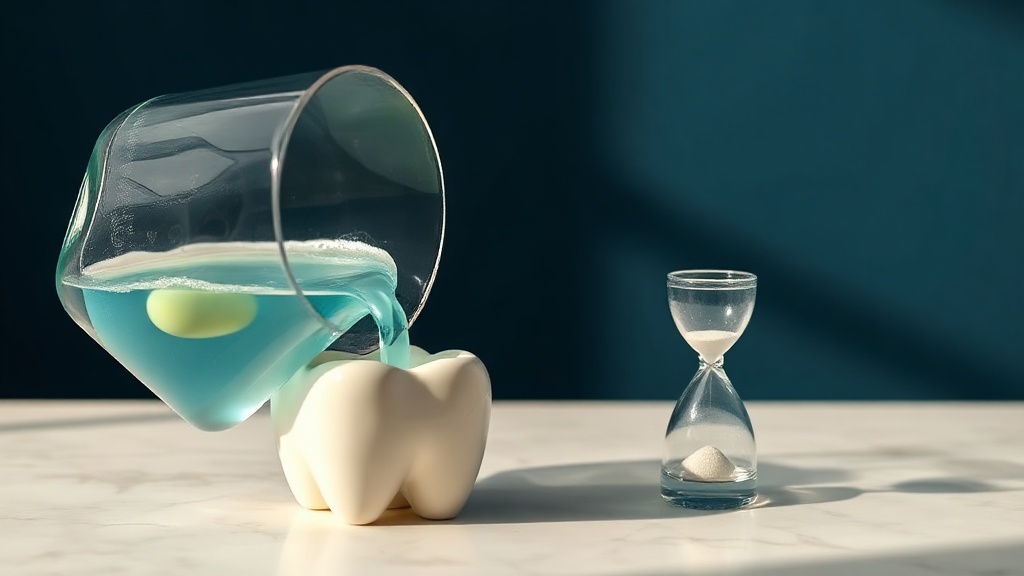
A rinse only touches teeth for seconds, so its colour effect stays small; whitening depends on both concentration and contact time.
What the research actually shows
Every claim below maps to a named, peer-reviewed source in the Sources section. According to PubMed.
| Claim | Evidence | Source |
|---|---|---|
| Whitening mouthrinses without peroxide only remove surface stain, producing a colour shift so small it is described as barely perceptible. | In-vitro study of four whitening mouthrinses over four weeks. | Ntovas et al., 2021 |
| Only peroxide truly whitens the tooth; other over-the-counter agents at best lift surface stain. | In-vitro comparison of over-the-counter agents versus peroxide. | Muller-Heupt et al., 2023 |
| Whitening from peroxide depends on concentration and contact time, so a brief rinse delivers far less than a strip or tray held on for longer. | Reference review of the bleaching mechanism. | Joiner, 2006 |
| Some antiseptic rinses, notably chlorhexidine, reliably cause brown extrinsic staining with regular use. | Cochrane review of 51 trials. | James et al., 2017 |
| A colour change must cross a perceptibility threshold to be seen at all, and most whitening rinses sit near or below it. | Study defining perceptibility and acceptability colour thresholds. | Paravina et al., 2015 |
Types of whitening mouthwash, honestly compared
| Type | How it works | Realistic effect | Worth knowing |
|---|---|---|---|
| Low-dose hydrogen-peroxide rinse | A little peroxide briefly contacts the teeth | A small real lift over several weeks | Short contact limits it; can sting a sensitive mouth |
| Non-peroxide cosmetic rinse | Lifts and blocks surface stain | Barely perceptible; mainly prevents new stain | Best as daily maintenance, not a colour change |
| Fluoride whitening rinse | Fluoride plus mild stain-control agents | Stain prevention with enamel support | A sensible all-rounder for daily upkeep |
| Charcoal rinse | Claims to adsorb stain from the surface | No reliable whitening shown | Studies and users advise caution; often overhyped |
| Antiseptic rinse (chlorhexidine, some CPC) | Antibacterial, not designed to whiten | Can darken teeth over weeks | The opposite of whitening for long cosmetic use |
What to actually look for, and what to ignore
Once you accept that a rinse is a maintenance product, choosing a good one gets simple. Look for honest surface-stain control paired with fluoride, so you get enamel support alongside stain prevention, and favour an alcohol-free formula if your mouth runs dry or feels irritated by stronger rinses. If your priority is gentleness, the most promising recent category is the peroxide-free colour corrector: in a review of these products, they reached a modest but genuine colour change while causing sensitivity in fewer than three percent of people, which is about as close as a low-intensity product gets to the idea of whitening without the sting. What to ignore is easier still. Treat dramatic before-and-after imagery with suspicion, because no rinse produces that kind of change. Skip charcoal rinses, which have no reliable whitening evidence and lean on abrasive marketing. And be wary of using an antiseptic mouthwash like chlorhexidine for cosmetic reasons over the long term, since it is well documented to stain teeth brown; it has real uses, but brightening your smile is not one of them. The best whitening mouthwash, in the end, is the one whose claims match what a rinse can physically do.
Evidence you can act on.
Occasional emails — new research, new protocols, no noise.
How to get the most from a whitening mouthwash
A whitening rinse works best as one small, consistent part of a routine rather than the centrepiece. Here is how to let it do its job without expecting it to do the impossible. None of this treats a disease; it is everyday cosmetic upkeep.
- 1
Use it as an add-on to brushing and flossing
twice dailyBrushing with a gentle whitening or baking-soda toothpaste removes far more surface stain than any rinse, so keep that as your foundation and let the mouthwash top it up. A rinse cannot compensate for skipped brushing or cleaning between the teeth.
- 2
Swish for the full labelled time
30 to 60 secondsBecause contact time is the main thing limiting a rinse, cutting it short throws away most of the little benefit on offer. Swish for the full time on the label, keep the liquid moving around all the teeth, and avoid rinsing with water straight afterwards if the instructions say so.
- 3
Choose fluoride and go easy on alcohol
when buyingPrefer a rinse that includes fluoride for enamel support and, if your mouth is sensitive or dry, an alcohol-free formula. Avoid leaning on chlorhexidine rinses for cosmetic use, since regular use stains teeth rather than brightening them.
- 4
Prevent stain at the source
every dayA rinse fights a losing battle if fresh stain keeps pouring in. Rinse with water after coffee, tea and red wine, use a straw for iced dark drinks, and avoid sipping them for hours, because staining builds up the longer it stays in contact.
- 5
Step up to peroxide for a real change
as directedIf you want a colour change you can actually see, a peroxide strip, a tray or a professional treatment is the honest next step, because those hold a stronger agent against the teeth for far longer. A dentist can suggest a safe option and check nothing else is going on.
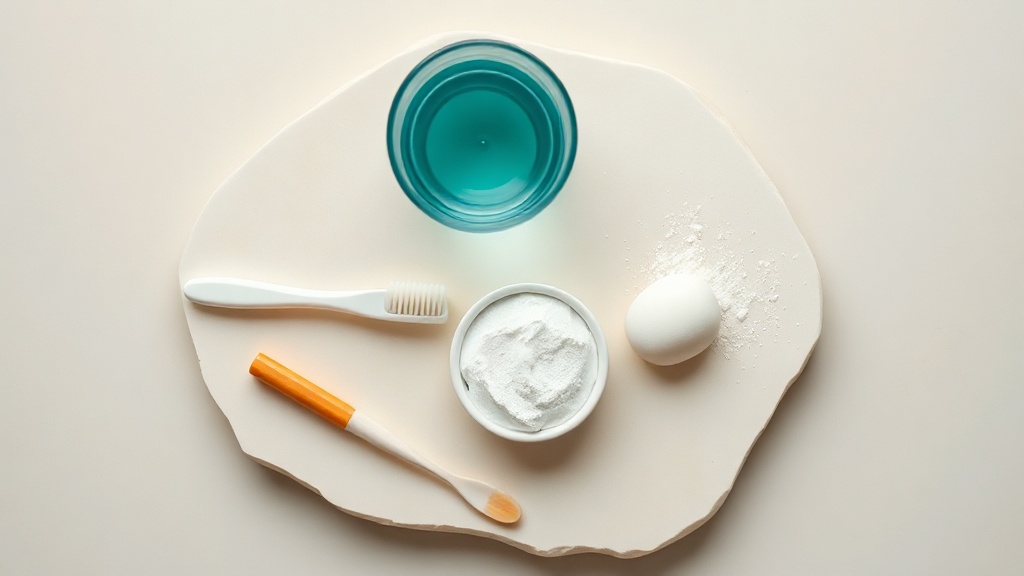
A rinse is one small part of upkeep; brushing and gentle polishing do the heavy lifting on surface stain.
If you want a noticeable, lasting colour change, a dentist can guide you to a safe whitening option that a rinse cannot match. See one in person if you have ongoing tooth sensitivity, if a single tooth has darkened on its own, or if staining seems to come from inside the tooth, since none of those respond to a mouthwash. Resist the urge to over-rinse or double up on antiseptic products in search of results, as that can irritate the mouth or even stain teeth further.
Frequently asked questions
Sources
- 1.
- 2.
- 3.
- 4.
- 5.
- 6.
- 7.
- 8.

Fix your breath at the source.
The complete science-backed protocol — engineered to eliminate volatile sulfur compounds at the biological source.
Start the Breath Protocol →Related reading
Educational purposes only. The content on this page is not medical advice and is not a substitute for consultation with a qualified dental or medical professional.
More from the library
 Comparisons8 min
Carbamide Peroxide vs Hydrogen Peroxide for Teeth Whitening: Which Works Better?
An evidence-based comparison of the two whitening peroxides, what actually separates them, and how to choose by format and comfort rather than by the biggest number.
Read →→ Answers8 min
How Often Should You Whiten Your Teeth? Safe Frequency by Method
A method-by-method guide to how often you can brighten your smile without overdoing it — and why more is rarely better.
Read →→ Answers9 min
Does Teeth Whitening Hurt? Why It Happens and How to Prevent It
The sting is common but manageable — and the real levers are lower concentration and shorter wear time, not gimmicks.
Read →→ Guides8 min
Purple Toothpaste: Does the Color-Correcting Trick Actually Work?
A calm look at how purple toothpaste masks yellow tones optically, why the effect is temporary, and where it fits alongside methods that actually change your shade.
Read →→ Answers8 min
Does Teeth Whitening Damage Enamel? The Evidence-Based Answer
The honest, evidence-based answer to whether whitening harms enamel — what peroxide really does to the surface, why sensitivity is not damage, and the DIY methods that actually cause wear.
Read →→ Answers8 min
Does Baking Soda Whiten Teeth? What the Evidence Says
An honest look at what baking soda can and cannot do for a whiter smile.
Read →→