Can You Heal Cavities Naturally?
The honest science of natural cavity care: early white-spot decay can be remineralized and arrested, but a true cavity cannot be healed at home.
- You can support your teeth powerfully with natural care, but the honest science draws a hard line: only early, non-cavitated decay — the chalky white-spot stage — can be remineralized and arrested. A true cavity, where the enamel surface has broken into a hole, cannot be healed at home by any product or diet.
- ‘Reversing’ a cavity really means reversing the early demineralization process before a hole forms — not regrowing a tooth that has already cavitated.
- Fluoride and fluoride-free hydroxyapatite both have real human evidence for strengthening enamel and remineralizing early lesions; in an 18-month adult trial they finished within about two percentage points of each other.
- The viral ‘heal cavities with diet alone’ claim has no human evidence — it traces back to 1930s feeding studies, mid-century rat experiments and a single non-peer-reviewed hypothesis paper.
- Natural care shines at prevention and at the earliest lesions, but a spot that has become a cavity needs a dentist. ‘Remineralizing’ an open tooth instead of treating it can let decay reach the nerve.
Partly — and only in one specific way. Early, non-cavitated decay (a white-spot lesion) can be remineralized and arrested with fluoride or hydroxyapatite, healthy saliva, and less sugar. But once enamel cavitates into a hole, no natural product or diet can heal it; that needs a dentist. Natural healing works on early decay, not on a true cavity.
What ‘healing a cavity naturally’ actually means
Your enamel lives in a constant tug-of-war. Every time you eat fermentable carbohydrate, plaque bacteria make acid and the pH at the tooth surface can fall below roughly 5.5 — the point where enamel mineral starts to dissolve. Between meals, saliva reverses the tide: it neutralizes acid and stays supersaturated with calcium and phosphate, which flow back into the softened surface. Salivary proteins such as statherin keep that mineral reservoir stable, and fluoride or hydroxyapatite make the rebuilt mineral more acid-resistant than before. That back-and-forth is the real meaning of ‘remineralization.’ It works because a white-spot lesion is subsurface damage under a still-intact surface — there is a crystal scaffold left to rebuild on. The catch is biological: mature enamel is about 96% mineral but completely acellular, with no living cells to regenerate lost structure the way skin or bone does. So once the surface actually collapses into a cavity, there is no scaffold and no cell to rebuild it. Natural remineralization can re-harden an early lesion; it cannot refill a hole.
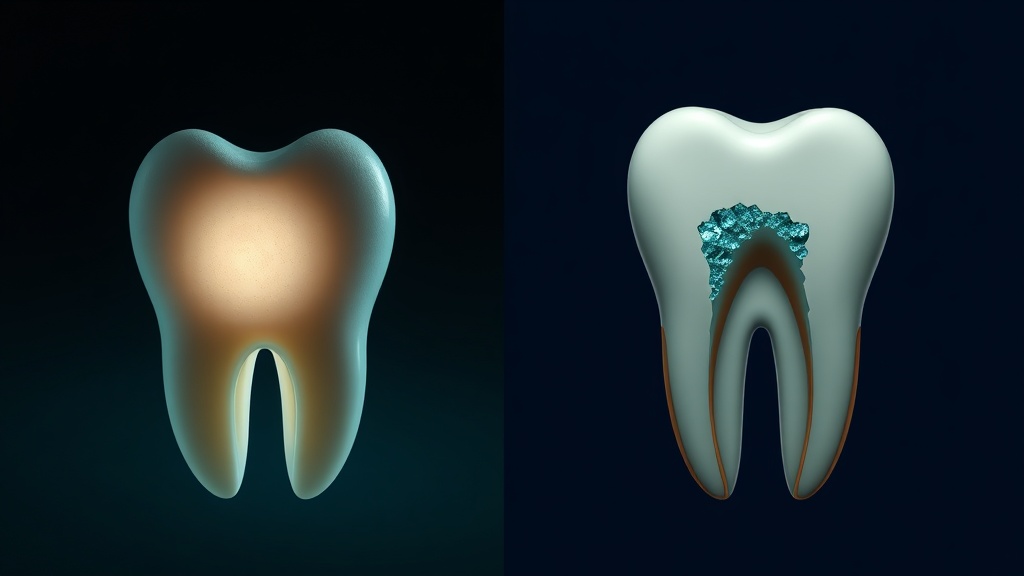
Natural remineralization re-hardens an early white-spot lesion, but a cavitated hole has no crystal scaffold left to rebuild on.
What the research actually shows
Every claim below maps to a named, peer-reviewed source in the Sources section. According to PubMed.
| Claim | Evidence | Source |
|---|---|---|
| Early demineralization can be prevented, arrested or reversed by protective factors like saliva and fluoride — the reversal is of the early process, not of a formed cavity. | Foundational review of the caries balance. | Featherstone, 1999 |
| Once enamel cavitates, it cannot repair itself — mature enamel is acellular and does not regrow structure. | Enamel biomaterials review. | Liu et al., 2022 |
| Fluoride-free hydroxyapatite toothpaste matched 1,450 ppm fluoride for adult caries prevention over 18 months (89.3% vs 87.4% caries-free). | 18-month randomized non-inferiority trial in adults. | Paszynska et al., 2023 |
| A 5% nano-hydroxyapatite leave-on layer applied after brushing raised remineralization from 37.7% to 58.4% versus placebo. | In-situ randomized crossover study. | Amaechi et al., 2021 |
| The ‘diet alone reverses cavities’ theory rests on 1930s and rat studies plus a single non-peer-reviewed hypothesis paper, with zero human remineralization data. | Hypothesis paper (Medical Hypotheses). | Southward, 2015 |
Early decay vs a true cavity
| Stage | Can natural care heal it? | What actually helps |
|---|---|---|
| White-spot / incipient lesion (surface intact) | Yes — it can remineralize and arrest | Fluoride or hydroxyapatite, healthy saliva, fewer sugar hits |
| Cavitation into enamel (surface broken) | No — the structure is lost | A dentist restores or seals it; you prevent the next one |
| Decay into dentin | No — needs professional care | Filling, or a dentist-applied arrest agent |
| Pain or a hole you can feel | No — this is well past the reversible window | See a dentist promptly |
Why ‘diet reverses cavities’ fails the evidence test
The internet’s most confident cavity-healing claims come from a specific lineage: the book Cure Tooth Decay and the wider ‘heal cavities with nutrition, skip the dentist and fluoride’ subculture. Traced to its roots, that idea rests on 1930s feeding experiments, 1960s–70s rat studies, and one 2015 paper in a journal expressly built for untested hypotheses — with no human data showing a cavity refilling. It is important to be fair here, because diet genuinely matters: free sugars are the single most important dietary risk factor for decay, and cutting how often you eat them is one of the most powerful levers you control. Vitamin D shows a real but modest, mostly developmental association with lower caries risk, and the evidence is low-certainty. Vitamin K2, despite its popularity in ‘tooth-healing’ protocols, has zero clinical trials showing it prevents or reverses caries in humans. So the honest reading is this: nutrition is a prevention tool that tips the demineralization–remineralization balance in your favor. It is not a repair tool that regrows a cavitated tooth.
Evidence you can act on.
Occasional emails — new research, new protocols, no noise.
How to support your teeth naturally — the honest routine
None of this treats a disease or refills a cavity. It strengthens enamel and gives an early lesion its best chance to remineralize, while keeping new decay from starting.
- 1
Cut the frequency of sugar, not just the amount
every dayEach sugar or refined-carb hit restarts the acid attack, and it is the number of attacks — more than the total quantity — that drives enamel loss. Grouping sweets with meals and stopping constant sipping and snacking gives saliva long windows to rebuild mineral.
- 2
Brush with a remineralizing toothpaste
twice dailyA 1,000–1,500 ppm fluoride toothpaste or a hydroxyapatite toothpaste both have human evidence for strengthening enamel and remineralizing early lesions. Spit, don’t rinse, so the active mineral stays on the tooth longer.
- 3
Consider a leave-on step for a flagged early spot
nightlyIn studies, a leave-on hydroxyapatite layer after brushing nearly doubled remineralization versus placebo. A thin leave-on paste or gel at night extends the contact time on a white-spot lesion your dentist is watching.
- 4
Protect your saliva
all daySaliva is your built-in remineralization system. Stay hydrated, chew xylitol gum, breathe through your nose, and talk to a clinician if medications leave your mouth dry — dry mouth measurably raises decay risk.
- 5
Get any spot professionally staged — the non-negotiable step
once, then rechecksOnly a dentist can tell a reversible white spot from a cavity that has quietly broken the surface, and even trained examiners find early lesions the hardest to score. Staging tells you whether you are in the reversible window or need treatment.
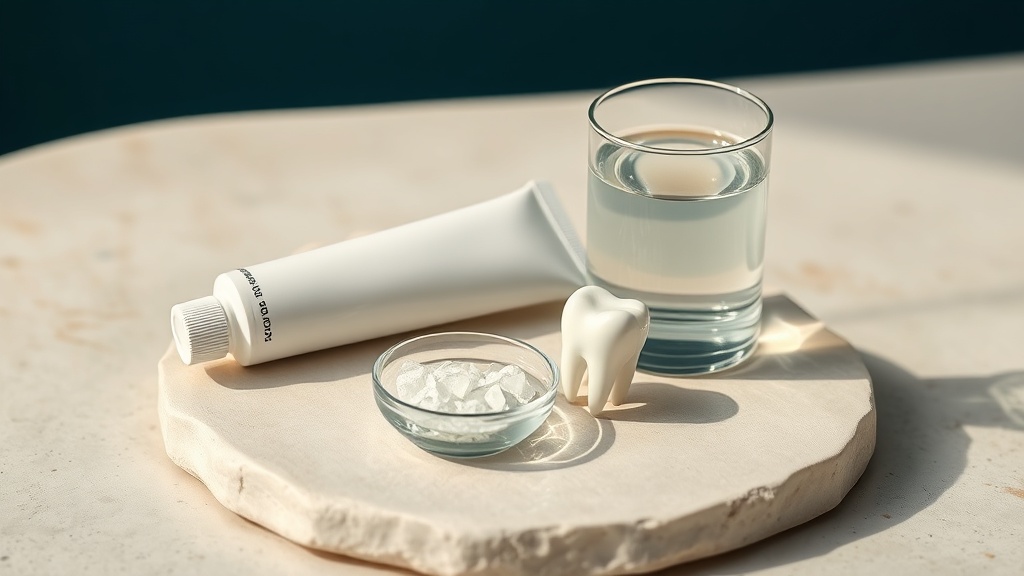
Natural care is a prevention and early-lesion routine — remineralizing toothpaste, xylitol, water and healthy saliva — not a cavity repair kit.
Natural care manages prevention and early spots — it is not a substitute for a diagnosis. See a dentist if you can see or feel a hole, if a tooth aches or reacts to sweet, hot or cold in a way that lingers, or if a dentist has already told you a spot is cavitated. There are documented cases of people leaving an open tooth to ‘remineralize’ and allowing decay to reach the root, turning a simple filling into a root canal or extraction. When in doubt, get it staged in person before you rely on any home routine.
Frequently asked questions
Sources
- 1.
- 2.
- 3.
- 4.
- 5.
- 6.
- 7.
- 8.

Fix your breath at the source.
The complete science-backed protocol — engineered to eliminate volatile sulfur compounds at the biological source.
Start the Breath Protocol →Related reading
Educational purposes only. The content on this page is not medical advice and is not a substitute for consultation with a qualified dental or medical professional.
More from the library
 Answers8 min
How to Remineralize Teeth: An Honest, Practical Guide
The practical routine that supports enamel remineralization, and the clear line between the early lesions it can rebuild and the decay it cannot.
Read →→ Guides8 min
White Spots on Teeth: Causes and What to Do
The two common reasons enamel turns chalky white, and the honest guide to which spots you can rebuild at home and which need professional care.
Read →→ Comparisons8 min
Hydroxyapatite vs Fluoride: Which Toothpaste Is Right for You?
Two ways to strengthen enamel, one big difference in how much evidence stands behind each.
Read →→ Guides8 min
Early Cavity: What to Do in the Reversible Window
The actionable playbook for an early cavity — the one stage of decay that is genuinely reversible — with the exact remineralization steps and when it needs treating instead.
Read →→ Answers8 min
How to Get Rid of White Spots on Teeth: Your Options, Ranked
An honest, evidence-based ladder of options, from what you can do at home to what only a dentist can fix.
Read →→ Ingredients8 min
Hydroxyapatite Toothpaste Benefits: What the Evidence Actually Supports
A calm, science-first look at what hydroxyapatite toothpaste can genuinely do for your enamel, and where the evidence stops.
Read →→