Can You Whiten Crowns? What Works and What Doesn't
The honest, evidence-based answer to whether teeth whitening works on crowns, veneers and fillings — and what to do instead.
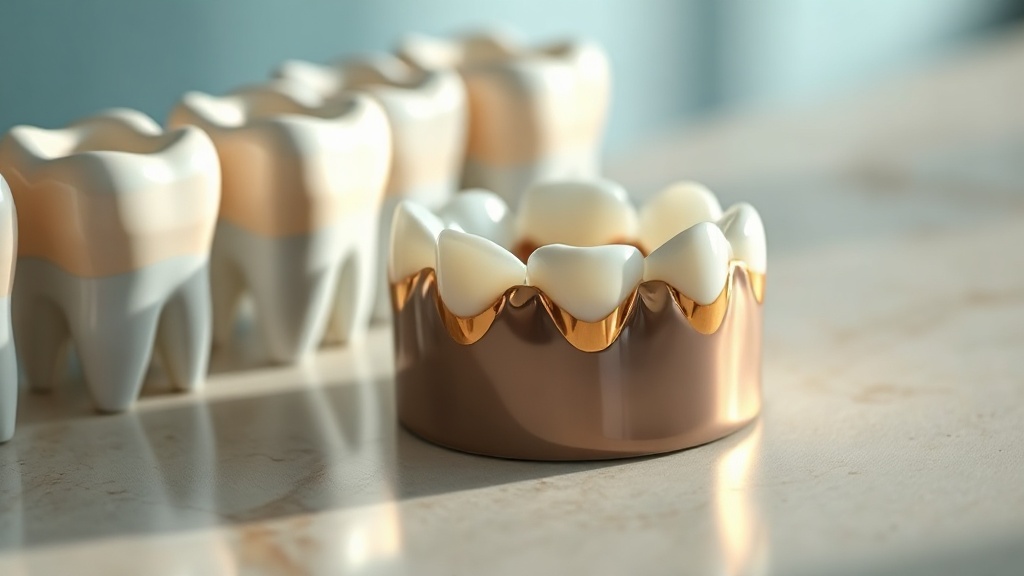
- The chalky-white or dark marks you cannot shift with whitening are usually a restoration doing exactly what it was built to do: hold one fixed colour. Whitening gel only lightens natural tooth structure, never a crown, veneer, bridge or white filling.
- The reason is chemistry. Peroxide whitens by soaking through enamel and breaking down the coloured molecules inside the natural tooth. A glazed ceramic or a set composite resin has no such molecules to break down, so the gel simply sits on the surface and does nothing.
- What you can improve on a restoration is surface staining. Coffee, tea, red wine and smoke films that build up on the outside can often be polished or gently brushed away, returning a crown to its original shade — but never taking it lighter than the day it was made.
- If a crown reads too dark or too yellow at its core, the only real fix is to have it professionally refaced or remade. No gel, strip, tray or LED lamp changes the colour of the material itself.
- Order matters more than anything: whiten your natural teeth first, let the shade settle, then have any visible crown matched to the new colour. Whitening after a front crown is placed almost always leaves an obvious mismatch.
No — you cannot whiten a crown, veneer or filling. Whitening gel only lightens natural enamel and dentin; porcelain and resin restorations do not respond to peroxide at all. You can polish off surface stains to restore a crown's original shade, but to make it genuinely lighter it has to be replaced.
Why whitening works on teeth but not on crowns
To see why a crown will not budge, it helps to know how whitening actually works. A whitening gel is really a peroxide delivery system. The peroxide diffuses through the porous enamel and into the dentin beneath, where it oxidises the large coloured molecules that make a tooth look yellow or grey — breaking them into smaller, less pigmented pieces so more light is reflected back. The effect is driven by how much peroxide reaches those molecules and for how long, which is why time on the tooth matters as much as strength. A crown or veneer is a completely different material. Porcelain and ceramic are fired, glazed and essentially glass-like: dense, non-porous, and holding their colour as a baked-in pigment rather than as oxidisable stain molecules. A white composite filling is a set plastic resin with its shade locked in during curing. Peroxide has nothing to diffuse into and nothing to oxidise, so it beads on the surface and rolls off. The colour of a restoration is fixed the moment it leaves the lab or the dentist's curing light — whitening cannot reach inside it. It also explains why the gadgets do not help: an LED lamp or laser only speeds how fast peroxide reacts on natural tooth structure, so aiming one at a crown changes nothing, because there is simply no reaction there to accelerate.
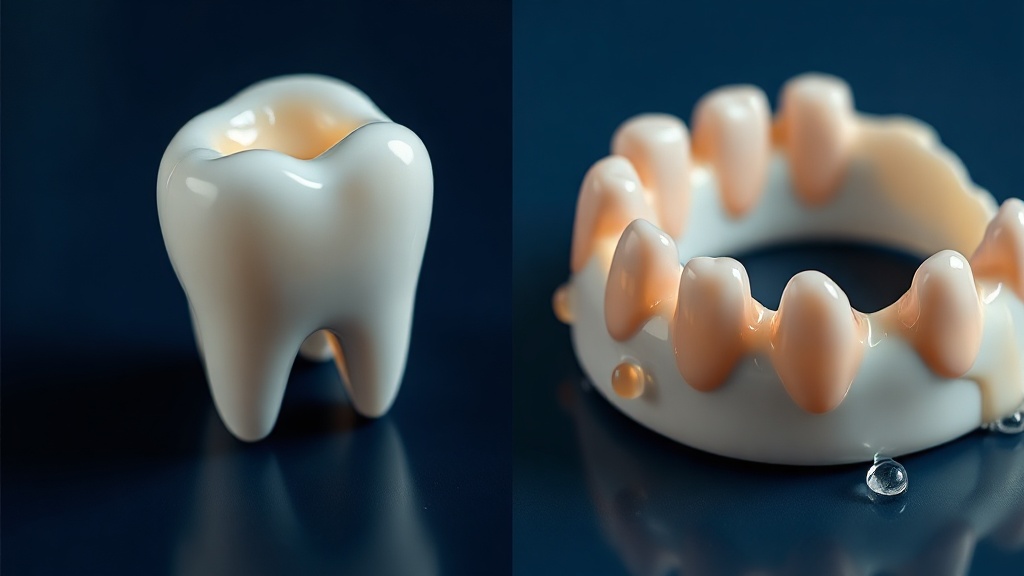
Peroxide soaks into porous natural enamel and brightens it from within. On a glazed ceramic crown it simply beads on the impermeable surface.
What the research actually shows
Every claim below maps to a named, peer-reviewed source in the Sources section. According to PubMed.
| Claim | Evidence | Source |
|---|---|---|
| Peroxide whitens by diffusing through enamel to oxidise coloured molecules mainly in the dentin, and its effect depends on concentration and contact time. | Reference review of the bleaching mechanism. | Joiner, 2006 |
| Even strong in-office bleaching (40% peroxide, laser-assisted) did not produce a clinically noticeable colour change in resin-based restorative materials. | Spectrophotometric study of three resin-based restoratives. | Karanasiou et al., 2021 |
| Whitening toothpastes reduced surface stain on composite and nano-ceramic materials but could not fully reverse discolouration, and did nothing for a 3D-printed ceramic-resin. | In-vitro brushing study across three restorative materials. | Celik et al., 2025 |
| Home and over-the-counter bleaching can roughen restorative materials and make them more prone to picking up new stains afterwards. | CAD/CAM materials tested for surface roughness and staining. | Tinastepe et al., 2020 |
| A colour difference becomes visible to the eye at about a delta-E of 1.2 and clinically unacceptable at about 2.7 — the thresholds a dentist uses when matching a new crown. | Reference perceptibility and acceptability thresholds. | Paravina et al., 2015 |
What actually responds to whitening
| What you are trying to lighten | Does peroxide whitening work? | What actually helps |
|---|---|---|
| Natural enamel and dentin | Yes — this is the only thing gel lightens | Peroxide gel, strips or trays; time on the tooth matters more than raw strength |
| Porcelain or ceramic crown / veneer | No — the glaze is inert | Professional polish for surface stain; replacement to change the core shade |
| Composite (white) filling | No — set resin will not lighten | Polishing lifts surface stain; replace it to match a whiter shade |
| Surface stains on any restoration | N/A — this is film, not the material | Gentle low-abrasion polishing or a professional clean |
| A crown that was always too dark | No | Ask your dentist about refacing or remaking it |
What you can and cannot fix at home
There is a useful distinction hiding here: the difference between the colour of the material and the film of stain that collects on top of it. The material colour is fixed and unreachable. The surface film is fair game. Everyday stains from coffee, tea, red wine and tobacco settle onto a crown just as they do onto enamel, and a gentle low-abrasion polish can lift them — one reason a plain baking-soda paste, which removes surface stain at low abrasivity, is a sensible choice for cleaning around restorations. What is not sensible is reaching for harsher fixes in the hope of going lighter. Highly abrasive charcoal pastes scratch the glaze and the polish, and studies show that soaking restorative materials in bleaching gel can actually roughen them and leave them more stain-prone than before. So the realistic home goal is to keep a crown at its original shade, not to beat it. If your restoration looks darker than it used to, start by having the surface professionally polished; if it still looks wrong, the colour is in the material and only your dentist can change that. A professional clean is the safest reset of all: a hygienist can polish built-up film from your enamel and your restorations in a single sitting, with none of the guesswork of home experiments. It also helps to know where restorations stain first. Crowns and veneers tend to pick up discolouration at their margins, the fine line where they meet the tooth, so a darkening edge is usually surface film or a little gum recession exposing the join, rather than the porcelain itself changing colour.
Evidence you can act on.
Occasional emails — new research, new protocols, no noise.
How to get an even, matched smile when you have crowns
You cannot whiten a restoration, but you can plan around it so the whole smile ends up even. The trick is sequence — brighten the natural teeth first, then match the crown to them, never the other way round.
- 1
Whiten your natural teeth first
2-4 weeksDo any whitening before you commit to a new front crown or veneer. Gentle, lower-concentration whitening used consistently is kinder to sensitive teeth and gets you to a stable shade you can then match to.
- 2
Let the colour settle before matching
up to 2 weeksFreshly whitened teeth are slightly dehydrated and look their lightest for a few days, then rebound a little as they rehydrate. Wait until the shade holds steady so the crown is matched to your real, settled colour. Rushing this step is the single most common reason a new crown ends up looking slightly off against the surrounding teeth a few weeks later.
- 3
Book a professional shade match
one visitAsk your dentist to match the new restoration to your brightened teeth using a shade guide, ideally in natural light. This is where the science of visible colour thresholds matters — a good match sits below the point where the eye notices a mismatch.
- 4
Keep restorations clean, not scrubbed
dailyMaintain with a soft brush and a low-abrasion paste to lift surface stain without scratching the glaze. Skip abrasive charcoal products and avoid bleaching gels on the restoration itself. If a stain will not lift with normal brushing, that is a cue to book a polish rather than to reach for something more abrasive, which tends to dull the glaze permanently.
- 5
Re-match if you whiten again later
as neededIf you top up your natural whitening down the line, remember the crown will not move with it. Plan a polish or, if the gap becomes obvious, a replacement so the smile stays even.
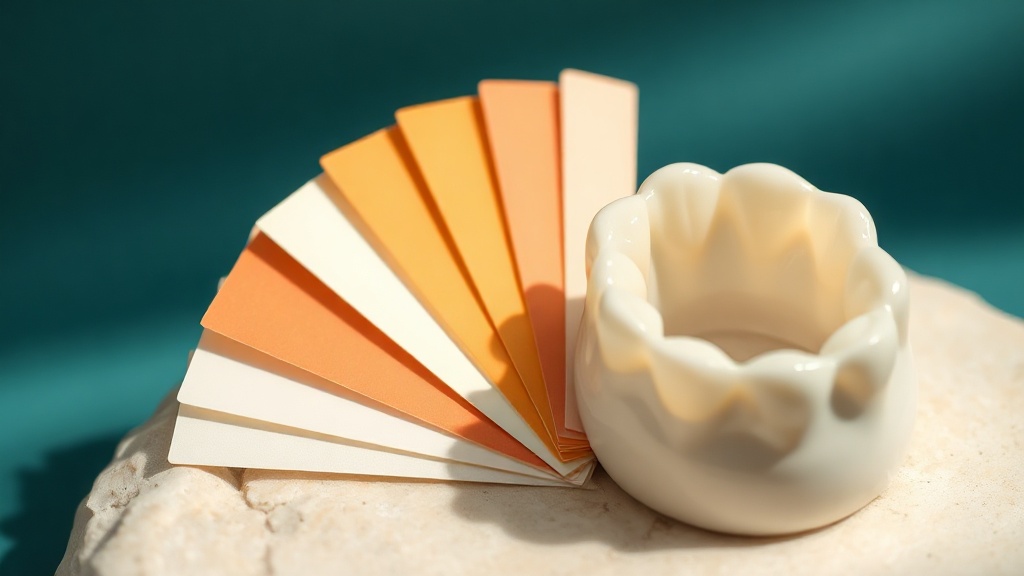
Because a crown holds one fixed colour, it is matched with a shade guide to your natural teeth — so whiten first, then match.
See a dentist if a crown or veneer looks noticeably darker than your other teeth, if a front restoration no longer matches after you have whitened, or if the edge of a crown is showing a dark line. These are cosmetic or fit issues a professional can assess in person — with options from a simple polish to refacing or remaking the restoration. If you are planning to whiten and you have visible crowns or fillings, a quick conversation first will save you from an uneven result. Bring photos of how your smile looked before, if you have them, so the match can be planned around the shade you are aiming for rather than the shade you happen to have today.
Frequently asked questions
Sources
- 1.
- 2.
- 3.
- 4.
- 5.
- 6.
- 7.

Fix your breath at the source.
The complete science-backed protocol — engineered to eliminate volatile sulfur compounds at the biological source.
Start the Breath Protocol →Related reading
Educational purposes only. The content on this page is not medical advice and is not a substitute for consultation with a qualified dental or medical professional.
More from the library
 Answers8 min
Does Teeth Whitening Damage Enamel? The Evidence-Based Answer
The honest, evidence-based answer to whether whitening harms enamel — what peroxide really does to the surface, why sensitivity is not damage, and the DIY methods that actually cause wear.
Read →→ Answers8 min
How Long Does Teeth Whitening Last? (And How to Extend It)
Whitening results last longer than most people think — teeth stay lighter for years — but they fade gradually, and a few simple habits slow it down.
Read →→ Guides8 min
How to Remove Coffee Stains From Teeth
A honest, evidence-based guide to lifting coffee stains from teeth without wrecking your enamel: what works, what only polishes the surface, and why to skip charcoal.
Read →→ Causes8 min
White Spots on Teeth After Braces: Causes and How to Fix Them
What causes the white marks left after braces come off, and the evidence-based cosmetic options that make them fade or blend in.
Read →→ Answers8 min
Does Baking Soda Whiten Teeth? What the Evidence Says
An honest look at what baking soda can and cannot do for a whiter smile.
Read →→ Best Of9 min
Best Fluoride-Free Whitening Toothpaste: An Honest, Evidence-Based Guide (2026)
Which fluoride-free whitening ingredients hold up to the research — and which are marketing. An honest buyer's guide.
Read →→