
Desensitizing Toothpaste: How It Works and What to Look For
A clear guide to the two mechanisms behind desensitizing toothpaste, which ingredient does what, and how to pick and use one.
- Desensitizing toothpaste tackles sensitive teeth in two distinct ways: calming the nerve or sealing the exposed dentine tubules — and the ingredient list tells you which one you are buying.
- The nerve-calming route relies on potassium (usually potassium nitrate), thought to make the nerve endings inside the tubules less quick to fire; it needs about two weeks of daily use to build up.
- The tubule-sealing route uses ingredients like stannous fluoride, arginine with calcium carbonate, or hydroxyapatite to deposit a mineral-like plug over the open tubule mouths.
- Both approaches are supported for reducing sensitivity, and many modern pastes combine them; results build with consistent twice-daily use rather than a single application.
- A desensitizing toothpaste soothes and shields — it does not regrow enamel or fix a cavity, so lingering or one-sided pain still needs a dentist.
Desensitizing toothpaste works one of two ways. Potassium-based pastes calm the nerve inside the exposed dentine tubules, easing sensitivity over about two weeks. Occlusion-based pastes — stannous fluoride, arginine plus calcium carbonate, or hydroxyapatite — physically seal the tubule openings so triggers cannot reach the nerve. Both help; use twice daily and give it time.
Route one: calming the nerve
The first family of desensitizing toothpastes works on the nerve rather than the tooth surface. Their active ingredient is a potassium salt — most often potassium nitrate, sometimes potassium chloride or citrate. The idea rests on the biology of the dentinal tubule: each open tubule connects the mouth to nerve endings near the pulp. Potassium ions are thought to diffuse down the tubules and build up around those nerve endings, keeping them in a state where they are far less likely to fire in response to a trigger. Because that build-up is gradual and depends on repeated exposure, potassium pastes are not instant — they typically need around two weeks of twice-daily brushing before the twinge noticeably quietens, and the benefit fades if you stop. It is worth being honest that the potassium mechanism has been debated: some reviewers note the clinical evidence is mixed and the exact mode of action is not fully proven. As one leading review put it, unproven should not be read as ineffective — many people get real relief from potassium pastes, which is why they remain a first-line, widely recommended option.
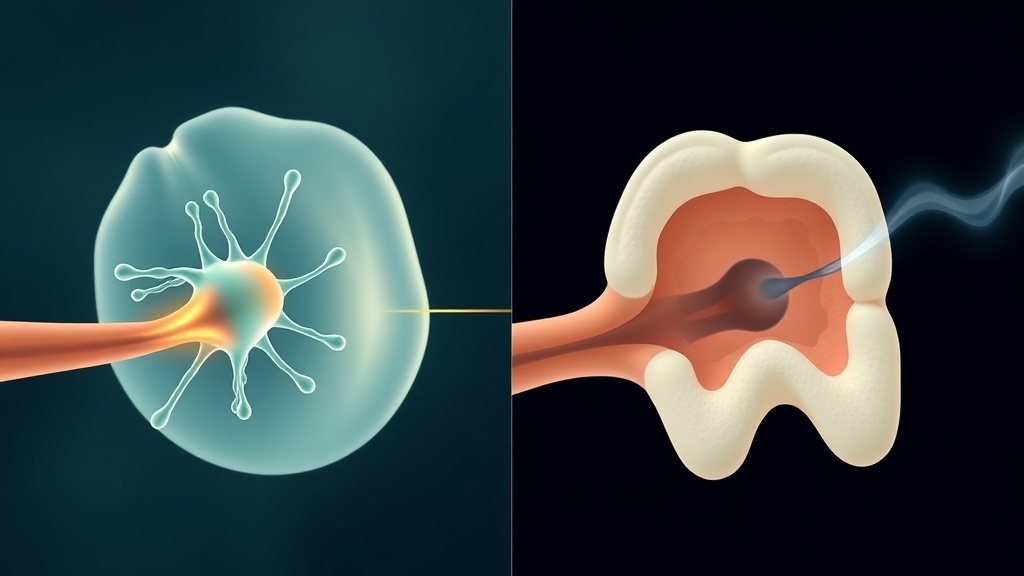
Desensitizing pastes either calm the nerve (potassium) or seal the tubule opening (stannous fluoride, arginine, hydroxyapatite).
What the research actually shows
Every claim below maps to a named, peer-reviewed source in the Sources section. According to PubMed.
| Claim | Evidence | Source |
|---|---|---|
| Both tubule-blocking technologies and potassium-based products are recognised approaches for treating dentine hypersensitivity, while plain fluoride toothpaste offers little direct relief. | Review of toothpaste in the treatment of dentine hypersensitivity. | Addy & West, 2013 |
| A potassium-nitrate toothpaste reduced iced-water sensitivity by about 81% at 7 days and 88.6% at 14 days of twice-daily use. | Randomised, examiner-blind clinical trial. | Seong et al., 2021 |
| A stannous-fluoride toothpaste occluded 82% of dentine tubules (vs 35% for control) and cut tactile sensitivity by about 42% at 8 weeks. | Laboratory and clinical evaluation. | Hines et al., 2019 |
| In a lab erosion model, potassium-nitrate paste reduced dentine permeability while some occlusion pastes did not — a reminder that ingredient performance varies and is not identical. | In vitro dentine-permeability study. | Joao-Souza et al., 2019 |
| Occlusion technologies (including arginine-calcium carbonate and potassium oxalate) partially seal tubules in the lab, with differing resistance to acid challenge. | Comparative in vitro tubule-occlusion study. | Sharma et al., 2013 |
The active ingredients, side by side
| Active ingredient | How it works | What to know |
|---|---|---|
| Potassium nitrate | Calms the nerve inside the tubule | Needs ~2 weeks to build up; first-line, widely used |
| Stannous fluoride | Seals tubules and adds fluoride | Dual benefit; can feel faster; may cause mild staining in some |
| Arginine + calcium carbonate | Plugs tubules with a calcium-rich layer | Marketed for on-the-spot relief; seal varies in the lab |
| Hydroxyapatite (nano) | Deposits tooth-like mineral over openings | Fluoride-free option; also supports remineralisation |
| Potassium oxalate / strontium | Forms crystals that block tubules | Often seen in point-relief products and rinses |
Route two: sealing the tubules
The second family works on the tooth itself, plugging the open tubules so triggers can no longer move the fluid inside them. Stannous fluoride is a standout here because it does two jobs at once: it lays down a tin-rich deposit that physically occludes the tubule mouths, and it delivers fluoride to strengthen the surface — in laboratory testing it sealed the large majority of open tubules where an ordinary paste sealed far fewer. Arginine paired with calcium carbonate is designed to bind to dentine and build a calcium-rich plug, and is often marketed for near-immediate relief when rubbed onto the tooth. Hydroxyapatite, the mineral enamel is mostly made of, deposits a tooth-like layer over the openings and doubles as a fluoride-free remineralising agent. The honest caveat is that these occlusion technologies do not all perform identically, and a plug can be partly washed or eroded away by acid, which is why continued daily use and easing off acids both matter. In practice many people do best with a paste that combines a sealing agent with potassium, covering both mechanisms — calming the nerve while shielding the surface.
Evidence you can act on.
Occasional emails — new research, new protocols, no noise.
How to choose and use one well
A desensitizing toothpaste is a comfort and protection product for exposed dentine, not a treatment for decay. Here is how to get the most from it.
- 1
Match the ingredient to your need
when choosingWant steady, build-up relief and a first-line option? Choose potassium nitrate. Want tubule sealing plus fluoride? Choose stannous fluoride. Prefer fluoride-free? Choose hydroxyapatite. A combination paste covers more than one base at once.
- 2
Use it as your everyday paste, twice daily
~2 minutes, morning and nightDesensitizing pastes work by accumulating their effect, so they are not an occasional treatment — make one your regular toothpaste and use it every brush for at least two weeks before judging.
- 3
Spit, do not rinse
after brushingRinsing straight after brushing washes the actives away. Spit out the excess and leave the thin film behind, especially at night, to give the ingredients longer to work.
- 4
Add a leave-on dab for sore spots
nightly, optionalFor a stubborn tooth, rub a little extra paste directly onto it after brushing and leave it on. This concentrates the active exactly where you need it.
- 5
Protect the surface between brushes
dailyBrush gently with a soft brush and ease off acidic foods and drinks. Any tubule seal lasts longer when it is not constantly being scrubbed off or dissolved by acid.
The active ingredient — potassium nitrate, stannous fluoride, arginine, or hydroxyapatite — tells you which mechanism a paste uses.
A desensitizing toothpaste is for mild, provoked sensitivity from exposed dentine. If two weeks of consistent use brings no relief, or if the pain lingers after the trigger, throbs, is spontaneous, is fixed to one tooth, or comes with swelling or a visible hole, see a dentist. Those signs can mean a cavity, crack, failing filling, or inflamed pulp — problems a toothpaste cannot reach. A dentist can also apply stronger in-office desensitising agents for cases that home products do not settle.
Frequently asked questions
Sources
- 1.
- 2.
- 3.
- 4.
- 5.

Fix your breath at the source.
The complete science-backed protocol — engineered to eliminate volatile sulfur compounds at the biological source.
Start the Breath Protocol →Related reading
Educational purposes only. The content on this page is not medical advice and is not a substitute for consultation with a qualified dental or medical professional.
More from the library
 Ingredients9 min
Potassium Nitrate Toothpaste: How It Calms Sensitive Teeth
A focused guide to potassium nitrate toothpaste: how the nerve-calming mechanism works, the honest evidence, the two-week timeline, and how to use it.
Read →→ Ingredients10 min
MI Paste for Teeth: What CPP-ACP Crème Really Does
A clear, honest guide to MI Paste (CPP-ACP): how the milk-derived crème works, where the evidence supports it, its limits, and how to use it.
Read →→ Guides9 min
Tooth Sensitivity: Causes, Triggers and Types
The causes-and-types companion to our sensitive-teeth guide: what exposes dentine, why the nerve fires, and when a twinge is really something else.
Read →→ Ingredients8 min
How Fluoride Toothpaste Remineralizes Teeth
The chemistry behind fluoride's remineralizing power, and the honest line between the early lesions it can rebuild and the cavities it cannot.
Read →→ Answers8 min
How to Get Rid of White Spots on Teeth: Your Options, Ranked
An honest, evidence-based ladder of options, from what you can do at home to what only a dentist can fix.
Read →→ Ingredients8 min
Hydroxyapatite Toothpaste Benefits: What the Evidence Actually Supports
A calm, science-first look at what hydroxyapatite toothpaste can genuinely do for your enamel, and where the evidence stops.
Read →→