
Rotten Teeth: What to Do, Step by Step
If your teeth have reached the point of visible decay, here is what is really going on and the practical, judgment-free path forward.
- You are not alone and this is not a moral failing. Untreated tooth decay is the single most common health condition on the planet, affecting billions of people, and it is driven mostly by biology, not by being a bad person.
- Advanced, visibly decayed teeth cannot be rebuilt at home. Once enamel cavitates into a hole, the tooth cannot repair itself, so the honest first step is professional care, not another remineralizing product.
- Modern dentistry is gentler than you may fear. For many lesions the evidence favours sealing decay in or arresting it over aggressive drilling, and there are options that stop decay without a needle.
- Trying to remineralize an already-open tooth can backfire. There are documented cases of infection spreading to the root because someone delayed professional care hoping to fix a deep cavity naturally.
- The teeth you still have can be protected starting today. Fluoride, fewer sugar moments and a supported saliva flow genuinely lower the risk to the rest of your mouth while you arrange care.
If your teeth are visibly rotting, see a dentist as the first and most important step, because advanced decay cannot be reversed at home. Meanwhile, protect the rest of your mouth with fluoride toothpaste, fewer sugar moments and good hydration. Modern care is often gentler than expected, and going sooner keeps options open and costs down.
What rotten teeth actually are, without judgment
The phrase rotten teeth sounds like an accusation, but what it describes is a purely physical process that happens to enormous numbers of people. Decay begins when acid from plaque bacteria repeatedly dissolves the mineral in enamel faster than saliva can rebuild it. For a long time this is invisible and painless. Only later does the surface finally break, and once a tooth has cavitated the developed enamel cannot repair itself, because enamel has no living cells to regenerate lost structure. From there the softened, darkened area spreads into the deeper dentin and can eventually reach the nerve. That progression is what people are seeing when they talk about a tooth going bad: brown or black patches, chalky or crumbling edges, sensitivity, or a visible hole. It is worth saying plainly that this is common, that many contributing factors, dry mouth, certain medications, a difficult diet, past dental fear, are outside anyone tidy sense of personal control, and that shame helps no one. What matters now is not how it got here but what to do, and the biology points to a clear answer: a tooth this far along needs a professional, and the sooner the better.
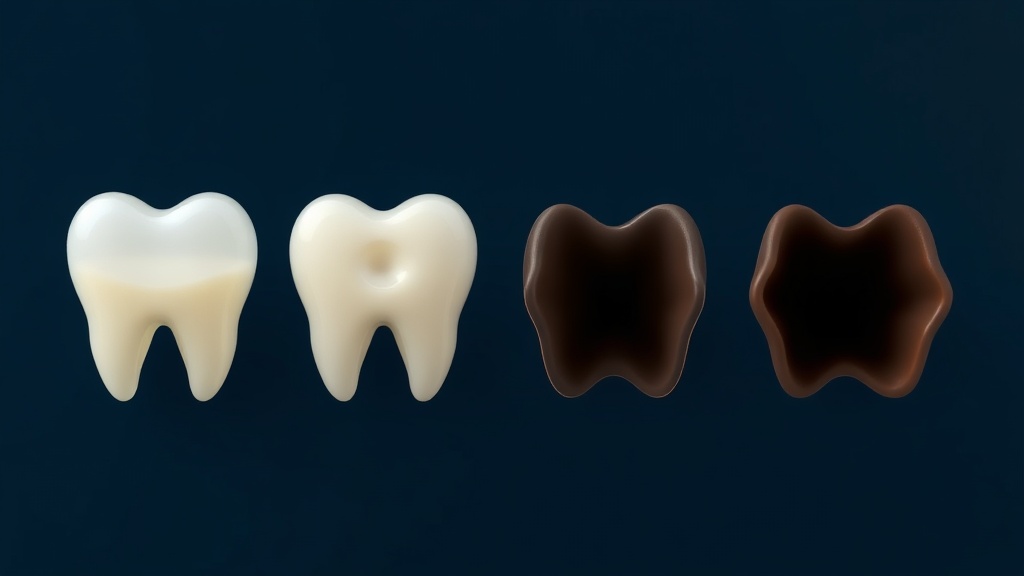
Decay moves through stages. Early spots can remineralize, but once the surface breaks the tooth needs professional care.
What the research actually shows
Every claim below maps to a named, peer-reviewed source in the Sources section. According to PubMed.
| Claim | Evidence | Source |
|---|---|---|
| Once enamel cavitates, the developed enamel cannot repair itself, because it has no cells to regenerate lost structure. | Review of enamel biology and remineralization limits. | Liu et al., 2022 |
| Decay can be arrested at any stage, but only where clinically plaque-free conditions can be achieved, which a deep cavitated lesion structurally prevents. | Foundational clinical caries paper. | Nyvad & Fejerskov, 1997 |
| For deep lesions, completely drilling out all decay fails more often than sealing decay in, supporting gentler, tooth-preserving care. | Network meta-analysis of cavitated lesion treatment. | Schwendicke et al., Cochrane 2021 |
| Silver diamine fluoride can arrest advanced cavitated lesions and is applied without drilling or injections. | Network meta-analysis of nonrestorative treatments. | Urquhart et al., 2019 |
| Dental fear affects about 15.3% of adults, and the fear-avoidance cycle that worsens disease hits 38.5% of fearful people versus 0.9% of the unafraid. | Meta-analysis and cohort study. | Silveira et al., 2021; Armfield 2013 |
What can and cannot help at this stage
| Approach | What it can do | Honest limit |
|---|---|---|
| Seeing a dentist promptly | Restore, arrest or remove decay; stop pain and spread | Requires making the appointment |
| Silver diamine fluoride (in-office) | Arrest advanced lesions without drilling | Stains the arrested area dark; dentist-applied |
| Sealing-in or minimal restoration | Preserve more of the tooth than full drilling | Still a professional procedure |
| Fluoride toothpaste at home | Protect the rest of your teeth going forward | Cannot rebuild a cavitated tooth |
| DIY remineralizing on an open tooth | Nothing helpful | Can let infection reach the root |
Why waiting costs more than going
The most common reason people put off care for badly decayed teeth is fear, sometimes of pain, sometimes of judgment, sometimes of bad news. That fear is real and widespread: about one in seven adults has significant dental anxiety, and it tends to feed a vicious cycle, where avoidance leads to worse disease, which makes the eventual visit feel even more daunting. Understanding that cycle is the way out of it, because every part of the fear tends to shrink once you actually go. Decay does not pause while you wait. A lesion that could have been arrested with a painless silver diamine fluoride application, or sealed with a small filling, can progress into the nerve, at which point the options narrow toward root canals or extraction and the discomfort increases. There is also a specific danger in trying to handle advanced decay yourself: there are documented accounts of people attempting to remineralize an open tooth, only for infection to travel to the root and force exactly the outcome they were trying to avoid. The kinder, cheaper, less painful path is almost always the earlier one. A dentist can numb the area, work in stages, and, crucially, tell you which of your teeth can still be saved simply, information that only gets more valuable the sooner you have it.
Evidence you can act on.
Occasional emails — new research, new protocols, no noise.
Your calm, practical next steps
This is a plan for moving forward, not a scorecard for the past. The home measures protect your remaining teeth; they are never a substitute for the first step.
- 1
Book a dental visit, and say you are anxious
today or this weekThis is the step that changes everything. Many practices are experienced with nervous patients and with advanced decay, and telling them upfront lets them take it slowly. If cost is the barrier, ask about dental schools, community clinics or payment plans, which exist precisely for this.
- 2
Protect every remaining tooth right now
twice dailyBrush gently with a fluoride toothpaste and, at night, spit without rinsing so the fluoride keeps working. This will not rebuild a rotten tooth, but it meaningfully lowers the risk to the teeth you still have while you arrange care.
- 3
Ease the sugar and acid load
every dayCut how often you have sugary or acidic drinks and snacks, and keep water as your default between meals. Fewer, shorter acid attacks slow decay across your whole mouth.
- 4
Support your saliva
all dayA dry mouth accelerates decay. Sip water, and if you take medications that dry your mouth, mention it to your dentist, because a dry mouth is a manageable risk factor rather than a fixed fate.
- 5
Do not dig, file or try to fix a broken tooth yourself
—Home tools and DIY remineralizing pastes cannot repair a cavitated tooth and can drive infection deeper. If a tooth is painful, swollen or broken, treat that as a reason to be seen sooner, not a project to solve alone.
The single most useful step is the appointment. Telling the practice you are anxious lets them make it gentle.
With advanced decay, the answer to when is now, before it becomes an emergency. See a dentist promptly for any visibly decayed, broken or darkened tooth. Seek same-day or urgent care if you have facial swelling, a fever, throbbing or spreading pain, a bad taste from a broken tooth, or difficulty swallowing, as these can signal a spreading infection that needs prompt attention. Advanced decay genuinely requires professional care; there is no safe home version of a filling, a root canal or an extraction. Going early keeps more of your teeth savable and turns a frightening situation into a manageable plan.
Frequently asked questions
Sources
- 1.
- 2.
- 3.
- 4.
- 5.
- 6.
- 7.

Fix your breath at the source.
The complete science-backed protocol — engineered to eliminate volatile sulfur compounds at the biological source.
Start the Breath Protocol →Related reading
Educational purposes only. The content on this page is not medical advice and is not a substitute for consultation with a qualified dental or medical professional.
More from the library
 Causes9 min
Demineralization of Teeth: How Acid Dissolves Enamel
The step-by-step chemistry of how enamel loses its minerals, and the point at which that loss stops being reversible.
Read →→ Guides8 min
How to Prevent Cavities: What Actually Works
The handful of habits that genuinely lower cavity risk, ranked by the strength of the science behind them.
Read →→ Guides8 min
White Spots on Teeth: Causes and What to Do
The two common reasons enamel turns chalky white, and the honest guide to which spots you can rebuild at home and which need professional care.
Read →→ Answers8 min
How to Remineralize Teeth: An Honest, Practical Guide
The practical routine that supports enamel remineralization, and the clear line between the early lesions it can rebuild and the decay it cannot.
Read →→ Answers8 min
How to Get Rid of White Spots on Teeth: Your Options, Ranked
An honest, evidence-based ladder of options, from what you can do at home to what only a dentist can fix.
Read →→ Ingredients8 min
Hydroxyapatite Toothpaste Benefits: What the Evidence Actually Supports
A calm, science-first look at what hydroxyapatite toothpaste can genuinely do for your enamel, and where the evidence stops.
Read →→