Dry Mouth in the Morning: Why It Happens and How to Feel Fresher
Morning dryness is mostly overnight physiology, not a disease — and your first waking hour is where the simplest fixes pay off.

- Morning dry mouth is usually not a disease — it is the predictable result of saliva slowing while you sleep, plus hours of air moving over the thin film of moisture that coats your mouth.
- Most of your resting saliva comes from the submandibular glands under your jaw, and those idle overnight, so the mouth is at its driest right as you wake.
- Sleeping with your mouth open is the biggest amplifier: evaporation happens only during mouth breathing, and over six to eight hours it can outpace the little saliva you make at night.
- The most useful window is the first hour after waking — rehydrating and gently restarting the chewing reflex is what makes the mouth feel fresher fastest.
- Constant morning dryness, or dryness with dry eyes, trouble swallowing, or a suspected medication cause, is worth a conversation with your dentist or doctor — and you should never stop a prescribed medicine on your own.
You wake up dry because saliva production falls to its lowest during sleep, and if you breathe through your mouth, air steadily evaporates the thin layer of moisture coating your mouth over six to eight hours. It is common and usually harmless. The fastest relief is rehydrating and gently restarting saliva in your first waking hour.
Why your mouth is driest at dawn
Saliva is not produced at a steady rate around the clock. Your resting, unstimulated flow is already low, and during sleep it drops close to its lowest point of the day. What protects your mouth from feeling dry is not a pool of saliva but a very thin film that coats every surface — thinnest of all on the roof of the mouth, where it is only a few micrometres deep. Research on salivary flow shows that dryness appears the moment fluid loss outpaces the rate at which saliva is resupplied, and that evaporative loss from the mouth happens essentially only while you are breathing through it. Put those two facts together and the morning makes sense: most of your resting saliva comes from the submandibular glands beneath your jaw, and those are the glands that idle most in sleep, while the parotid glands hold their reserve for when you eat. So by the time the alarm goes off you are making the least saliva of the day, and if your mouth fell open in the night, hours of quiet airflow have been drying that thin film the whole time. Add an evening medication that reduces saliva, a warm dry bedroom, or a nightcap, and the film can be all but gone by morning.
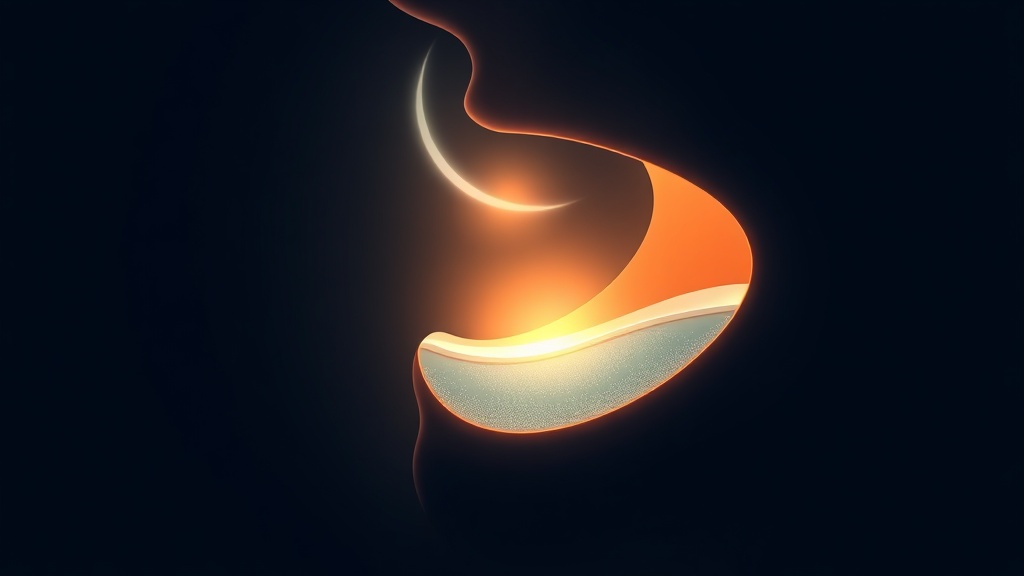
As you sleep, saliva slows to its lowest and the thin film of moisture is left to evaporate — so the mouth is driest right as you wake.
What the research actually shows
Every claim below maps to a named, peer-reviewed source in the Sources section. According to PubMed.
| Claim | Evidence | Source |
|---|---|---|
| Dry mouth appears when fluid loss outpaces saliva supply, and evaporation from the mouth occurs essentially only during mouth breathing. | Salivary flow and evaporation modelling. | Dawes, 2004 |
| Mouth breathing significantly reduced measured oral moisture and worsened dryness scores in direct human testing. | Controlled human oral-moisture measurement. | Oto et al., 2013 |
| Night-time and early-morning dryness tracks the submandibular gland — the source of most resting saliva, which idles in sleep. | Salivary-function study of night dryness. | Dijkema et al., 2012 |
| Overnight heated humidification significantly reduced early-morning oral discomfort and night-time dryness. | Controlled humidification pilot. | Hay & Morton, 2006 |
| An overnight xylitol adhering disc raised perceived oral wetness more than threefold and eased morning discomfort — a small, uncontrolled pilot. | Within-subject pilot (n=15). | Burgess & Lee, 2011 |
What makes some mornings worse
| Factor | Why it dries the morning mouth | Can you change it? |
|---|---|---|
| Sleeping with your mouth open | Evaporation runs for hours over the thin oral film | Yes, partly — nasal breathing and sleep position |
| Naturally low saliva in sleep | Resting flow idles overnight, mostly from the submandibular glands | No — it is normal biology |
| Dry bedroom air | Speeds up evaporation from the mouth | Yes — a humidifier helps |
| Evening medications | Many common medicines reduce saliva | Ask your prescriber — never stop on your own |
| Alcohol or caffeine at night | Both are dehydrating and lower flow | Yes — ease off before bed |
Why the first hour after waking matters most
The moment you wake is the low point: saliva flow is at its floor and the protective film is at its thinnest. It is also why morning breath and morning dryness travel together — when saliva idles all night, odour-producing bacteria and a soft coating build up on the tongue, and studies of very low resting flow link it to higher levels of the sulfur gases behind that stale morning smell. The encouraging part is that saliva is a reflex, not a reservoir. The submandibular and parotid glands respond within a minute or two to the simple acts of sipping, tasting and chewing, so a small, deliberate routine in that first hour restarts the system far faster than waiting for it to catch up on its own. This is also the moment to be honest with yourself about the pattern. Dryness that eases within an hour of waking and stays away all day is almost always ordinary overnight physiology. Dryness that lingers all day, or that arrived when you started a new medicine, is a different story and deserves a professional look rather than a bedside fix.
Evidence you can act on.
Occasional emails — new research, new protocols, no noise.
Your first-hour reset
None of this treats a disease — it simply helps your mouth recover moisture faster after the natural overnight low. Run through it in order in your first waking hour.
- 1
Rehydrate before anything else
first 60 secondsKeep water at the bedside and take a few slow sips the moment you wake, before coffee. Plain water re-wets the thin film that dried overnight; your morning coffee or tea is fine, but let water go first so you are not starting the day more dehydrated.
- 2
Restart saliva with a gentle chew
about 5 minutesReach for sugar-free gum or a lozenge. The relief comes from the act of chewing and sucking itself, which is the strongest everyday trigger for your salivary glands — not from any flavour. Choose a xylitol-sweetened option, which is tooth-friendly rather than sugary.
- 3
Clear the overnight film off your tongue
about 30 secondsGentle tongue cleaning plus your normal brushing removes the soft bacterial coating that accumulates while saliva idles — the same coating behind morning breath. An alcohol-free rinse supports the whole environment without adding to the dryness.
- 4
Set tonight up for a better morning
before bedA bedroom humidifier significantly reduced early-morning oral discomfort in a controlled trial, and it is a low-risk thing to try. Encourage nasal breathing, and if you use a CPAP machine, ask about adding heated humidification. An overnight xylitol adhering disc raised perceived wetness in a small pilot — promising for comfort, not proven, but reasonable to test.
- 5
Notice the pattern — and flag it if it persists
ongoingAn occasional dry morning is normal. Dryness every single morning, dryness that lasts all day, or dryness that appeared with a new medication or alongside dry eyes is worth raising with a dentist or doctor. Never stop a prescribed medicine on your own to chase relief — ask about alternatives instead.
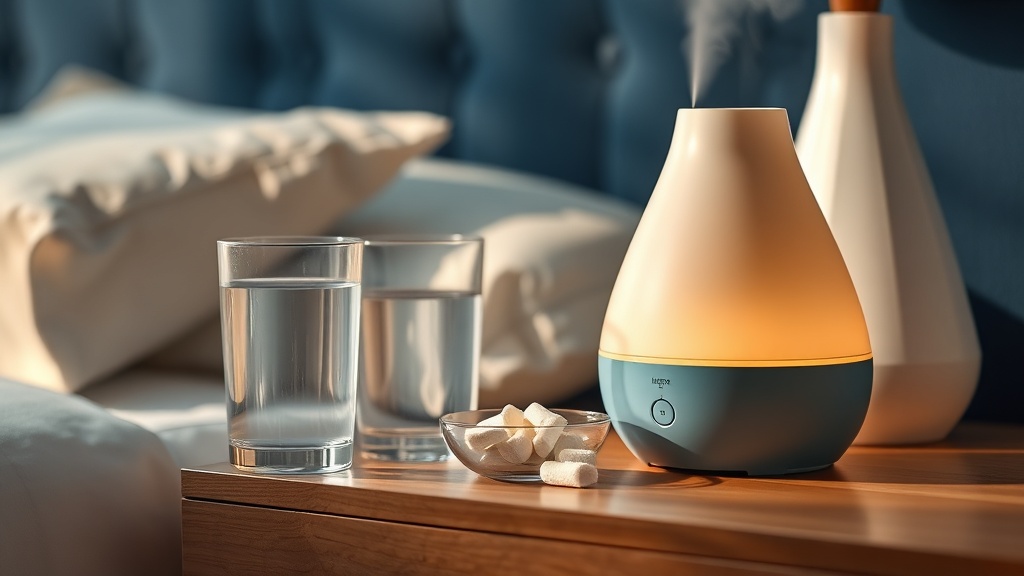
A glass of water, sugar-free gum and a bedroom humidifier are the simplest levers for a fresher-feeling morning.
See a dentist or doctor if your morning dryness is constant, if your mouth is dry all day rather than just on waking, or if it comes with dry, gritty eyes, trouble swallowing or speaking, a persistently burning tongue, or a run of new cavities. Because dry mouth is one of the strongest risk factors for tooth decay, protecting your teeth matters too — ask your dentist whether a high-fluoride toothpaste is right for you. If the dryness started with a new medicine, do not stop or change it on your own; ask your prescriber about the options.
Frequently asked questions
Sources
- 1.
- 2.
- 3.
- 4.
- 5.
- 6.
- 7.
- 8.
- 9.

Fix your breath at the source.
The complete science-backed protocol — engineered to eliminate volatile sulfur compounds at the biological source.
Start the Breath Protocol →Related reading
Educational purposes only. The content on this page is not medical advice and is not a substitute for consultation with a qualified dental or medical professional.
More from the library
 Guides8 min
Waking Up With Dry Mouth: Why It Happens and How to Sleep Easier
Why a parched, sticky mouth on waking usually comes down to night-time breathing, a blocked nose, or a medication, and what actually helps.
Read →→ Guides8 min
Dry Mouth at Night: Why It Happens and How to Sleep Easier
Nighttime dryness is common because your saliva naturally slows while you sleep, and a few targeted habits can make a real difference.
Read →→ Guides9 min
How to Prevent Dry Mouth While You Sleep
The practical, evidence-led bedtime plan for a mouth that stays comfortable through the night.
Read →→ Causes8 min
Can a CPAP Cause Dry Mouth? Why It Happens and How to Fix It
A dry mouth is one of the most common CPAP complaints, and it almost always has a fixable cause. Here is what is really drying you out overnight, and how to fix it without giving up the therapy that helps you breathe.
Read →→ Guides8 min
How to Fix Dry Mouth: An Evidence-Based Guide
Dry mouth is usually manageable once you know what is driving it and which supportive habits actually move the needle.
Read →→ Guides8 min
What Causes Dry Mouth? The Common Triggers, Explained
Dry mouth almost always has an identifiable trigger, and knowing yours is the first step toward relief.
Read →→