Waking Up With Dry Mouth: Why It Happens and How to Sleep Easier
Why a parched, sticky mouth on waking usually comes down to night-time breathing, a blocked nose, or a medication, and what actually helps.

- Waking up dry is usually about how air moves through your mouth at night. Saliva evaporates only when you breathe through your mouth, so a night of mouth-breathing leaves you parched by morning.
- A blocked or congested nose is a common hidden driver, because it quietly forces you to breathe through your mouth all night without you realising.
- Your saliva naturally slows to its lowest point during sleep, so there is less to replace what you lose, which is why the mouth so often feels driest first thing.
- Medications are the most common cause of dry mouth overall, and several are taken in the evening, so their drying effect can peak while you sleep.
- The popular idea of taping your mouth shut is not a safe fix. A systematic review found a potentially serious risk of harm, so the sensible route is to clear the nose, add moisture to the air, and see a professional if snoring or a blocked nose is the problem.
You wake up dry mainly because you breathe through your mouth at night, which lets the thin film of saliva evaporate, while your saliva is already at its lowest overnight. A blocked nose, evening medications and CPAP can all add to it. Clearing the nose, humidifying the air and an overnight-lasting product help; taping your mouth shut is not a safe answer.
Why morning is the driest moment
There is a simple piece of physics behind waking up parched. Dryness sets in when your mouth loses fluid faster than saliva replaces it, and the biggest overnight source of loss is evaporation. Crucially, evaporation from the mouth happens only while you are breathing through it. Research that modelled this found mouth-breathing can carry off saliva at a meaningful rate, and it hits hardest at the roof of the mouth, where the protective film of saliva is thinnest. Let that thin film dry out and the surface feels dry almost immediately. Now layer on two more things that all peak overnight. First, your saliva naturally slows while you sleep, reaching its lowest flow of the day, so there is simply less to replace what evaporates. Second, many people breathe through the mouth at night without knowing it, often because the nose is partly blocked. Put those together and morning becomes the perfect storm: least saliva, most mouth-breathing, hours of uninterrupted evaporation. This is why the mouth can feel fine all day and yet you wake with your tongue stuck to your teeth. It also points straight at the fixes, because almost every one of them works by getting you breathing through your nose again or by putting moisture back into the equation.

Saliva evaporates only during mouth-breathing, so a night with the mouth open dries the thin palatal film out by morning.
What the research actually shows
Every claim below maps to a named, peer-reviewed source in the Sources section. According to PubMed.
| Claim | Evidence | Source |
|---|---|---|
| Dry mouth sets in when fluid loss outpaces saliva, and evaporation from the mouth occurs only during mouth-breathing, hitting the thin film on the palate hardest. | Analysis of oral fluid balance and residual saliva. | Dawes, 2004 |
| Direct measurement confirmed that mouth-breathing significantly reduced oral moisture and worsened the feeling of dryness. | Bedside humidity and oral-moisture study. | Oto et al., 2013 |
| Overnight heated humidification significantly improved night-time and early-morning oral comfort and reduced dry cough. | Two-week pilot in adults with severe dry mouth. | Hay & Morton, 2006 |
| For CPAP users, adding heated humidification significantly reduced dryness of the mouth. | Randomised cross-over trial, 44 patients. | Ruhle et al., 2010 |
| Across all causes, medications are the single most frequently reported reason people develop dry mouth, and several are dosed in the evening. | Clinical review of xerostomia aetiology. | Guggenheimer & Moore, 2003 |
Why you wake up dry, and what helps
| What is happening overnight | Why it dries your mouth | What helps |
|---|---|---|
| Mouth-breathing while asleep | Air moving over the mouth evaporates the thin saliva film, worst on the palate | Clear the nose before bed; add a humidifier; see a doctor about snoring |
| A blocked or congested nose | Quietly forces you to breathe through the mouth all night | Treat allergies or congestion at the source with a clinician |
| Saliva slows during sleep | Resting flow is lowest overnight, so less is left to replace losses | A bedside humidifier and an overnight-lasting product |
| Evening-dosed medications | Many common drugs reduce saliva, and the effect can peak overnight | Ask your prescriber about timing; never change doses yourself |
| CPAP without humidification | Continuous airflow dries the mouth and throat | Add heated humidification; raise it with your sleep clinician |
The morning-breath and midnight-thirst connection
Two experiences almost always travel with waking up dry, and both make sense once you understand the saliva side of it. The first is morning breath. Saliva is the mouth's natural rinse, and when resting flow drops to very low levels overnight, odour-producing sulfur compounds and tongue coating both climb, which is exactly why breath is at its worst on waking. The dryness and the smell are two faces of the same low-saliva night. The second is the frustrating loop of waking thirsty, drinking water, and still feeling dry, sometimes while getting up to use the bathroom again and again. Part of that is simple: water rinses and wets the mouth for a moment but does not restore the saliva film that actually keeps it comfortable, so the relief fades fast. And in older adults, nocturnal dry mouth has been found to travel alongside getting up more often to pass urine and poorer sleep, so the two can reinforce each other through a broken night. The practical lesson is that drinking more and more water is rarely the answer on its own. What tends to work better is reducing the loss in the first place, by breathing through the nose and adding moisture to the air, and using something that holds moisture in the mouth through the night rather than a glass you have to keep refilling. It is worth being concrete about what actually reduces the loss, since that is the lever that matters. Getting air to move through your nose instead of your mouth removes the evaporation almost entirely, and adding moisture to the bedroom air means that whatever film of saliva you do have is not stripped away as fast. Together those two changes attack the problem from both sides at once, which is why people who fix their nasal breathing and run a humidifier often notice the biggest difference of anything they try. A glass of water on the nightstand still has its place for a quick rinse, but think of it as the backup, not the plan.
Evidence you can act on.
Occasional emails — new research, new protocols, no noise.
How to wake up more comfortable
These steps target the real overnight problem: too much evaporation and too little saliva. None of them treats a disease, and none involves changing a medication on your own.
- 1
Get your nose clear before bed
nightlyBecause mouth-breathing is the main driver, anything that helps you breathe through your nose helps your mouth. Manage evening congestion and allergies, and if a persistently blocked nose or loud snoring is the issue, that is worth raising with a doctor rather than working around it.
- 2
Add moisture to the bedroom air
overnightA bedside humidifier puts water back into the equation while you sleep. In studies, overnight humidification significantly improved night-time and early-morning mouth comfort, and for people on CPAP, adding heated humidification measurably reduced dryness.
- 3
Use something that lasts through the night
overnightMost lozenges and sprays fade within an hour, which is useless at 3am. A slow-dissolving adhering disc is the one format designed to release moisture over the hours you are asleep, and it is the most sensible overnight tool while you sort out the cause.
- 4
Mind the evening drying agents
eveningsAlcohol and caffeine late in the day both work against you, and several medications reduce saliva with an effect that can peak overnight. If you suspect a medicine, ask the prescriber whether timing can be adjusted. Do not change or stop it yourself.
- 5
Do not tape your mouth shut
—Taping the lips closed is a popular online trend, but a systematic review found a potentially serious risk of harm, including a danger of restricted breathing if the nose is blocked. Fix the nasal breathing and add moisture instead, and let a professional assess snoring or suspected sleep apnea.
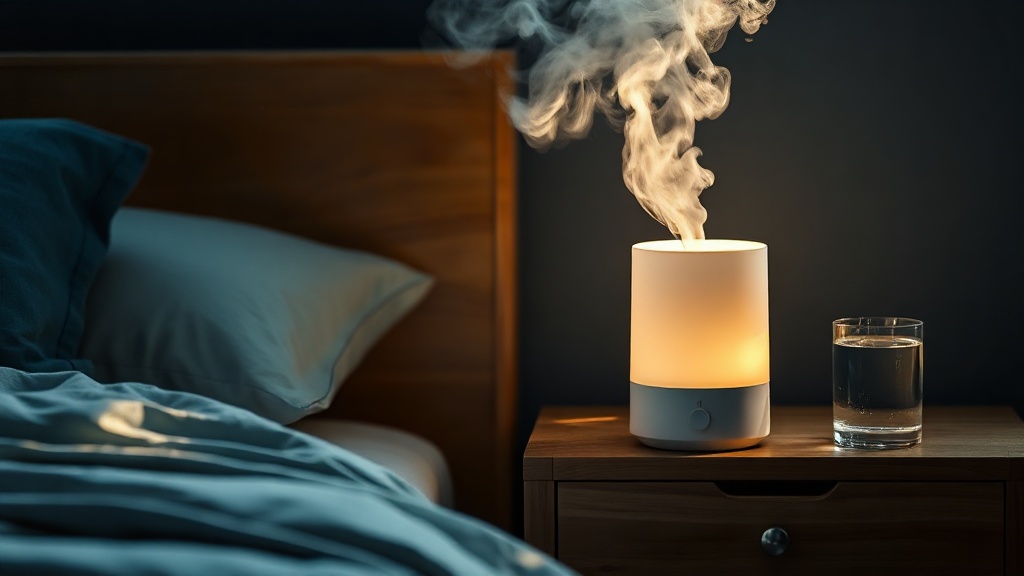
Overnight humidification is one of the best-supported fixes, putting moisture back while you sleep.
Waking up dry is usually manageable at home, but some patterns deserve a professional's eyes. See a doctor if you snore loudly, gasp or stop breathing in your sleep, or feel unrefreshed despite a full night, since these can point to sleep apnea that needs proper assessment. See a doctor too if your eyes are dry as well as your mouth, or if the dryness is persistent and unexplained. If you think a medication is behind it, take that to the prescriber to review timing or options, and never stop a prescribed medicine on your own. And see a dentist if the dryness is bringing morning sensitivity, cavities or a sore tongue.
Frequently asked questions
Sources
- 1.
- 2.
- 3.
- 4.
- 5.
- 6.
- 7.
- 8.

Fix your breath at the source.
The complete science-backed protocol — engineered to eliminate volatile sulfur compounds at the biological source.
Start the Breath Protocol →Related reading
Educational purposes only. The content on this page is not medical advice and is not a substitute for consultation with a qualified dental or medical professional.
More from the library
 Guides8 min
Dry Mouth at Night: Why It Happens and How to Sleep Easier
Nighttime dryness is common because your saliva naturally slows while you sleep, and a few targeted habits can make a real difference.
Read →→ Answers8 min
Does Dry Mouth Cause Bad Breath?
Low saliva and bad breath are closely linked, and understanding the connection points straight to what helps.
Read →→ Guides8 min
What Causes Dry Mouth? The Common Triggers, Explained
Dry mouth almost always has an identifiable trigger, and knowing yours is the first step toward relief.
Read →→ Guides8 min
How to Fix Dry Mouth: An Evidence-Based Guide
Dry mouth is usually manageable once you know what is driving it and which supportive habits actually move the needle.
Read →→ Best Of8 min
Best Mouthwash for Dry Mouth: What to Look For
The best dry-mouth rinse is the one that soothes without drying, and the label tells you more than the marketing.
Read →→ Reviews8 min
XyliMelts Side Effects: An Honest, Evidence-Based Review
An honest look at what XyliMelts adhering discs feel like overnight, what side effects people report, and where the evidence for comfort really stands.
Read →→