
Bad Breath That Will Not Go Away: How to Troubleshoot Persistent Halitosis
When the usual routine is not enough, the odour has a specific hiding place. Here is a calm, step-by-step way to find it and address it.

- Bad breath that survives brushing and mouthwash is rarely a mystery; it almost always has a specific source that a toothbrush simply never reaches.
- The four usual hiding places are the coating on the back of the tongue, a dry mouth, inflamed gums, and tonsil stones, with a smaller share coming from outside the mouth entirely.
- Rinses and mints mask odour for minutes, not hours: studies show sulfur gases rebound quickly, which is exactly why a masking-only routine feels like it never works.
- The reliable fix is to find the source and reduce the bacteria there, using mechanical cleaning of the tongue plus targeted adjuncts, rather than adding another mint.
- If odour persists despite thorough, consistent care, or comes with bleeding gums, a dry mouth or one-sided throat symptoms, it is time to see a dentist or doctor.
Persistent bad breath usually means the odour is being made somewhere a toothbrush cannot reach, most often the back of the tongue, a dry mouth, inflamed gums or tonsil stones. The fix is to locate that source and lower the bacteria there with mechanical cleaning and targeted adjuncts, then see a professional if it still will not budge.
Why brushing and mouthwash are not enough
If you brush twice a day, rinse, and still notice odour by mid-morning, you are not doing it wrong; you are aiming at the wrong target. Brushing and flossing clean the teeth beautifully, but the bacteria responsible for most breath odour live in a thick, sheltered coating on the rear third of the tongue, a zone a toothbrush barely grazes. Standard mouthwash has a second limitation: it largely masks. Research on mechanical tongue cleaning shows it can cut the sulfur gases behind malodour sharply, yet the effect is short-lived, with levels climbing back toward baseline within roughly half an hour if nothing changes the underlying bacterial load. A mint or an alcohol rinse buys you minutes of cover, then the same organisms resume producing the same gases. That mismatch is the whole reason chronic bad breath feels so stubborn: the routine most people reach for treats the symptom for a few minutes rather than the source for the day. Breaking the loop means switching from masking to genuinely reducing the population of odour-producing bacteria at their actual home, and keeping the mouth moist enough that saliva can do its natural cleansing work between efforts.
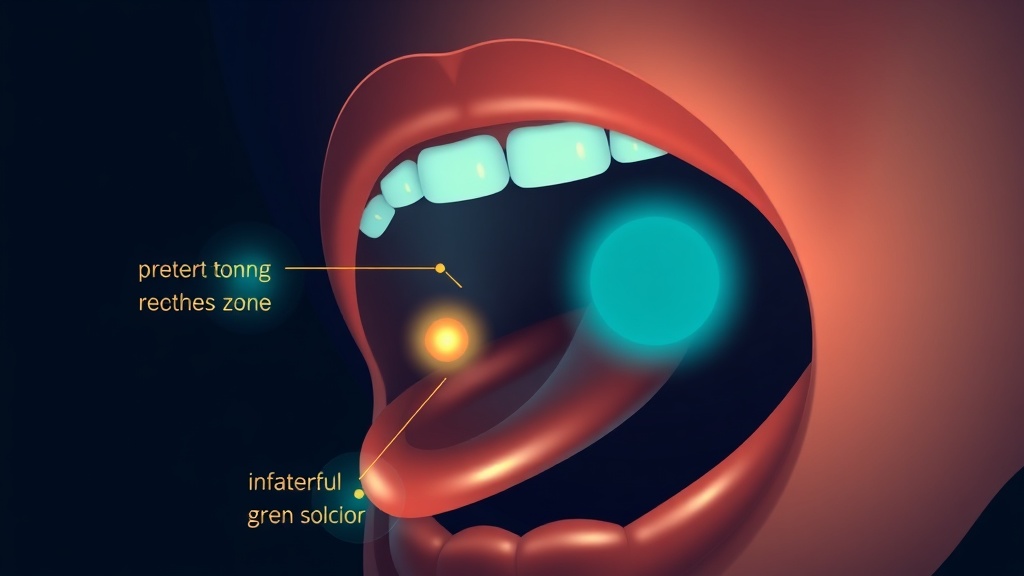
Persistent odour usually hides in one of four places a toothbrush misses: the back of the tongue, a dry mouth, the gum line, or the tonsils.
What the research actually shows
Every claim below maps to a named, peer-reviewed source in the Sources section. According to PubMed.
| Claim | Evidence | Source |
|---|---|---|
| Mechanical tongue cleaning meaningfully reduces the volatile sulfur compounds behind malodour, but the benefit is modest and short-lived without ongoing care. | Cochrane systematic review of tongue scraping. | Outhouse et al., 2006 |
| A range of mechanical and chemical measures can lower oral malodour, but the overall evidence base is limited, underscoring the need to target the actual source. | Cochrane review of interventions for managing halitosis. | Kumbargere Nagraj et al., 2019 |
| Chlorhexidine-based mouthrinses reduce plaque and can serve as a short-term chemical adjunct when the gums contribute to odour. | Cochrane review of chlorhexidine mouthrinse. | James et al., 2017 |
| When thorough oral measures do not resolve odour, an extra-oral cause becomes more likely; roughly 10 to 20 percent of genuine cases arise outside the mouth. | Systematic review of the causes of halitosis. | Memon et al., 2023 |
| Successful management depends on identifying the specific source rather than masking, since persistent halitosis is a symptom with a locatable cause. | Clinical overview of halitosis in the BMJ. | Scully and Porter, 2008 |
Where persistent odour hides, and how to spot it
| Hidden source | Telltale sign | First move |
|---|---|---|
| Tongue coating | Thick white or yellow film on the rear of the tongue | Gentle daily scraping of the back third |
| Dry mouth | Worse odour when thirsty, on waking, or after talking a lot | Steady hydration; check medications with a clinician |
| Gum inflammation | Gums that bleed when brushing or flossing | Careful flossing; a dental check for gum health |
| Tonsil stones | Small pale flecks and a smell that returns even with clean teeth | Gentle low-pressure rinsing; do not gouge |
| Extra-oral cause | No improvement despite excellent oral care | See a doctor to look beyond the mouth |
Working through the four hiding places
Troubleshooting persistent breath is really a process of elimination across four zones. Start with the tongue, because it is both the most common source and the easiest to address: a soft coating on the back of the tongue shelters the bacteria that generate sulfur gases, and gentle mechanical cleaning removes that reservoir directly. Next consider saliva. A dry mouth, whether from dehydration, mouth breathing or certain medications, removes the mouth own rinse and lets odour build, so it can quietly sabotage an otherwise good routine. Third are the gums: inflammation and the pockets that form along the gum line trap debris and bacteria, and a chemical adjunct such as a chlorhexidine rinse can help in the short term while a dentist addresses the gum health itself. Fourth are the tonsils, whose natural crypts can collect debris that hardens into odour-producing tonsil stones, which explains a smell that persists even when teeth and tongue are spotless. Only when all four are genuinely addressed and odour still lingers does an extra-oral cause move up the list, and that is the point to involve a doctor rather than buy another product.
Evidence you can act on.
Occasional emails — new research, new protocols, no noise.
A step-by-step troubleshooting routine
Work through these in order over a couple of weeks. None of this treats a disease; it is a methodical, cosmetic-first way to find and reduce the source of a stubborn smell.
- 1
Reset the tongue
under a minute, twice dailyClean the back third of the tongue with a scraper, using light, repeated strokes rather than force. This targets the single most common source directly. Give it a full week before judging the effect.
- 2
Restore moisture
all daySip water regularly, favour nose over mouth breathing, and note whether any medications leave you dry. A moist mouth lets saliva clear debris continuously, which no rinse can replicate.
- 3
Tighten up the gum line
dailyFloss carefully and watch for bleeding, which signals inflammation worth a dental check. A short course of a chemical adjunct rinse can help while the underlying gum health is addressed professionally.
- 4
Check the tonsils
as neededIf a smell returns even with clean teeth and tongue, look for small pale tonsil stones. Dislodge them only with gentle, low-pressure rinsing; never dig with metal or sharp tools, which can injure the tissue.
- 5
Reduce the overall bacterial load
twice dailyAlongside the targeted steps, keep general oral care thorough and consider an oral-targeted probiotic approach to help maintain a fresher balance between cleanings, rather than relying on masking mints.

Working the sources in order, tongue, saliva, gums, tonsils, is what turns a stubborn smell into a solved one.
Book a dental or medical visit if bad breath persists despite two to three weeks of thorough, consistent care, or if it comes with bleeding or receding gums, a constantly dry mouth, loose teeth, one-sided throat or ear discomfort, a persistent lump, or difficulty swallowing. A dentist can assess the gums, tongue and tonsils in person, and a doctor can look for the less common causes beyond the mouth. Persistent, one-sided or worsening symptoms should always be evaluated rather than self-managed.
Frequently asked questions
Sources
- 1.
- 2.
- 3.
- 4.
- 5.
- 6.
- 7.

Fix your breath at the source.
The complete science-backed protocol — engineered to eliminate volatile sulfur compounds at the biological source.
Start the Breath Protocol →Related reading
Educational purposes only. The content on this page is not medical advice and is not a substitute for consultation with a qualified dental or medical professional.
More from the library
 Guides7 min
Bad Breath Even After Brushing? The Biological Reason (and Fix)
You brushed, flossed and rinsed — and the smell is still there. The reason usually isn't hygiene; it's where the odour-causing bacteria actually live.
Read →→ Guides8 min
How to Get Rid of Bad Breath Permanently: An Evidence-Based Plan
The honest version: "permanently" means ongoing control, not a one-time fix. Here is the daily routine the research actually supports, and when to get help.
Read →→ Answers6 min
How Often Should You Scrape Your Tongue?
Once a day? Twice? After every meal? Here is what the research on tongue cleaning actually supports — and why frequency matters less than consistency.
Read →→ Ingredients9 min
Probiotics for Bad Breath: Do Oral Probiotics Actually Work?
Oral probiotics try to fix bad breath at the source, by shifting which bacteria live on your tongue. The idea is promising; the evidence is still early.
Read →→ Best Of8 min
The Best Mouthwash for Bad Breath, by Active Ingredient
There is no single winner, only the right rinse for the right job. Here is how the active ingredients compare on the evidence, and which suits everyday fresh breath.
Read →→ Best Of7 min
Copper Tongue Scraper Benefits: What the Evidence Supports
Copper scrapers are having a moment — but which benefits are backed by research and which are marketing? Here is the honest, evidence-based breakdown.
Read →→