Gingivitis vs Periodontitis: The Two-Stage Difference
Two stages of the same disease - one reversible, one not. Here is exactly how gingivitis and periodontitis differ, and why the line between them matters so much.
- Gingivitis and periodontitis are not two separate diseases but two stages of one process - and the line between them is the most important thing to understand.
- Gingivitis is inflammation of the gum tissue only, with no lasting damage. It is fully reversible: remove the plaque and the gums return to health.
- Periodontitis is the later stage, where the inflammation has destroyed supporting bone and attachment. That loss is permanent - it can be arrested and stabilised, but not reversed.
- Not all gingivitis becomes periodontitis, and clinicians cannot reliably predict who will progress - which is exactly why treating the reversible stage promptly matters.
- Only a dentist can measure attachment and bone to tell the two apart with certainty, so an in-person assessment is the way to know which stage you are actually at.
Gingivitis and periodontitis are two stages of gum disease. Gingivitis is reversible inflammation of the gums with no lasting damage. Periodontitis is the advanced stage where supporting bone and attachment are permanently lost. Gingivitis can be cured; periodontitis can only be managed. Only a dentist can measure which stage you are at.
One disease, two stages
Gum disease is best pictured as a continuum. It begins as gingivitis: plaque collects along the gumline, the gums become red, swollen and prone to bleeding, but nothing has been destroyed - the tissue is simply reacting. At this stage everything is recoverable. In some people, and for reasons that are not fully predictable, the inflammation deepens and crosses a threshold. The body''s response to the bacteria begins to break down the fibres and bone that hold teeth in place, and the disease is now periodontitis. The crucial difference is what has changed. Gingivitis is a state the gums are in; periodontitis leaves a mark that stays. Once attachment and bone are lost, treatment can stop further loss and calm the inflammation, but it does not rebuild what is gone - a treated patient is described as having periodontitis on a reduced periodontium. Same origin, same bacteria, but one stage is reversible and the other is not.
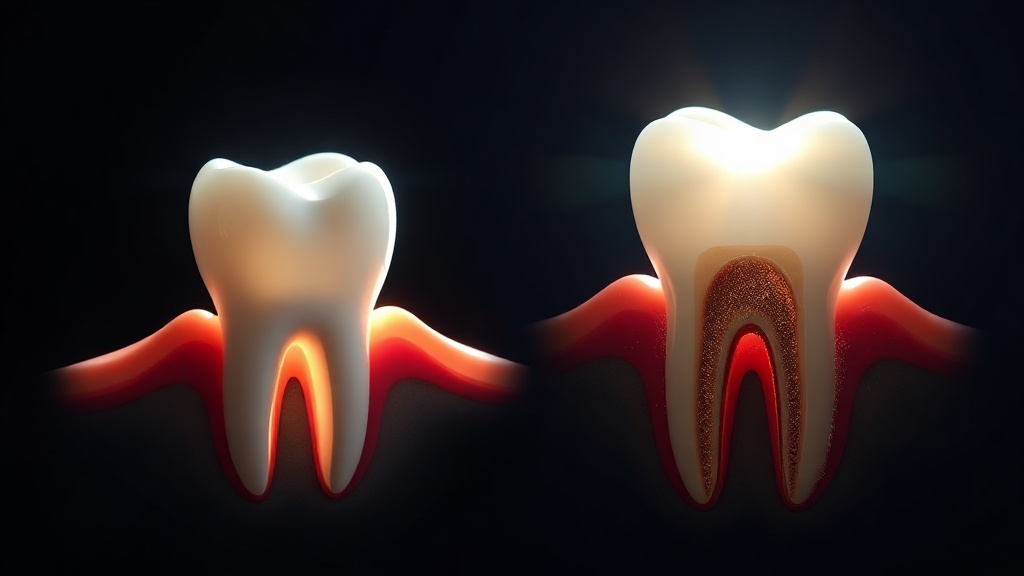
Gingivitis affects the gum tissue only and is reversible; periodontitis has destroyed the supporting bone, which does not grow back.
What the research actually shows
Every claim below maps to a named, peer-reviewed source in the Sources section. According to PubMed.
| Claim | Evidence | Source |
|---|---|---|
| Gingivitis is reversible while periodontitis is described as a ubiquitous and irreversible inflammatory condition - the defining difference between the two stages. | European Federation of Periodontology consensus. | Chapple et al., 2015 (EFP consensus) |
| After periodontitis, the patient is classed as having periodontitis on a reduced periodontium: inflammation is controlled but lost attachment and bone are not regained. | 2017 World Workshop consensus classification. | Papapanou et al., 2018 (World Workshop) |
| Gingival bleeding is the single most prevalent sign of periodontal disease worldwide - the reversible, near-universal stage is extremely common. | Global epidemiology review. | Petersen & Ogawa, 2012 |
| Around 1.07 billion people have severe periodontitis globally, and its prevalence has not fallen in three decades - the advanced stage is a major, unresolved burden. | Global Burden of Disease analysis. | Nascimento et al., 2024 (GBD 2021) |
| Not all gingivitis progresses to periodontitis, and clinicians cannot reliably predict which cases will - the rationale for treating the reversible stage universally. | Review of periodontal disease progression. | Jin et al., 2011 |
Gingivitis vs periodontitis, feature by feature
| Feature | Gingivitis | Periodontitis |
|---|---|---|
| Stage | Early gum inflammation | Advanced gum disease |
| What is affected | The gum tissue only | Gum plus supporting bone and attachment |
| Reversible? | Yes - fully | No - only managed and stabilised |
| Typical signs | Red, swollen gums that bleed when brushed | Receding gums, deep pockets, loose teeth, persistent bad breath |
| Bone loss? | None | Yes, and it is permanent |
| Goal of care | A genuine cure - return to health | Arrest and control further loss |
Why the line between them matters so much
The reason to understand this distinction is not academic - it changes what is at stake and what you should do. On the gingivitis side of the line, time is forgiving: the problem is reversible, and a professional cleaning plus good home care returns the gums to health. On the periodontitis side, time works against you, because every episode of active disease can take a little more bone that will not come back, and residual deep pockets carry a steeply rising risk of eventually losing the tooth. That asymmetry is the whole argument for acting early. Since not everyone with gingivitis progresses, and no one can reliably predict who will, the safe strategy is to treat the reversible stage as the opportunity it is. It is also why honest information matters here: the false promise that receding gums or lost bone can be regrown at home is not just wrong, it can cost someone the window in which their gum disease was still fully reversible.
Evidence you can act on.
Occasional emails — new research, new protocols, no noise.
How to tell where you are - and what to do
You cannot diagnose the stage yourself, but you can read the clues and take the right next step. Only a dentist can confirm it by measuring.
- 1
Notice the reversible signs
-Red, puffy gums that bleed when you brush, with no recession or looseness, point toward gingivitis - the reversible stage. This is good news and a cue to act while everything is still recoverable.
- 2
Watch for signs of progression
-Gums that have receded, teeth that feel loose or have shifted, persistent bad breath, or a sense of gaps opening up between teeth suggest the disease may have crossed into periodontitis. These warrant prompt attention.
- 3
Get a professional assessment
one visitOnly a dentist can measure pocket depth and attachment and read an X-ray for bone loss - the definitive way to tell the two stages apart. If you are unsure which side of the line you are on, this is how you find out.
- 4
If it is gingivitis, act to reverse it
2 to 3 weeksA professional cleaning plus a consistent daily routine of brushing and interdental cleaning returns the gums to health, usually within a few weeks. This is the curable window - use it.
- 5
If it is periodontitis, shift to managing it
ongoingThe goal changes from cure to control: professional therapy to arrest the disease, address risk factors like smoking, and a maintenance schedule to hold the ground you have. Lost bone is not regained, but further loss can be stopped.
Only a professional measurement of pocket depth and attachment can tell reversible gingivitis from irreversible periodontitis.
Because only a dentist can measure attachment and bone, an in-person assessment is the only way to know for certain which stage you are at - and the two need different plans. See a dentist promptly if your gums bleed persistently, have receded, feel tender, or if any tooth feels loose or has shifted. The earlier gum disease is caught, the more of it is still in the reversible stage.
Frequently asked questions
Sources
- 1.
- 2.
- 3.
- 4.
- 5.
- 6.

Fix your breath at the source.
The complete science-backed protocol — engineered to eliminate volatile sulfur compounds at the biological source.
Start the Breath Protocol →Related reading
Educational purposes only. The content on this page is not medical advice and is not a substitute for consultation with a qualified dental or medical professional.
More from the library
 Answers8 min
Is Gingivitis Curable? The Honest Answer
Early gingivitis is genuinely reversible - but the cure is a professional cleaning and daily hygiene, not a product, and periodontitis is a different story.
Read →→ Answers8 min
How to Treat Gingivitis: The Full Professional and Home Path
The complete treatment pathway for gingivitis - what the dentist does, what you do at home, and the risk factors that decide whether it holds.
Read →→ Guides8 min
Gum Recession Treatment: Every Option, Compared
The right treatment depends on why your gums receded and how far. Here is the full ladder, with what each rung can honestly deliver.
Read →→ Answers8 min
Can Receding Gums Grow Back? The Honest Answer
It is the question everyone with recession asks. The straight answer, and what you can realistically do instead.
Read →→ Guides8 min
Gum Disease Symptoms: The Early Warnings You Can Feel
The symptoms of gum disease you can feel and notice yourself, why bleeding comes first, and when a symptom means see a dentist now.
Read →→ Guides8 min
Periodontal Disease: The Full Spectrum, Explained
A clear, honest overview of periodontal disease as a spectrum: the difference between gingivitis and periodontitis, what the colloquial phrase gum disease misses, and why early bleeding is the signal to act.
Read →→