
Periodontal Disease: What It Really Means, From Gingivitis to Periodontitis
A clear, honest overview of periodontal disease as a spectrum: the difference between gingivitis and periodontitis, what the colloquial phrase gum disease misses, and why early bleeding is the signal to act.

- Periodontal disease is an umbrella term, not a single condition. It covers the whole spectrum of disease affecting the tissues around the teeth, from mild reversible inflammation to advanced, irreversible bone loss.
- The word periodontal simply means around the tooth. Periodontal disease is disease of that supporting apparatus: the gum, the ligament and the bone.
- The spectrum has two broad tiers. Gingivitis is inflammation of the gum that is fully reversible with good cleaning; periodontitis is the stage where supporting bone and attachment are destroyed and cannot grow back.
- Everyday language blurs this. When people say gum disease they often mean anything from bleeding gums to loose teeth, but the honest, clinically important line is whether attachment has actually been lost.
- Bleeding gums are the single most common early sign, and gingivitis is where the disease is most reversible. Catching it early, and seeing a professional for anything more advanced, is what protects your teeth.
Periodontal disease is an umbrella term for disease of the tissues surrounding the teeth. It ranges from gingivitis, a reversible inflammation of the gum, to periodontitis, an irreversible destruction of the supporting bone and attachment. The everyday phrase gum disease covers the same ground loosely; the meaningful distinction is whether the disease has crossed from reversible inflammation into permanent structural loss.
What periodontal disease actually means
Periodontal comes from the Greek for around the tooth, and the periodontium is the set of tissues that hold a tooth in place: the gum you can see, the thin periodontal ligament that suspends the tooth in its socket, and the alveolar bone of the jaw. Periodontal disease is any disease of that supporting apparatus, and it is best understood as a spectrum rather than a single diagnosis. At the mild end sits gingivitis, where bacterial biofilm at the gumline irritates only the gum surface; it looks red and bleeds easily, but nothing structural has been lost, and it resolves completely once the biofilm is cleaned away. If that inflammation is left to smoulder in susceptible people, it can cross a threshold into periodontitis, where the immune response begins to destroy the ligament and bone. That crossing is the whole point of the term: everything on the gingivitis side is reversible, and everything on the periodontitis side involves permanent loss. Periodontal disease is the label for the entire road, and where you are on it decides everything about what can be done.
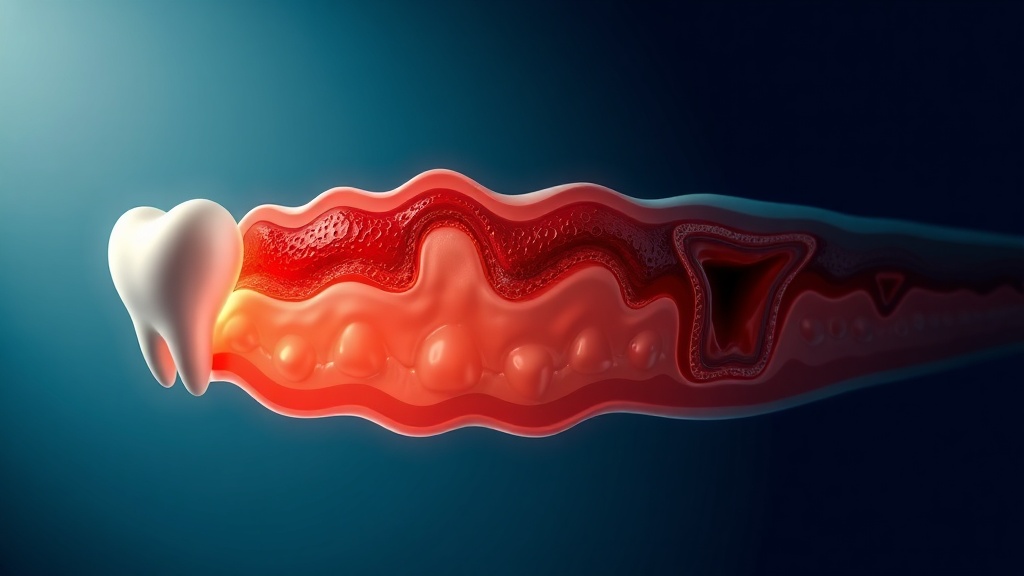
Periodontal disease is a continuum: reversible gingivitis at one end, irreversible periodontitis at the other.
What the research actually shows
Every claim below maps to a named, peer-reviewed source in the Sources section. According to PubMed.
| Claim | Evidence | Source |
|---|---|---|
| Gingival bleeding is the single most prevalent sign of periodontal disease worldwide, while deep pockets are present in only about 10–15% of adults. | Global review of periodontal disease burden and prevention. | Petersen PE, Ogawa H, 2012 |
| Gingivitis is reversible: in the experimental model all clinical measures rose during two weeks without cleaning and returned to baseline once cleaning resumed. | Experimental gingivitis clinical study. | Wellappuli N, et al., 2017 |
| Periodontitis is irreversible; the rational strategy is primary prevention of periodontitis by managing gingivitis first. | European Federation of Periodontology consensus report. | Chapple ILC, et al., 2015 |
| More than 35% of US adults over 30 have periodontitis, so a large share of the spectrum has already crossed into structural loss. | Large US national survey of periodontal status. | Albandar JM, et al., NHANES III |
| An estimated 1.07 billion people have severe periodontitis, and the burden has not improved in three decades. | Global Burden of Disease modelling. | Nascimento GG et al., GBD 2021 |
Gingivitis, periodontitis, and everyday gum disease
| Term | What it refers to | Reversible? |
|---|---|---|
| Gingivitis | Inflammation of the gum surface only, from biofilm at the gumline | Yes — resolves fully with good cleaning |
| Periodontitis | Destruction of the bone and attachment supporting the tooth | No — the loss is permanent, only controllable |
| Gum disease (everyday phrase) | A loose catch-all people use for anything from bleeding gums to loose teeth | Depends entirely which stage is actually present |
| Periodontal disease (umbrella) | The whole clinical spectrum, from gingivitis to periodontitis | Only the gingivitis end is reversible |
Why the label you use changes what you should do
The colloquial phrase gum disease is not wrong, but it hides the one distinction that actually governs your options: has attachment been lost or not? If the answer is no, you are dealing with gingivitis, and diligent daily cleaning can return the gum to full health without a dentist ever touching a root surface. If the answer is yes, you have periodontitis, and no amount of brushing will rebuild what is gone; the job shifts to a professional halting further loss. This is why a vague sense that your gums are a bit bad is not enough to act on. Bleeding when you brush is the early warning the whole spectrum turns on, and it is worth taking seriously precisely because it is usually gingivitis, the stage where you can still turn things around completely. The danger of the loose everyday term is that it lets people file bleeding gums under minor and wait until teeth feel loose, by which point the disease has quietly crossed the line that cannot be uncrossed. Naming the stage correctly, ideally with a professional assessment, is what points you at the right response.
Evidence you can act on.
Occasional emails — new research, new protocols, no noise.
How to respond to periodontal disease at each stage
Where you sit on the spectrum decides what helps. These steps move from what you can do yourself for early inflammation to when professional care becomes essential — none of them is a cure for established periodontitis.
- 1
Take bleeding gums seriously and clean well
twice dailyBleeding is the earliest, most reversible signal. Thorough twice-daily brushing plus cleaning between the teeth removes the biofilm driving gingivitis, and in most people the gum settles back to health within a couple of weeks. This is genuinely effective at the gingivitis end of the spectrum.
- 2
Support the gum environment
dailySupportive measures such as an antimicrobial or essential-oil rinse can help lower the overall bacterial load between the teeth where brushing misses. These support gum health; they do not treat structural disease, so treat them as helpers, not solutions.
- 3
Get a professional assessment to find your stage
one appointmentOnly a dentist can measure pocket depth and check the bone to tell whether you are still in reversible gingivitis or have crossed into periodontitis. If your gums bleed persistently, recede, or a tooth feels loose, book that assessment rather than guessing.
- 4
Follow professional treatment if periodontitis is found
as prescribedIf attachment has been lost, the path is professional: scaling and root planing to clean below the gumline, regular maintenance visits, and sometimes surgery. Home care continues alongside this to support the result, but it cannot replace the deep clean.
- 5
Reduce the risk factors that drive progression
ongoingSmoking is the biggest modifiable driver of the disease moving from mild to severe, and managing diabetes matters too. Cutting these lowers the chance of gingivitis tipping over into permanent loss and improves how well any treatment works.
Bleeding when you brush is the most common early sign — and the point on the spectrum where the disease is still fully reversible.
Because periodontal disease spans a reversible stage and an irreversible one, only a professional can tell you which you actually have. Book a dental assessment if your gums bleed regularly, look swollen or are pulling back from your teeth, if you have persistent bad breath, or if any tooth feels loose. A quick probing and, where needed, an X-ray places you on the spectrum and points you to the right care before more is lost.
Frequently asked questions
Sources
- 1.
- 2.
- 3.
- 4.
- 5.
- 6.
- 7.
- 8.

Fix your breath at the source.
The complete science-backed protocol — engineered to eliminate volatile sulfur compounds at the biological source.
Start the Breath Protocol →Related reading
Educational purposes only. The content on this page is not medical advice and is not a substitute for consultation with a qualified dental or medical professional.
More from the library
 Guides8 min
Periodontitis: Stages, Bone Loss, and How It Is Managed
An honest, evidence-based guide to periodontitis: what it does to bone and attachment, how dentists stage and grade it, and why professional care is the non-negotiable core of managing it.
Read →→ Guides8 min
Gum Pockets: What Those Numbers at the Dentist Mean
A plain-English guide to gum pockets: what they are, why your hygienist calls out numbers like two, three and five, what counts as healthy, and why the deeper ones need a professional clean.
Read →→ Answers8 min
Can Receding Gums Grow Back? The Honest Answer
It is the question everyone with recession asks. The straight answer, and what you can realistically do instead.
Read →→ Guides8 min
How to Stop Receding Gums: What Actually Slows It
You cannot will your gum line back up, but you can often stop it from dropping further. Here is what the evidence supports.
Read →→ Guides8 min
Gum Disease Symptoms: The Early Warnings You Can Feel
The symptoms of gum disease you can feel and notice yourself, why bleeding comes first, and when a symptom means see a dentist now.
Read →→ Causes9 min
Swollen Gums During Pregnancy: Why It Happens
Why pregnancy makes gums swell, what is normal, and the safe steps to take with your dental and prenatal team.
Read →→