TMJ Neck Pain: Why It Happens and Gentle Ways to Ease It
The jaw and the upper neck share nerves and muscles, so trouble in one often shows up in the other.

- The jaw and the upper neck are closely wired together. The nerves that carry jaw sensation and upper-neck sensation feed into the same region of the brainstem, so pain in one area is often felt in the other.
- Neck pain, more than posture geometry, tracks with jaw-muscle tenderness. In one study of TMD patients, jaw-muscle sensitivity lined up with neck-muscle tenderness, not with the degree of forward head posture.
- Because the two are linked, treating the neck can help the jaw. Neck-focused physical therapy produced a large short-term reduction in jaw pain in people with muscle-driven TMD.
- Gentle self-care, warmth, jaw and neck rest, easy movement, and clench and stress awareness, is low-cost and supported by evidence, but it is comfort care, not a cure.
- Persistent, severe, or one-sided pain, or pain with numbness, headaches, or dizziness, deserves a professional assessment rather than more home exercises.
TMJ and neck pain often occur together because the jaw and upper neck share nerve pathways and muscle connections, so tension in one region is felt in the other. Gentle warmth, jaw and neck rest, easy movement, and reducing clenching can ease it, and neck-focused therapy can help, but persistent pain needs a professional.
Why the jaw and neck are connected
Your jaw and your upper neck are not the separate territories they feel like. Sensation from the jaw and face travels along the trigeminal nerve, while sensation from the upper neck travels along the top cervical nerves, and both funnel into the same pool of neurons in the brainstem, a hub sometimes called the trigeminocervical complex. Because those signals mix at one junction, the brain can struggle to pinpoint exactly where a pain is coming from, so trouble in the jaw is often felt in the neck, and neck tension is often felt in the jaw. This is classic referred pain. Layered on top of the shared wiring is shared work: the muscles that open and close the jaw and the muscles that stabilise the head and neck operate as a team every time you chew, talk, or simply hold your head up. So a clenching habit that overloads the jaw muscles rarely stays politely in the jaw; it tugs on the neck as well. That is why so many people with TMJ describe a persistently stiff neck, and why chronic neck tension so often comes with an aching jaw. It is one linked system, not two separate problems, and that changes how you treat it.
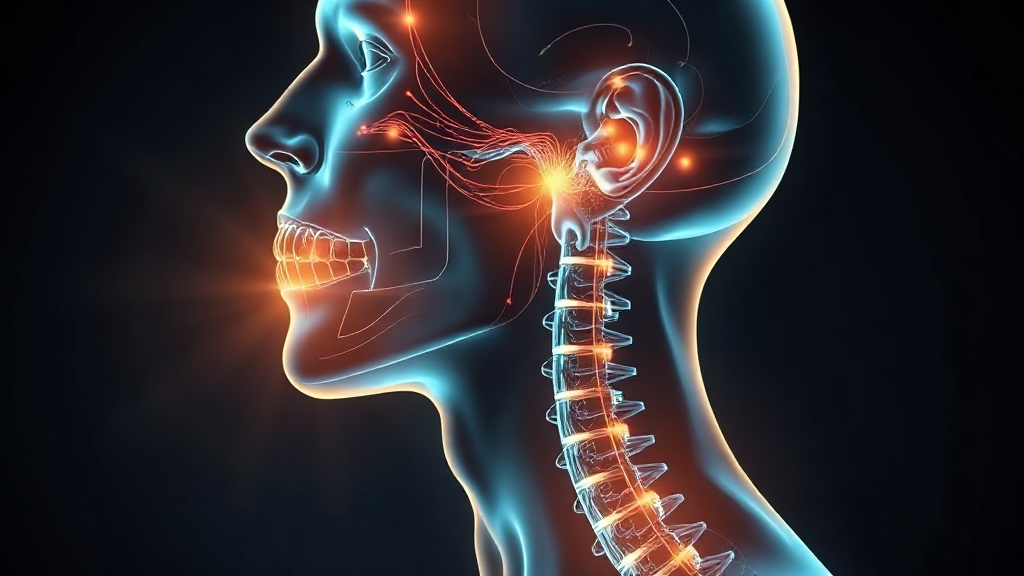
The jaw and upper neck share nerve pathways and work as one muscular team, so tension in one region is often felt in the other.
What the research actually shows
Every claim below maps to a named, peer-reviewed source in the Sources section. According to PubMed.
| Claim | Evidence | Source |
|---|---|---|
| In 145 TMD patients, jaw-muscle pressure-pain sensitivity was associated with neck-muscle tenderness, not with the degree of forward head posture; the presence of neck pain is what mattered. | Cross-sectional observational study. | Yao et al., 2022 |
| Whether head-and-neck posture is linked to TMD remains controversial and unclear across the published studies. | Systematic review. | Rocha et al., 2013 |
| Neck (cervical) rehabilitation produced a large short-term reduction in pain for adults with muscle-driven TMD (SMD -0.98). | Systematic review and meta-analysis of 7 RCTs. | Bednarczyk et al., 2024 |
| Jaw exercise therapy meaningfully reduced TMD pain and improved mouth opening (pain SMD -0.58) across 16 trials and 812 participants. | Systematic review with meta-analysis. | Idanez-Robles et al., 2022 |
| TMD is the second most common musculoskeletal chronic pain disorder after low back pain, affecting roughly 6 to 9% of adults with pain-related TMD. | GRADE clinical practice guideline. | Busse et al., 2023 |
What tends to help, and what to expect
| Approach | How it may help | Honest expectation |
|---|---|---|
| Gentle warmth to jaw and neck | Eases muscle tension and improves comfort | Simple, low-risk symptom relief; not a cure |
| Neck-focused physical therapy | Targets the shared muscle and joint links | Good short-term evidence for muscle-driven TMD; best guided by a therapist |
| Gentle jaw and neck exercises | Restores easy movement and lowers guarding | Modest, real benefit; do them pain-free, never forced |
| Clench and posture awareness | Reduces the daytime overload on both regions | Helpful habit change; effects build slowly over time |
| Massage of tight jaw and neck muscles | Relaxes overworked muscles | Can give quick short-term relief; not a structural fix |
The posture question, answered honestly
It is tempting to blame TMJ neck pain squarely on forward head posture, the so-called tech neck, and to assume that straightening up will fix everything. The evidence is messier than that story. The best systematic review on the topic concluded that the relationship between head-and-neck posture and TMD is still controversial and unclear, with studies pointing both ways. And when researchers actually measured it in 145 patients, jaw-muscle tenderness lined up with the presence of neck pain, not with how far forward the head was held. The practical takeaway is liberating: chasing a perfect posture angle matters less than addressing the neck tension and jaw overload themselves. Improving your posture may still feel good, and there is no harm in it, but do not expect a posture tweak alone to resolve jaw pain. Put your energy into releasing tension, moving both areas gently, and catching the daytime clench, and get persistent pain assessed rather than pinning it all on a single posture villain.
Evidence you can act on.
Occasional emails — new research, new protocols, no noise.
Gentle relief you can try
These steps aim at comfort and at easing tension in a linked jaw-neck system. They do not treat a disorder, and forcing them is counterproductive.
- 1
Warm and rest both areas
15 to 20 minutesA warm compress across the jaw muscles and the back of the neck can loosen tension in the shared muscle group. Give both the jaw and the neck genuine rest: soft foods during a flare, and avoid wide yawning or heavy chewing for a while.
- 2
Find the jaw resting position
throughout the dayLet your teeth part slightly, tongue resting lightly behind the top teeth, lips together. This lips-together, teeth-apart resting position unloads the jaw-closing muscles, which in turn eases their pull on the neck.
- 3
Gentle, pain-free neck and jaw movement
a few minutes, twice dailySlow, small neck rotations and easy, comfortable jaw opening keep both areas mobile and reduce guarding. Exercise therapy helps TMD pain in trials, but the benefit comes from gentle, regular movement, never from pushing into pain.
- 4
Ease tight muscles with light massage
a few minutesGently massaging the jaw and upper-neck muscles can bring short-term relief. Keep the pressure comfortable. If a spot is sharply painful, ease off rather than digging into it.
- 5
Address the daytime clench
ongoingNotice moments of clenching or shoulder-hunching at a screen, and consciously release them. Because clenching overloads the shared jaw-neck muscles, catching it is one of the most useful long-term habits you can build.

Gentle, pain-free movement of both the neck and jaw eases tension in a system that works as one.
See a dentist, a TMJ or orofacial-pain specialist, or a physiotherapist if your jaw and neck pain lasts more than a few weeks, is severe or one-sided, or keeps coming back. Get prompt care if pain comes with numbness or tingling in the arm, severe or sudden headaches, dizziness, jaw locking, facial swelling, or fever, since these point beyond simple muscle tension. Self-care is for comfort; a professional can diagnose the cause and build a proper plan.
Frequently asked questions
Sources
- 1.
- 2.
- 3.
- 4.
- 5.
- 6.
- 7.

Fix your breath at the source.
The complete science-backed protocol — engineered to eliminate volatile sulfur compounds at the biological source.
Start the Breath Protocol →Related reading
Educational purposes only. The content on this page is not medical advice and is not a substitute for consultation with a qualified dental or medical professional.
More from the library
 Guides8 min
TMJ Headache: Why the Jaw Refers Pain to Your Head, and How to Ease It
How temporomandibular disorder refers pain to the head, gentle self-care for a TMJ headache, and when recurrent or severe headaches need a professional.
Read →→ Guides8 min
TMJ Physical Therapy: Exercises, Timeline, and What to Expect
A clear-eyed look at what physical therapy can and cannot do for jaw pain — and how to start safely.
Read →→ Guides8 min
Masseter Massage: How to Release a Tight Jaw Muscle
How to gently massage the masseter for comfort and tension relief — pain-free pressure only, and when a tight jaw needs a pro.
Read →→ Guides9 min
TMJ Disorder: The Complete Guide
What TMJ disorder really is, how common it is, and the conservative-care-first path most people never hear about.
Read →→ Guides8 min
Jaw Relaxation Exercises: A Step-by-Step Comfort Guide
A step-by-step down-regulation routine for a tight, clenched jaw, built on gentle relaxation rather than force.
Read →→ Guides9 min
Does Mewing Actually Work? An Honest, Evidence-Based Breakdown
The honest, evidence-based answer to whether tongue posture can reshape an adult jaw — what the research really shows, and why forcing it can backfire.
Read →→