TMJ Physical Therapy: Exercises, Timeline, and What to Expect
A clear-eyed look at what physical therapy can and cannot do for jaw pain — and how to start safely.

- Physical therapy is one of the best-supported ways to ease temporomandibular disorder (TMD) jaw pain and stiffness: the largest network meta-analysis to date, covering 153 trials and 8,713 people, ranked therapist-assisted jaw mobilisation and guided movement among the most effective options of all.
- It works by calming and retraining the jaw and neck muscles and restoring comfortable movement, not by permanently reshaping the joint. Most TMD symptoms are managed rather than cured, and they tend to settle over time.
- Simple, dentist-guided self-care at home matched a custom splint at 3, 6 and 12 months in a 200-person trial, so low-cost movement and education is a legitimate first step, not a consolation prize.
- Because the jaw and neck share nerve pathways, treating the neck often helps the jaw, which is why a good program also looks at posture and the cervical spine.
- None of this treats a disease. Persistent, severe, locking or one-sided jaw pain, or any new neurological symptom, should be assessed in person by a dentist, TMJ specialist or physical therapist.
For most people, physical therapy meaningfully eases TMD jaw pain and stiffness. Guided jaw exercises, manual therapy of the jaw and neck, and posture work all have reasonable evidence behind them, and they often match a splint. It is comfort-focused care that restores movement, and it works best alongside a professional assessment.
What TMJ physical therapy actually does
Temporomandibular disorders are an umbrella term for pain and dysfunction in the jaw muscles and the joint itself, and they are common: about 31% of adults carry at least one sign or symptom, making TMD the second most frequent musculoskeletal pain condition after low back pain. Physical therapy does not re-carve the joint or permanently correct your bite. What it does is quieter and more useful: it lowers the muscle guarding that keeps the jaw clenched and sore, coaxes back a comfortable range of movement, and gradually desensitises tissues that have become protective and painful. The single clearest message from the best evidence is that care which promotes coping and encourages gentle movement and activity outperforms passive or aggressive alternatives. That is why a therapist starts by teaching you that hurt does not equal harm here, then layers in controlled jaw exercises, hands-on mobilisation, and posture work. The aim is not a heroic transformation but a steady shift: less pain, wider pain-free opening, and a jaw that feels like it belongs to you again. Think of it as retraining an overprotective muscle system, not repairing a broken machine.
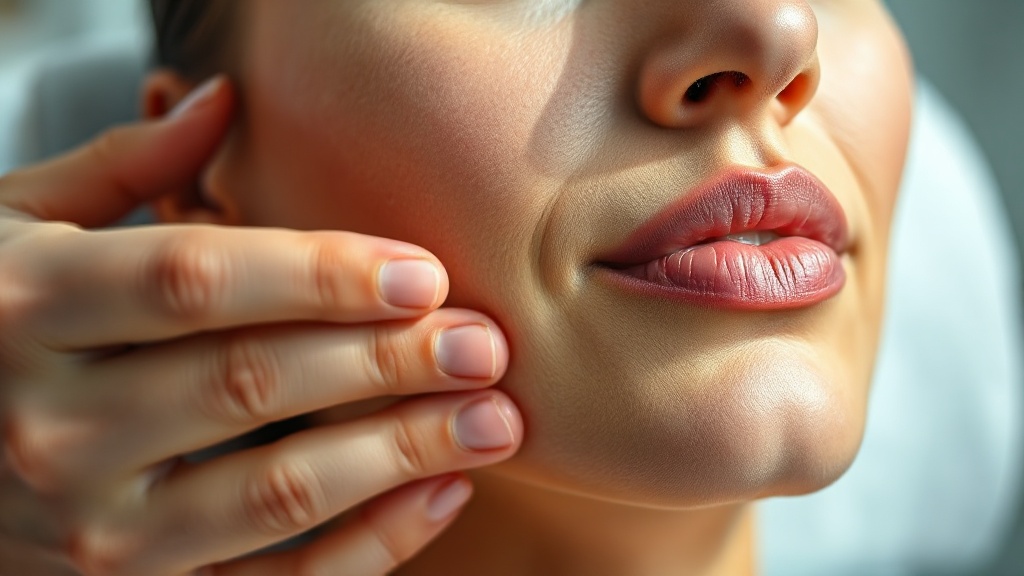
Manual therapy of the jaw and neck is hands-on and gentle — it eases muscle guarding and restores comfortable movement, rather than forcing the joint.
What the research actually shows
Every claim below maps to a named, peer-reviewed source in the Sources section. According to PubMed.
| Claim | Evidence | Source |
|---|---|---|
| Therapist-assisted jaw mobilisation and manual trigger-point therapy were among the most effective treatments for chronic TMD pain, beating sham by a risk difference of 36% and 32%. | Network meta-analysis of 153 RCTs / 8,713 patients. | Yao & Busse et al., BMJ 2023 |
| Jaw exercise therapy significantly reduced TMD pain (SMD -0.58) and improved maximum mouth opening. | Systematic review and meta-analysis, 16 RCTs / 812 participants. | Idanez-Robles et al., Clin Rehabil 2023 |
| Exercise therapy and occlusal splints both improved painful TMD, with no clear superiority of one over the other. | Systematic review and meta-analysis comparing exercise vs splint. | Zhang et al., Ann Palliat Med 2021 |
| Dentist-prescribed self-care (education, jaw rest, thermal packs, gentle exercise) equalled hard and soft splints at 3, 6 and 12 months. | Randomised controlled trial of 200 TMD patients. | Truelove et al., JADA 2006 |
| Manual therapy combined with active exercise, including neck-directed techniques, produced clinically meaningful jaw-pain reduction versus standard care. | Foundational systematic review and meta-analysis. | Armijo-Olivo et al., Phys Ther 2016 |
The main physical-therapy tools, compared
| Approach | What it targets | How strong is the evidence? |
|---|---|---|
| Supervised jaw exercise and stretching | Pain, jaw mobility and physical function | Moderate certainty; improves function and opening |
| Manual therapy (jaw and neck mobilisation) | Pain and comfortable mouth opening | Moderate certainty; among the most effective for pain |
| Guided home self-care and education | Overall symptoms and flare management | Strong and foundational; matched splints in an RCT |
| Trigger-point therapy or dry needling | Tight, tender jaw and cheek muscles | Moderate but mostly short-term |
| Clinic modalities (laser, TENS) | Short-term symptom relief | Weaker and dose-dependent; an add-on, not a core |
Why the neck matters as much as the jaw
One of the most useful insights in modern TMD care is that the jaw rarely acts alone. The nerves that carry sensation from the face and the upper neck converge on the same brainstem relay, so an irritated neck can amplify jaw pain and vice versa. In practice, studies find that the presence of neck pain, rather than the exact geometry of your posture, is what tracks with jaw symptoms, and adding cervical manual therapy reliably lowers pain and raises the pressure threshold at the masseter. That is why a thorough program treats the neck, shoulders and posture, not just the jaw. It also helps to be honest about the timeline and the ceiling. No single therapy is uniformly superior, and reviews going back years conclude that most TMD symptoms improve without invasive treatment; passive gadgets such as at-home laser or electrical stimulation can take the edge off in the short term but are dose-dependent and best treated as extras. Expect a gradual arc measured in weeks, not days: a typical course runs several sessions over roughly six weeks, with home exercises doing much of the real work between visits. Consistency, not intensity, is what moves the needle.
Evidence you can act on.
Occasional emails — new research, new protocols, no noise.
How a TMJ physical-therapy program usually unfolds
This is a general picture of what conservative, comfort-focused jaw care looks like — not a prescription. Get assessed first, and stop anything that sharply increases pain.
- 1
Start with an assessment, not an exercise
before anything elseSee a dentist, TMJ-focused physiotherapist or specialist so the cause is identified and serious problems are ruled out. Clinicians use a validated screening framework (the DC/TMD) to sort muscle-driven from joint-driven pain, and the right exercises depend on which you have.
- 2
Gentle, controlled jaw movements
a few minutes, twice dailySlow, pain-free opening and closing, light resisted movements and relaxed-tongue positioning help restore range and calm the muscles. Keep everything within a comfortable zone. If a movement provokes sharp pain or clicking that hurts, ease off rather than pushing through.
- 3
Posture and the neck
woven through the dayChin tucks, gentle neck mobility and screen-height fixes reduce the cervical load that feeds jaw pain. Because treating the neck helps the jaw, this is a core part of the program and not an optional add-on.
- 4
Warmth, soft foods and rest during flares
as neededMoist heat, a softer diet, and letting the jaw rest give irritated tissues room to settle. Avoid wide yawning, gum, hard or chewy foods and clenching while things calm down.
- 5
Consistency over force
about 4 to 6 weeksThe evidence favours coping and steady movement over aggressive fixes. Do the small daily work, track your comfortable opening, and give it a few weeks. If there is no improvement, return to your clinician to reassess rather than doubling the intensity.

Home exercises do most of the real work between visits — small, pain-free movements done consistently, never forced.
Physical therapy is first-line, low-risk care, but it is not a substitute for a diagnosis. See a dentist, TMJ specialist or doctor if your jaw locks open or closed, if pain is severe or steadily worsening, if it is concentrated on one side and persistent, if you have swelling, fever, numbness, or a sudden change in how your teeth meet, or if home care brings no improvement after a few weeks. These signs warrant an in-person assessment to rule out other causes.
Frequently asked questions
Sources
- 1.
- 2.
- 3.
- 4.
- 5.
- 6.
- 7.
- 8.
- 9.

Fix your breath at the source.
The complete science-backed protocol — engineered to eliminate volatile sulfur compounds at the biological source.
Start the Breath Protocol →Related reading
Educational purposes only. The content on this page is not medical advice and is not a substitute for consultation with a qualified dental or medical professional.
More from the library
 Guides8 min
Jaw Exercises for Tension and Comfort
A calm, honest guide to jaw exercises that ease tension and improve movement, plus the honest limits of what they can and cannot change.
Read →→ Guides9 min
Home Remedies for TMJ: 9 Natural Ways to Relieve Jaw Pain at Home
Simple at-home self-care, soft foods, warmth, gentle movement and load reduction, can genuinely ease TMJ jaw discomfort for many people.
Read →→ Answers8 min
How to Relax Your Jaw (Simple Techniques That Actually Help)
Quick, everyday techniques to release a tense, clenched jaw, and the simple resting cue worth remembering.
Read →→ Guides9 min
TMJ Disorder: The Complete Guide
What TMJ disorder really is, how common it is, and the conservative-care-first path most people never hear about.
Read →→ Guides8 min
Jaw Relaxation Exercises: A Step-by-Step Comfort Guide
A step-by-step down-regulation routine for a tight, clenched jaw, built on gentle relaxation rather than force.
Read →→ Guides9 min
Does Mewing Actually Work? An Honest, Evidence-Based Breakdown
The honest, evidence-based answer to whether tongue posture can reshape an adult jaw — what the research really shows, and why forcing it can backfire.
Read →→