
Periodontitis: What It Is, Its Stages, and How It Is Managed
An honest, evidence-based guide to periodontitis: what it does to bone and attachment, how dentists stage and grade it, and why professional care is the non-negotiable core of managing it.
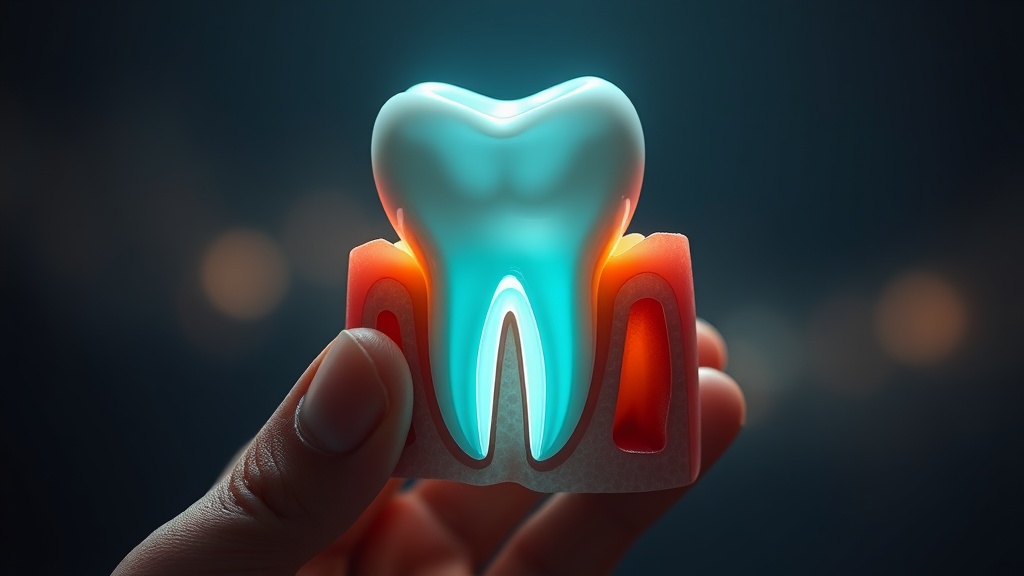
- Periodontitis is a serious, common gum disease in which chronic inflammation destroys the bone and fibres that anchor your teeth to your jaw. Unlike early gum inflammation, that lost attachment does not grow back.
- It is not rare. An estimated 1.07 billion people worldwide have severe periodontitis, and more than a third of US adults over 30 have some form of the disease.
- Dentists measure periodontitis in stages (I to IV) by how much attachment and bone are already lost, and grade it (A to C) by how fast it is progressing.
- Periodontitis is manageable, not curable. Scaling and root planing, ongoing maintenance, and sometimes surgery can halt it and hold your teeth for decades, but the goal is control, not regrowth.
- Home brushing, cleaning between teeth, and supportive products keep the gum environment healthier, but they cannot reach the hardened deposits deep inside a pocket. They support professional care; they never replace it.
Periodontitis is an advanced, irreversible gum disease in which bacterial biofilm drives chronic inflammation that destroys the bone and connective tissue holding teeth in place. It cannot be cured or reversed at home, but a dentist or periodontist can arrest it with deep cleaning and regular maintenance, and well-managed patients keep their teeth for life.
What periodontitis actually is
Periodontitis begins where gingivitis leaves off. A sticky film of bacteria, called biofilm or plaque, collects at and below the gumline. In gingivitis, that biofilm irritates the gum and it becomes red, swollen and prone to bleeding, but nothing structural is lost yet, and the situation is fully reversible. Periodontitis is the point at which the inflammation stops being a surface problem. The body mounts a sustained immune response to the bacteria wedged under the gum, and, over months and years, that response begins to dissolve the very tissues it is trying to defend: the periodontal ligament fibres that lash each tooth to the socket, and the alveolar bone that forms the socket itself. As those anchors recede, the shallow groove around the tooth deepens into a pocket that traps still more biofilm, and the cycle feeds itself. Leading consensus reports describe periodontitis plainly as a ubiquitous and irreversible inflammatory condition: the inflammation can be controlled, but the bone and attachment already lost are not regained.
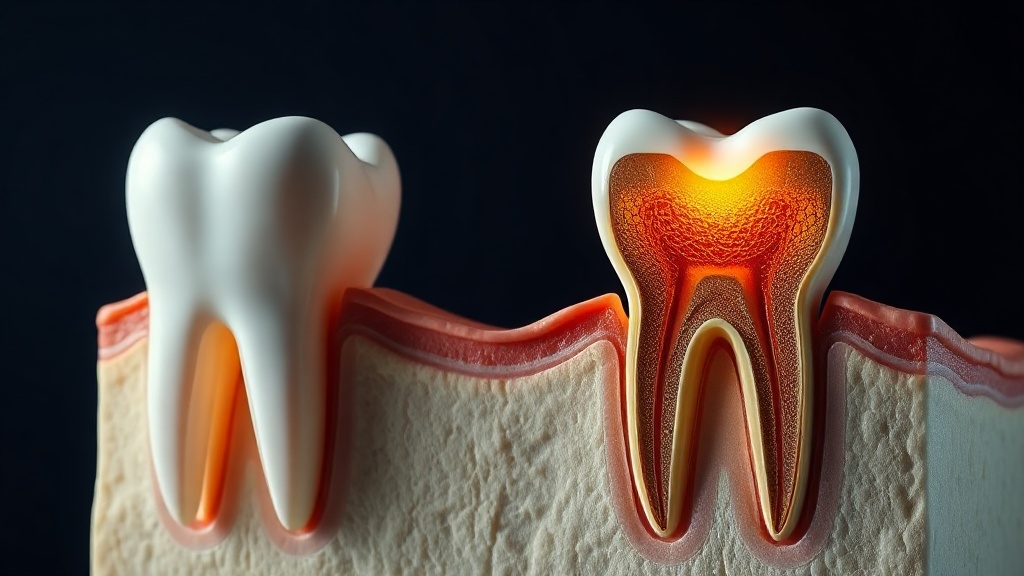
In periodontitis the supporting bone and fibres are destroyed and the pocket deepens — a structural loss the body does not rebuild.
What the research actually shows
Every claim below maps to a named, peer-reviewed source in the Sources section. According to PubMed.
| Claim | Evidence | Source |
|---|---|---|
| An estimated 1.07 billion people have severe periodontitis worldwide, and prevalence has not fallen in 30 years. | Global Burden of Disease modelling of severe periodontitis and edentulism. | Nascimento GG et al., GBD 2021 |
| More than 35% of US adults aged 30 and over have periodontitis, and 53.1% show attachment loss of at least 3 mm. | Large US national survey of periodontal status. | Albandar JM et al., NHANES III |
| Periodontitis is irreversible: a treated patient becomes periodontitis on a reduced periodontium, with inflammation controlled but lost bone and attachment not regained. | EFP consensus and 2017 World Workshop classification. | Chapple ILC et al., 2015; Papapanou PN et al., 2017 |
| Professional subgingival instrumentation reduces pocket depth by about 1.4 mm and closes roughly 74% of pockets. | Systematic review and meta-analysis of subgingival instrumentation. | Suvan J et al., 2020 (EFP) |
| A residual pocket of 7 mm or deeper after therapy raises the odds of losing that tooth by up to roughly 64-fold. | 11-year cohort of treated periodontitis patients. | Matuliene G et al., 2008 |
How periodontitis is staged
| Stage | What has been lost | Typical clinical picture |
|---|---|---|
| Stage I (initial) | Earliest attachment loss, around 1–2 mm | Shallow pockets, bleeding, no tooth loss from the disease |
| Stage II (moderate) | 3–4 mm of attachment loss, bone loss in the coronal third of the root | Pockets up to about 5 mm, mostly horizontal bone loss |
| Stage III (severe) | 5 mm or more of attachment loss, bone loss to mid-root, up to 4 teeth may be lost | Deep pockets of 6 mm or more, furcation involvement |
| Stage IV (advanced) | Extensive loss with 5 or more teeth lost and bite or chewing function compromised | Needs complex rehabilitation as well as disease control |
Why it can be managed but not cured
The word cure implies putting things back the way they were, and that is exactly what periodontitis will not allow. Once bone and ligament are gone, treatment does not grow them back; it removes the bacterial cause, calms the inflammation, and stabilises what remains. Clinicians describe a successfully treated patient as having periodontitis on a reduced periodontium: fewer supporting structures than an untreated healthy mouth, but no longer actively breaking down. That distinction matters enormously, because a stabilised, reduced periodontium can serve you for the rest of your life. The natural history studies make the stakes clear. In an untreated population followed for decades, the fastest progressors lost all their teeth by their mid-forties. Yet in a landmark 30-year programme combining professional care with disciplined home cleaning, patients lost on average well under two teeth across the entire study, and progression of the disease was essentially halted. The message is not that damage can be undone, but that further damage can be stopped — and that is a goal worth everything.
Evidence you can act on.
Occasional emails — new research, new protocols, no noise.
How periodontitis is managed
None of the steps below is a home cure. Periodontitis is a disease that requires professional diagnosis and treatment; the home measures exist only to support that care between visits.
- 1
Get a professional diagnosis first
one appointmentA dentist or periodontist measures the depth of the pocket around every tooth, checks for bleeding, and takes X-rays to see the bone level. From this they assign a stage and grade. You cannot self-diagnose periodontitis, and you should never assume a home product has handled it.
- 2
Scaling and root planing
1–2 visitsThis professional deep clean removes biofilm and hardened calculus from the root surfaces below the gumline — the deposits a toothbrush physically cannot reach. It is the core, non-substitutable therapy for periodontitis and, on its own, closes about three-quarters of pockets.
- 3
Commit to periodontal maintenance
every 3–4 monthsPeriodontitis is a chronic condition, so it needs ongoing supervision rather than a single fix. Regular maintenance cleanings keep pockets shallow and catch any recurrence early. Under this kind of regular care, patients typically lose only about one tooth every ten years, and many lose none.
- 4
Consider surgery for deep pockets that remain
as advisedWhere deep pockets persist after non-surgical care, a periodontist can fold back the gum to clean and reshape the root and bone, or in places use regenerative techniques. This is a decision for a specialist, based on your own charts and X-rays.
- 5
Control the risk factors you can change
ongoingSmoking nearly doubles the risk of progression and blunts how well treatment works, so quitting is one of the highest-value moves you can make. Managing diabetes matters too, as blood-sugar control and gum health influence each other in both directions.
- 6
Support the mouth daily at home
twice dailyBrushing thoroughly, cleaning between the teeth, and using supportive rinses lower the overall bacterial load and keep the gum environment healthier. Be honest about the limit: this maintains the surroundings and supports professional results, but it cannot remove calculus already lodged deep in a pocket.
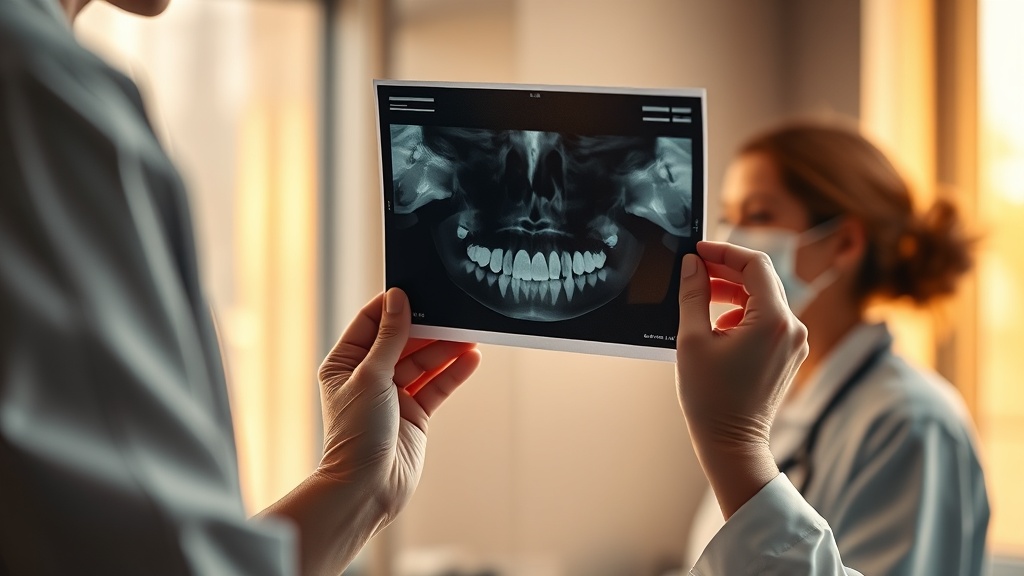
Only a dentist or periodontist can reach and remove the subgingival deposits that drive periodontitis — home care cannot substitute for that.
If your gums bleed regularly, feel tender or look like they are pulling away from your teeth, if a tooth feels loose, or if you notice persistent bad breath or a bad taste, book a dental assessment rather than reaching for a home remedy. Periodontitis is diagnosed by probing and X-rays, and the earlier it is staged and treated, the more of your bone and attachment you keep. If you already have deep pockets, ask specifically about seeing a periodontist.
Frequently asked questions
Sources
- 1.
- 2.
- 3.
- 4.
- 5.
- 6.
- 7.
- 8.
- 9.
- 10.
- 11.

Fix your breath at the source.
The complete science-backed protocol — engineered to eliminate volatile sulfur compounds at the biological source.
Start the Breath Protocol →Related reading
Educational purposes only. The content on this page is not medical advice and is not a substitute for consultation with a qualified dental or medical professional.
More from the library
 Guides8 min
Periodontal Disease: The Full Spectrum, Explained
A clear, honest overview of periodontal disease as a spectrum: the difference between gingivitis and periodontitis, what the colloquial phrase gum disease misses, and why early bleeding is the signal to act.
Read →→ Guides8 min
Periodontal Pockets: How They Are Measured and Reduced
A precise, honest explainer of periodontal pockets: how they form, how a dentist measures probing depth, what the millimetre numbers mean, and why deep pockets are closed by professional care rather than any rinse or paste.
Read →→ Answers8 min
Can Receding Gums Grow Back? The Honest Answer
It is the question everyone with recession asks. The straight answer, and what you can realistically do instead.
Read →→ Guides8 min
How to Stop Receding Gums: What Actually Slows It
You cannot will your gum line back up, but you can often stop it from dropping further. Here is what the evidence supports.
Read →→ Guides8 min
Gum Disease Symptoms: The Early Warnings You Can Feel
The symptoms of gum disease you can feel and notice yourself, why bleeding comes first, and when a symptom means see a dentist now.
Read →→ Causes9 min
Swollen Gums During Pregnancy: Why It Happens
Why pregnancy makes gums swell, what is normal, and the safe steps to take with your dental and prenatal team.
Read →→