How to Unlock a Locked Jaw: Gentle Self-Relief
Calm, evidence-based ways to coax a recently stuck jaw open again — and the red flags that mean it is time to get help.

- A jaw that suddenly will not open or close all the way is usually the cushioning disc inside the jaw joint slipping out of position, or the surrounding muscles clamping down — not a broken bone. In recent, mild cases it can often be coaxed back gently.
- The heart of self-relief is relaxation, not force. Warmth, unclenching, and slow, small movements let the muscles let go so the joint can slide back on its own.
- Never wrench, pry, or force a stuck jaw. Aggressive pulling can bruise the joint, strain the muscles, or push a displaced disc further out of place.
- Some locked jaws are urgent. A jaw stuck wide open that will not close, one that locks after a blow or accident, or one with fever, swelling, or trouble swallowing needs same-day or emergency care.
- Gentle self-care can match costly appliances for everyday jaw trouble — but a jaw that keeps locking should be looked at by a dentist or jaw specialist to find out why.
A recently locked jaw often eases if you stop forcing it and help the muscles relax: unclench, apply gentle warmth, let the jaw hang loose, then make slow side-to-side and small opening movements until it releases. Do not pry it open. If it stays locked, is stuck wide open, or follows an injury, get professional help.
Why a jaw gets stuck
Your jaw joint — the temporomandibular joint, or TMJ — sits just in front of each ear, where the lower jaw meets the skull. Between the two bones is a small, soft cushion called the articular disc that glides forward and back as you open and close. A jaw locks when that smooth glide is interrupted. In the most common pattern, the disc slips forward and gets caught in front of the joint, so the jaw can only open partway before it jams — often called a closed lock. Less often, the jaw slides too far open and cannot drop back, leaving it stuck wide open. And sometimes nothing is wrong with the disc at all: the powerful chewing muscles simply spasm and guard, holding the jaw shut the way a cramped calf resists a stretch. Jaw-joint trouble is far more common than people assume — pooled research puts a temporomandibular sign or symptom in roughly 31% of adults, and disc-displacement problems are the single most frequent type. Knowing which pattern you are dealing with matters, because gentle self-help suits a muscle-guarded or a fresh, mild disc catch, while a jaw locked wide open or one that will not budge needs hands-on care.
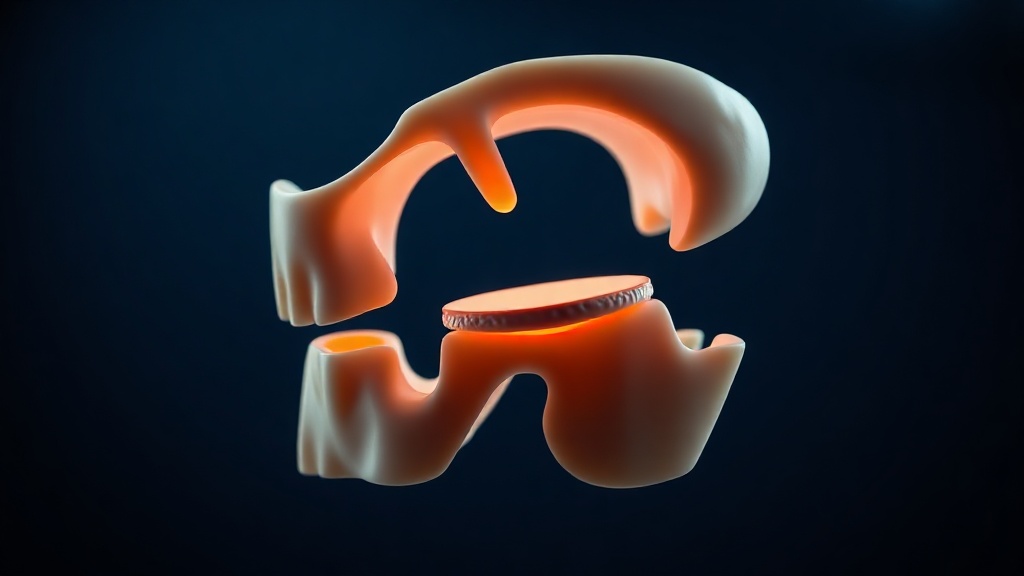
Inside the jaw joint, a soft disc cushions the bone and glides as you open and close; a locked jaw is that glide getting caught.
What the research actually shows
Every claim below maps to a named, peer-reviewed source in the Sources section. According to PubMed.
| Claim | Evidence | Source |
|---|---|---|
| About 31% of adults show a temporomandibular sign or symptom, and disc-displacement problems — the mechanism behind most locking — are the most common type. | Pooled systematic review and meta-analysis. | Valesan et al., 2021 |
| Dentist-guided self-care — gentle jaw rest, warmth, and easy movement — matched a custom hard splint and a soft mouthguard for jaw symptoms at 3, 6, and 12 months. | 200-person randomized controlled trial. | Truelove et al., 2006 |
| For ongoing jaw-joint pain, approaches that encourage coping and gentle movement work best; the 2023 guideline advises against relying on occlusal splints or botulinum toxin as first-line care. | GRADE clinical practice guideline. | Busse et al., 2023 |
| Jaw exercise therapy produced a moderate reduction in jaw pain across 16 randomized trials. | Meta-analysis, 812 participants (SMD -0.58). | de Melo et al., 2023 |
| Therapist-assisted jaw mobilization ranked among the most effective options for chronic jaw-joint pain in a 153-trial network analysis. | Network meta-analysis, 8,713 patients. | Yao/Busse et al., 2023 |
Which kind of locked jaw is it?
| Pattern | What it feels like | What to do |
|---|---|---|
| Muscle guarding or spasm | Jaw feels clamped and tight, hard to open, but with no true catch; often after a long dental visit, stress, or clenching | Warmth and gentle relaxation usually ease it |
| Fresh closed lock (disc caught) | Opens only partway then jams, often after clicking that has recently stopped | Slow guided movements can sometimes free it; do not force |
| Locked wide open | Jaw is stuck open and will not close, often after a big yawn | Urgent — needs hands-on repositioning by a professional |
| After a blow or accident | Jaw will not move, looks misaligned, or is very painful after trauma | Emergency care — do not attempt self-relief |
When gentle self-help is right — and when it is not
The honest answer is that self-help has a narrow, sensible lane. It suits a jaw that is clamped by tense muscles, or a fresh, mild disc catch that has only just started jamming. In those situations the muscles are doing most of the holding, and giving them permission to relax — with warmth, unclenching, and unhurried movement — is often all it takes. What self-help cannot do is force a joint back into place. If your jaw has been locked for hours or days, if it is stuck wide open, if it will not move at all, or if the lock arrived with pain, swelling, fever, or after an injury, then prying and pulling will only cause harm. A jaw locked wide open in particular is a true dislocation that a clinician needs to reposition with a specific, trained maneuver — it is not a do-it-yourself job. It is also worth being clear-eyed about recurrence. A jaw that locks again and again is telling you something about the joint or your daytime habits, and the useful move there is not a cleverer home trick but a proper assessment by a dentist or jaw specialist, who can map out what is actually happening and guide longer-term care.
Evidence you can act on.
Occasional emails — new research, new protocols, no noise.
How to gently unlock a recently stuck jaw
These steps are for a jaw that has only recently become stuck and is not the result of an injury. Go slowly and stop the moment anything sharply hurts — the goal is to invite the muscles to release, never to force the joint.
- 1
Stop, breathe, and unclench
1-2 minutesThe first instinct is to keep straining against the lock, which only tightens the muscles holding your jaw shut. Instead, pause. Let your top and bottom teeth come apart, rest the tip of your tongue lightly behind your upper front teeth, and take several slow breaths. Dropping the shoulders and softening the face gives the jaw its best chance to settle.
- 2
Warm the joint and muscles
10-15 minutesHold a warm compress or a warm, damp cloth against the side of your face over the joint and the broad cheek muscle. Gentle heat increases blood flow and helps tight muscles let go, which is often exactly what a guarded jaw needs. Keep it comfortably warm, not hot.
- 3
Let the jaw hang and rest
a few minutesWith the muscles warmer, let your jaw hang loosely in a slightly open, relaxed position rather than holding it clenched or forcing it wide. Support your chin gently in your hand if that feels steadier. You are aiming for the loose, heavy feeling of a jaw doing no work at all.
- 4
Guide it with small, slow movements
a few minutesGently ease the lower jaw a little to one side, then the other, then try a small, unforced open-and-close. Some people find a fresh catch releases as the disc slides back. Keep every movement slow and within the range that feels easy — if it jams, ease off rather than pushing through.
- 5
Rest, soften your food, and reassess
the next day or twoOnce it eases, be kind to the joint: eat softer foods, avoid wide yawns and gum, and skip chewy or hard items for a day or two. If it does not release, keeps re-locking, or the discomfort grows, stop the home approach and arrange a professional assessment.

Gentle warmth over the joint and cheek muscle helps a clamped jaw relax — the calm first move before any movement.
Most muscle-guarded jaws ease with patience, but some situations need prompt, in-person care. Seek same-day or emergency help if your jaw is locked wide open and will not close, if it will not move at all, or if the locking followed a blow, fall, or accident. Also get seen quickly if a stuck jaw comes with fever, noticeable swelling, difficulty swallowing or breathing, or severe one-sided pain — these can signal an infection or another problem that home care cannot address. And if your jaw locks repeatedly, book a non-urgent visit with a dentist or jaw specialist: recurrent locking deserves a proper assessment rather than an endless series of home fixes.
Frequently asked questions
Sources
- 1.
- 2.
- 3.
- 4.
- 5.
- 6.
- 7.

Fix your breath at the source.
The complete science-backed protocol — engineered to eliminate volatile sulfur compounds at the biological source.
Start the Breath Protocol →Related reading
Educational purposes only. The content on this page is not medical advice and is not a substitute for consultation with a qualified dental or medical professional.
More from the library
 Guides8 min
How to Fix Lockjaw: Causes, Safe Steps, and When It's an Emergency
A jaw that will not open or close is not always the same problem, and some causes need urgent care rather than a home fix.
Read →→ Guides9 min
TMJ Flare-Up: How to Calm Jaw Pain Fast
What a TMJ flare is, why it happens, and the gentle, proven steps that calm jaw pain fastest — plus when to get help.
Read →→ Guides8 min
Jaw Tension: Why It Happens and How to Ease It
A tight jaw is usually an over-worked muscle, not a broken joint — here is what drives jaw tension and how to gently let it go.
Read →→ Answers8 min
How to Relax Your Jaw (Simple Techniques That Actually Help)
Quick, everyday techniques to release a tense, clenched jaw, and the simple resting cue worth remembering.
Read →→ Guides8 min
Jaw Relaxation Exercises: A Step-by-Step Comfort Guide
A step-by-step down-regulation routine for a tight, clenched jaw, built on gentle relaxation rather than force.
Read →→ Guides9 min
Does Mewing Actually Work? An Honest, Evidence-Based Breakdown
The honest, evidence-based answer to whether tongue posture can reshape an adult jaw — what the research really shows, and why forcing it can backfire.
Read →→