
Deep Cleaning Teeth Cost: What Drives the Price
Why a deep clean costs more than a regular clean, the real drivers, and how to avoid billing surprises.

- A deep cleaning (scaling and root planing) costs more than a regular cleaning because it is a different, more involved treatment: it works below the gumline, is usually numbed, is billed by area of the mouth, and often needs more than one visit.
- The biggest driver is how many quadrants are affected, since a deep clean is charged per quadrant; one or two areas cost far less than all four.
- Severity, whether a general practice or a periodontist does it, sedation, and optional add-ons such as a local antibiotic all move the total.
- A deep clean is usually filed under basic or periodontal benefits rather than preventive, so insurance often contributes but with limits, unlike a regular clean which is frequently fully covered as prevention.
- The real total includes the maintenance cleanings that follow; they are a recurring cost, and they are what keep the disease from returning after the deep clean.
Deep cleaning teeth cost is driven mainly by how many quadrants need treatment, since it is billed by area, plus severity, the provider, sedation, add-ons, and your insurance. It costs more than a regular clean because it treats disease below the gumline. Expect a range, ask for an itemised quote, and budget for the maintenance cleanings that follow.
Why a deep clean costs more than a regular clean
The first sticker shock with a deep cleaning is comparing it to the routine cleaning you are used to, which is often fully covered by insurance and feels almost free. It is worth understanding why the two are priced so differently, because they are genuinely different pieces of work. A regular cleaning polishes the teeth above the gumline; it is quick, needs no anaesthetic, and is classed as preventive care. A deep cleaning treats active gum disease below the gumline: it removes tartar cemented to the tooth roots inside gum pockets, is usually done under local anaesthetic, takes considerably longer, and is charged per quadrant of the mouth rather than as a single flat fee. So the single biggest driver of your total is simply how many quadrants are affected, someone needing one area treated pays a fraction of what someone needing all four does. Layered on top are severity (deep, tartar-heavy pockets take more time and sometimes more visits), who performs it, whether you choose sedation, and whether optional extras such as a local antibiotic are added. None of these is padding; each reflects real clinical work. But it does mean the honest answer to what does a deep clean cost is a range that only your own mouth can narrow down.
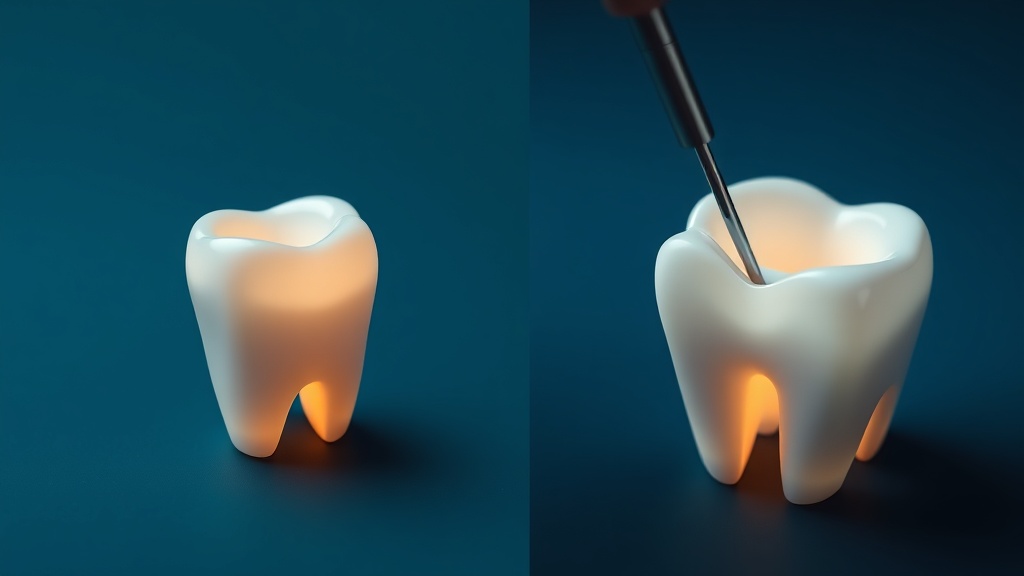
A deep clean is a bigger, below-the-gumline treatment billed by area, which is why it costs more than a polish.
The clinical facts behind the cost
Every claim below maps to a named, peer-reviewed source in the Sources section. According to PubMed.
| Claim | Evidence | Source |
|---|---|---|
| A deep clean reduces pocket depth by about 1.4 mm and closes roughly 74% of treated pockets, so it is a substantive treatment, not a premium polish. | European Federation of Periodontology systematic review. | Suvan et al., 2020 |
| Optional adjuncts such as local antibiotics or lasers add only 0.2 to 0.6 mm over the cleaning alone, so they are an add-on cost of limited extra benefit. | American Dental Association systematic review and meta-analysis. | Smiley et al., 2015 |
| A home toothbrush cannot reach tartar below the gumline, so a deep clean is a professional necessity rather than a discretionary upgrade. | Study of calculus removal by pocket depth. | Rabbani et al., 1981 |
| Leaving a deep pocket untreated sharply raises the odds of eventually losing that tooth, so skipping the deep clean can carry a much larger downstream cost. | Long-term cohort of residual pockets and tooth loss. | Matuliene et al., 2008 |
| With ongoing maintenance after treatment, tooth loss averages about 0.1 tooth per patient per year and most people lose none, so the recurring cost protects the result. | Systematic review of tooth loss during supportive care. | Carvalho et al., 2021 |
Regular clean versus deep clean: why the cost differs
| Feature | Regular clean | Deep clean |
|---|---|---|
| What it treats | Healthy gums, upkeep above the gumline | Active gum disease below the gumline |
| How it is billed | One flat preventive fee | Per quadrant of the mouth |
| Anaesthetic | Usually none | Usually local anaesthetic |
| Visits | One | Often one or two, split by area |
| Typical insurance category | Preventive, often fully covered | Basic or periodontal, often partly covered with limits |
Insurance surprises, and the true total
The most common billing shock with a deep clean is not the headline fee but how insurance handles it. A regular cleaning usually sits under preventive benefits, which many plans cover in full, so people expect the same treatment for a deep clean, and are caught out when it does not happen. Deep cleanings are typically filed under basic or periodontal benefits, which cover a percentage rather than the whole cost, and often cap how frequently the treatment can be repeated. That is why it pays to have the practice submit a pre-treatment estimate before you start, so you see your actual share and any limits in advance rather than after the fact. Two other things belong in your real total. First, the optional adjuncts: a local antibiotic placed into individual pockets can add up fast when billed per site, yet it adds only a small fraction of a millimetre over a thorough cleaning, so it is fair to ask whether it is essential for you. Second, the maintenance that follows, usually cleanings every three to four months, which is a recurring cost but the very thing that keeps the disease arrested. Weighed against the alternative, an untreated deep pocket that can eventually cost you the whole tooth, the deep clean plus maintenance is generally the economical choice, not the extravagant one.
Evidence you can act on.
Occasional emails — new research, new protocols, no noise.
How to get an accurate quote and avoid surprises
You cannot price a deep clean from an article, but you can make sure the quote is complete and there are no billing shocks later. This is about being an informed patient; the treatment itself is done by your dental team.
- 1
Get charted and ask to see the numbers
one visitPocket measurements and x-rays determine how many quadrants need treatment and how severe each is. Ask to see them; they justify the recommendation and shape the quote.
- 2
Ask how many quadrants and why
same visitBecause a deep clean is billed by area, the number of affected quadrants is the biggest driver. Confirm exactly how many are being treated, so the total is clear and comparable.
- 3
Separate essential from optional
same visitAsk which parts are the core cleaning and which are add-ons, such as sedation or a local antibiotic. Knowing what is optional lets you decide where the added spend is justified in your case.
- 4
Get an insurance pre-estimate
before bookingHave the practice submit a pre-treatment estimate so you know your share and any frequency limits. This is where deep-clean billing surprises usually hide, so clear them up before you start.
- 5
Budget for maintenance
ongoingInclude the maintenance cleanings that follow, typically every three to four months. They are a recurring cost, but they are what protect the deep clean and keep the disease from coming back.

A pre-treatment insurance estimate is where most deep-clean billing surprises get resolved.
No article or online figure can tell you what your deep cleaning will cost, because it depends on how many quadrants are affected and how severe the disease is, which only pocket charting shows. Book an assessment, ask for an itemised, quadrant-by-quadrant estimate, and have the practice submit an insurance pre-estimate. A trustworthy clinician will show you the measurements behind the recommendation and be clear about what is essential versus optional.
Frequently asked questions
Sources
- 1.
- 2.
- 3.
- 4.
- 5.

Fix your breath at the source.
The complete science-backed protocol — engineered to eliminate volatile sulfur compounds at the biological source.
Start the Breath Protocol →Related reading
Educational purposes only. The content on this page is not medical advice and is not a substitute for consultation with a qualified dental or medical professional.
More from the library
 Guides8 min
Deep Cleaning Teeth: The Plain-English Guide
What a deep cleaning actually is, how it differs from a regular clean, and whether you really need one.
Read →→ Guides8 min
Scaling and Root Planing Cost: What Actually Drives the Price
The honest cost drivers behind scaling and root planing, how it is billed, and where insurance fits.
Read →→ Guides8 min
Scaling and Root Planing: What It Is and What to Expect
What scaling and root planing does, why a toothbrush cannot replace it, and what to expect in the chair.
Read →→ Guides9 min
Gum Disease Treatment: The Professional Path and How Home Care Supports It
The evidence-based treatment path for gum disease, why professional care is non-negotiable, and how home habits support but never replace it.
Read →→ Guides8 min
Gum Disease Symptoms: The Early Warnings You Can Feel
The symptoms of gum disease you can feel and notice yourself, why bleeding comes first, and when a symptom means see a dentist now.
Read →→ Answers8 min
Can Receding Gums Grow Back? The Honest Answer
It is the question everyone with recession asks. The straight answer, and what you can realistically do instead.
Read →→