Does Mouth Tape Work?
The honest answer on nighttime mouth taping: the evidence is limited and low-quality, the benefits are oversold, and there is a genuine safety risk if you have undiagnosed sleep apnea.
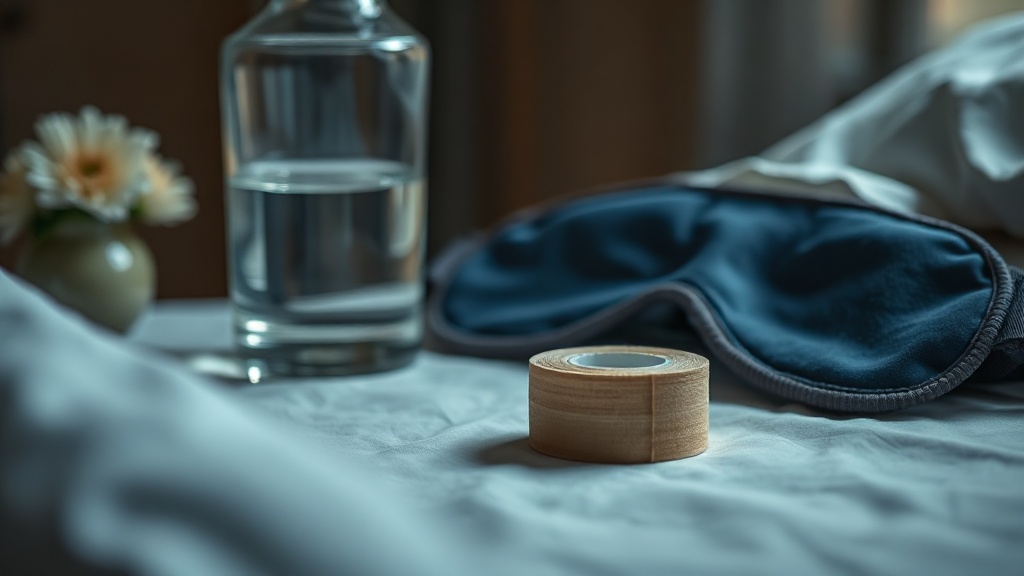
- The honest verdict: the evidence that nighttime mouth taping helps is limited and low quality — one systematic review found only two of ten studies showed any benefit.
- That same review flags a potentially serious risk of harm, including asphyxiation, if your nose is blocked or you have undiagnosed obstructive sleep apnea.
- The single most-cited positive study worked only in a small group of pre-screened, supervised mild-apnea mouth-breathers with no nasal obstruction — not the general public.
- Obstructive sleep apnea is common and diagnosable, and is confirmed by a sleep study, not by a phone app or by taping your mouth and hoping.
- If your goal is better nasal breathing, treating congestion and, where appropriate, myofunctional therapy have far better safety and evidence than a strip of tape.
Not really — at least not as a proven fix. The evidence that mouth taping improves sleep or breathing is limited and low quality, and the one systematic review of it warns of a serious risk of harm, including asphyxiation, if your nose is blocked or you have undiagnosed sleep apnea. It is not a substitute for a proper diagnosis.
What mouth taping claims to do — and what we actually know
The idea behind mouth taping is simple and, on the surface, appealing: seal the lips at night so you are forced to breathe through your nose, and in theory you get all the benefits of nasal breathing — less snoring, a less dry mouth, deeper sleep. Nasal breathing genuinely is the better default, and that grain of truth is why the trend spread so fast on social media. The problem is that forcing the mouth shut does not address why someone breathes through their mouth in the first place, and the evidence that a strip of tape delivers those promised benefits is remarkably thin. When researchers gathered the entire published literature on nighttime mouth taping, they found only ten studies, and just two of them showed any benefit. That is not a strong foundation for a habit being sold as a sleep transformation. Worse, most of those studies specifically excluded the people most likely to be harmed — those with nasal obstruction — so the evidence does not even speak to a large share of the people trying it at home. The reasonable reading is not that taping is magic, nor that it is universally dangerous, but that it is an under-tested hack being marketed with far more confidence than the data support.

The core danger: if the nose is blocked and the mouth is taped, there is no easy path for air.
What the research actually shows
Every claim below maps to a named, peer-reviewed source in the Sources section. According to PubMed.
| Claim | Evidence | Source |
|---|---|---|
| The entire evidence base for nighttime mouth taping is ten studies, only two of which showed benefit; the review warns of a potentially serious risk of harm, including asphyxiation with nasal obstruction. | Systematic review. | Rhee et al., 2025 |
| The most-cited positive result — apnea-hypopnea index falling from 8.3 to 4.7 — came only from 20 pre-screened, supervised mild-apnea mouth-breathers without nasal obstruction, with no control group. | Preliminary uncontrolled study. | Lee et al., 2022 |
| An estimated 936 million adults worldwide have obstructive sleep apnea, much of it undiagnosed — the exact population most endangered by sealing the mouth. | Global prevalence modelling. | Benjafield et al., 2019 |
| Sleep apnea is confirmed by a sleep study; guidelines recommend against diagnosing it from questionnaires or consumer apps — so you cannot safely rule it out before taping. | AASM clinical practice guideline. | Kapur et al., 2017 |
| For genuinely improving airway function, myofunctional therapy reduced adult apnea-hypopnea index by roughly 50% as an adjunct — a far better-evidenced route than tape. | Systematic review and meta-analysis. | Camacho et al., 2015 |
Mouth taping: the claim vs the reality
| The claim | What the evidence says |
|---|---|
| Forces healthy nasal breathing | Only if your nose is clear; if it is blocked, it forces no breathing at all |
| Cures snoring and sleep apnea | Not supported — apnea is a medical condition needing proper diagnosis and treatment |
| Backed by studies | Ten studies total, two positive, most excluding the highest-risk people |
| Safe because it is just tape | The one systematic review flags a serious risk of harm, including asphyxiation |
| Works for everyone | The one positive study screened out anyone with nasal obstruction first |
The safety line you should not cross
This is the part that matters more than any potential benefit. Obstructive sleep apnea is a condition in which the airway repeatedly narrows or closes during sleep, and it is far more common than most people realise — hundreds of millions of adults worldwide, a large fraction of whom have never been diagnosed. If you are one of them and you tape your mouth shut, you may be removing your body's backup route for air at exactly the moments it needs it. That is why the only systematic review of the practice does not treat asphyxiation as a distant theoretical concern; it lists it as a real risk. And because sleep apnea cannot be reliably diagnosed from a questionnaire or a phone app — it takes a proper sleep study — you cannot safely assume you are in the clear before taping. The people most drawn to mouth taping are often those who snore, wake unrefreshed, or notice a dry mouth: precisely the symptoms that should prompt a sleep assessment rather than a home seal. If you snore loudly, gasp or stop breathing in your sleep, or feel exhausted during the day, the honest and safe next step is a clinician, not a roll of tape.
Evidence you can act on.
Occasional emails — new research, new protocols, no noise.
If you are tempted to try it anyway, do this first
We are not endorsing mouth taping — the evidence does not support it and it carries a real risk. But if you are set on exploring nasal breathing at night, these steps put safety and the actual cause first.
- 1
Rule out sleep apnea properly
before anything elseIf you snore heavily, gasp, wake unrefreshed or have been told you stop breathing in your sleep, get a sleep assessment. Apnea is common, diagnosable and treatable — and it is the single situation where taping is most dangerous. This step is non-negotiable.
- 2
Make sure your nose actually works
ongoingTaping only makes sense if you can breathe comfortably through your nose. Treat allergies and congestion at the source first. If your nose is chronically blocked, taping does not help — it just removes your remaining airway.
- 3
Try the cause-first alternatives
weeksDaytime nasal-breathing practice, treating congestion, side-sleeping and, where indicated, myofunctional therapy all target why you mouth-breathe, with far better safety than a seal. These are where the real, better-evidenced gains are.
- 4
Never tape a child's mouth
—Children, anyone sedated or who has been drinking alcohol, and anyone with nausea or a blocked nose should never have their mouth sealed at night. The risk of not being able to clear the airway is simply too high.

Snoring, exhaustion or a dry mouth are cues to see a clinician — not to reach for tape.
Book a proper assessment rather than experimenting with tape if you snore loudly or habitually, if a partner has seen you gasp or stop breathing in your sleep, if you wake with headaches or feel exhausted despite a full night, or if you have any breathing or heart condition. These are the signs of possible obstructive sleep apnea, which is common, diagnosed with a sleep study, and very treatable once identified. A clinician can also check whether a blocked nose — not a lack of tape — is the real problem.
Frequently asked questions
Sources
- 1.
- 2.
- 3.
- 4.
- 5.
- 6.

Fix your breath at the source.
The complete science-backed protocol — engineered to eliminate volatile sulfur compounds at the biological source.
Start the Breath Protocol →Related reading
Educational purposes only. The content on this page is not medical advice and is not a substitute for consultation with a qualified dental or medical professional.
More from the library
 Guides8 min
Mouth Breathing: Why Nasal Breathing Wins, and How to Switch Back
Why your nose is built for breathing, what chronic mouth breathing does to your mouth and sleep, and the honest, gentle ways to shift the habit back.
Read →→ Guides8 min
Myofunctional Therapy: What It Is, What It Helps, and What It Cannot Do
A grounded guide to orofacial myofunctional therapy: real, modest evidence for snoring, mild sleep apnea and tongue-thrust — and an honest line on the jawline claims it cannot deliver.
Read →→ Guides8 min
Proper Tongue Posture: How to Rest Your Tongue Correctly
The calm, neutral resting position for your tongue, lips and jaw, explained honestly.
Read →→ Guides8 min
How to Stop Grinding Teeth in Your Sleep, Naturally
Grinding your teeth at night is an involuntary, arousal-driven movement — here is what natural care can and cannot do about it.
Read →→ Guides8 min
Jaw Relaxation Exercises: A Step-by-Step Comfort Guide
A step-by-step down-regulation routine for a tight, clenched jaw, built on gentle relaxation rather than force.
Read →→ Guides9 min
Does Mewing Actually Work? An Honest, Evidence-Based Breakdown
The honest, evidence-based answer to whether tongue posture can reshape an adult jaw — what the research really shows, and why forcing it can backfire.
Read →→