ProDentim Review for Bad Breath: Does It Actually Work?
Judging ProDentim on the one question that matters here: can an oral probiotic genuinely fresh your breath?
- Bad breath is mostly caused by volatile sulfur compounds (VSCs), gases made by anaerobic bacteria on the tongue; an oral probiotic tries to freshen breath by shifting that bacterial balance rather than by masking the smell.
- The oral-probiotic idea has real proof-of-concept for breath, but almost all of the strongest breath research is on one specific strain, Streptococcus salivarius K12, which is not the headline strain in ProDentim.
- Meta-analyses show oral probiotics can improve how breath is judged over a few weeks, yet their effect on measured sulfur gases is inconsistent, so the honest picture is early and modest, not settled.
- The breath-specific verdict: ProDentim may act as a short-term cosmetic adjunct for some people, but there is no breath trial of ProDentim itself, so treat any confident promise with caution.
- For fresher breath, the reliable levers are still tongue cleaning, flossing and hydration; a probiotic is something you add on top, not the thing that does the work.
ProDentim may give some people modest, short-term help with breath as part of a good routine, but the evidence is early. Oral probiotics can improve breath scores over a few weeks, yet their effect on the sulfur gases behind odour is mixed, and the strongest research is on K12, not ProDentim. Treat it as a cosmetic adjunct, not a cure.
Why breath odour is a bacteria problem
To judge ProDentim for bad breath specifically, you have to start with what causes the smell. The great majority of everyday bad breath comes from within the mouth, where anaerobic bacteria, mostly on the back of the tongue, break down proteins and release volatile sulfur compounds: hydrogen sulfide, methyl mercaptan and related gases. Those VSCs are what other people actually smell. Cosmetic control of bad breath therefore comes down to reducing the population of these odour-producing bacteria or interrupting the gases they make. This is exactly where an oral probiotic is supposed to fit. Instead of masking the smell with mint, the probiotic premise is to introduce friendly bacteria that compete with the odour-makers for space and nutrients, and in some cases produce compounds that suppress them, tilting the tongue community toward a fresher balance. It is a genuinely sensible mechanism. The open question is not whether the idea makes sense, but whether a given product delivers it in a real mouth over real time.

Breath odour starts on the tongue: VSC-producing bacteria are the target an oral probiotic is meant to crowd out.
What the breath research actually shows
Every claim below maps to a named, peer-reviewed source in the Sources section. According to PubMed.
| Claim | Evidence | Source |
|---|---|---|
| An early study of Streptococcus salivarius K12 found it could reduce oral malodour parameters, providing the first clear signal that an oral probiotic can influence breath, though from a small sample. | Study of S. salivarius K12 and oral malodour. | Burton et al., 2006 |
| The rationale for K12 rests on it being a naturally dominant, safety-assessed tongue strain that can occupy the same niche as odour-producing bacteria, which is why it became the reference oral probiotic for breath. | Characterisation of S. salivarius K12 as an oral probiotic. | Burton et al., 2005 |
| K12 shows antimicrobial activity against species implicated in oral malodour, offering a plausible biological route by which it may help control the bacteria behind VSCs. | Study of the antimicrobial activity of S. salivarius K12. | Masdea et al., 2012 |
| Across seven trials, probiotics reduced smell scores and VSCs in the short term (four weeks or less), but the VSC benefit did not persist beyond four weeks, pointing to a transient effect. | Systematic review and meta-analysis of probiotics for halitosis. | Huang et al., BMJ Open 2022 |
| A separate meta-analysis found probiotics improved smell scores but did not significantly cut measured VSC concentrations, and rated the evidence insufficient for firm recommendations. | Systematic review and meta-analysis of probiotics on halitosis. | Yoo et al., 2019 |
ProDentim for breath: promise vs evidence
| The breath question | What the evidence says | Honest verdict |
|---|---|---|
| Does it target the real cause (VSCs)? | The mechanism plausibly does; oral probiotics aim at odour bacteria | Right target, uncertain delivery for this product |
| Are its strains the breath-proven ones? | The breath research is mostly on K12, not ProDentim strains | Cannot borrow K12 results for ProDentim |
| Will it lower the sulfur gases? | Meta-analyses are mixed on VSC reduction | Possible short-term, not dependable |
| How long does any benefit last? | VSC benefit faded beyond four weeks in review | Likely transient; needs ongoing use |
| Can it replace tongue cleaning? | No evidence supports substitution | No; adjunct only |
The honest breath-specific verdict
Put the pieces together and a fair verdict emerges. The oral-probiotic approach is legitimately aimed at the true cause of bad breath, and there is real proof-of-concept that a well-chosen strain can help, but that proof is concentrated on Streptococcus salivarius K12, the strain built and safety-assessed specifically as a tongue-colonising breath probiotic. ProDentim is not a K12 product; it is a general oral-health blend, so it is simply not honest to promise it will match K12 breath studies. Layered on top of that, the broader meta-analyses agree on a modest, short-lived improvement in how breath is judged, while disagreeing on whether the sulfur gases themselves drop meaningfully, and no trial has tested ProDentim for breath at all. So the breath-specific answer is a qualified maybe: it could act as a short-term cosmetic adjunct for some people, and it is unlikely to do harm, but anyone selling it as a reliable cure for bad breath is ahead of the science. For the full ingredient-by-ingredient picture and the wider claims, see our fuller ProDentim review; here, the takeaway is narrower and firmer, treat it as a helper, never as the fix.
Evidence you can act on.
Occasional emails — new research, new protocols, no noise.
If you want to try ProDentim for breath
Give it a fair test without letting it become the whole plan.
- 1
Clean the tongue first
twice dailyBecause most breath odour lives in the tongue biofilm, scrape the back of the tongue morning and night. This is the single most reliable lever for fresh breath, and it gives any probiotic a cleaner surface to work on.
- 2
Keep the mouth moist
dailyA dry mouth concentrates odour bacteria, so sip water through the day and avoid drying alcohol rinses. Hydration supports the same balanced environment a probiotic is trying to encourage.
- 3
Add the probiotic consistently
dailyIf you trial ProDentim, take it as directed every day rather than sporadically, ideally after cleaning so friendly strains meet a fresher surface. Consistency is what gives an oral probiotic any chance to establish.
- 4
Test it for a set window
2 to 4 weeksMatch the timeframe used in probiotic breath research and hold the rest of your routine steady, so you can judge the probiotic on its own. Use a simple morning self-check or a trusted person for honest feedback.
- 5
Decide, and escalate if needed
ongoingKeep it only if your breath is genuinely fresher and the cost feels worth it. If odour persists despite clean habits, stop chasing supplements and see a dentist to rule out gum inflammation or dry mouth.
For breath, the probiotic is step three: cleaning and hydration come first, the supplement supports them.
If your breath stays bad despite thorough tongue cleaning, flossing and hydration, that is a signal to see a dentist rather than to buy a stronger supplement. Persistent odour can reflect gum inflammation, a dry mouth, or occasionally a cause outside the mouth, and a professional can find and address the real source instead of masking it.
Frequently asked questions
Sources
- 1.
- 2.
- 3.
- 4.
- 5.
- 6.

Fix your breath at the source.
The complete science-backed protocol — engineered to eliminate volatile sulfur compounds at the biological source.
Start the Breath Protocol →Related reading
Educational purposes only. The content on this page is not medical advice and is not a substitute for consultation with a qualified dental or medical professional.
More from the library
 Reviews9 min
ProDentim Reviews: An Honest, Evidence-Based Verdict
A no-hype look at the popular oral-probiotic supplement, and what the science does and does not support.
Read →→ Best Of8 min
The Best Oral Probiotics for Bad Breath
Oral probiotics aim to shift the balance of bacteria in your mouth toward fresher breath — here is which strains have the evidence and how to choose one.
Read →→ Ingredients7 min
S. salivarius K12: The Fresh-Breath Probiotic, Explained
The idea is not to sterilise your mouth. It is to repopulate it with the right bacteria.
Read →→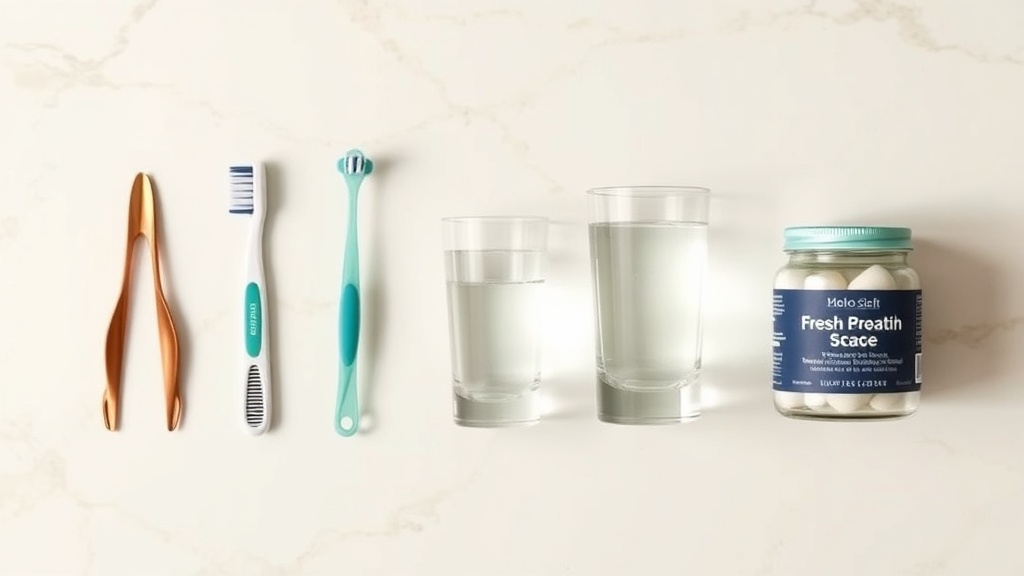 Guides9 min
How to Fix Bad Breath: A Practical, Step-by-Step Action Plan
The practical fix-it plan: four everyday moves — tongue, teeth, hydration, and microbiome — that target where bad breath actually starts.
Read →→ Guides8 min
How to Get Rid of Bad Breath Permanently: An Evidence-Based Plan
The honest version: "permanently" means ongoing control, not a one-time fix. Here is the daily routine the research actually supports, and when to get help.
Read →→ Guides7 min
Bad Breath Even After Brushing? The Biological Reason (and Fix)
You brushed, flossed and rinsed — and the smell is still there. The reason usually isn't hygiene; it's where the odour-causing bacteria actually live.
Read →→