Jawzrsize Review: Does This Jaw Exerciser Actually Work?
Jaw exercisers promise a chiselled jaw. The science says they enlarge the very muscle that widens a face - and can strain the jaw. Our honest, non-endorsing verdict.

- Jawzrsize is a silicone ball you bite against repeatedly - essentially resistance training for the masseter, the main chewing muscle. It does load and work that muscle.
- But there is no reliable evidence that resistance chewing sculpts, slims or sharpens the jawline. The best controlled chewing trial changed neither jaw-muscle thickness nor jaw shape.
- The bigger problem: if it does enlarge the masseter, that widens and squares the lower face - the opposite of the sharp jaw most buyers want. Clinics shrink this muscle to slim a jaw.
- Heavy, repetitive resistance chewing can fatigue the jaw muscle and strain the jaw joint, so for some people a device like this is more likely to cause ache than definition.
- Our honest verdict: not recommended as a jawline tool. The real levers for a defined jaw are body fat, bone structure and posture - and jaw pain belongs with a dentist, not a gadget.
No - we do not recommend Jawzrsize for a sharper jawline. It genuinely works the chewing muscle, but no study shows resistance chewing reshapes the jaw, and bulking that muscle actually widens the face. It can also strain the jaw joint. Save your money and effort for body fat, posture and, if needed, a dentist.
What Jawzrsize is and what it claims
Jawzrsize is a small silicone ball, usually sold in a few firmness levels, that you place between your teeth and bite against in fast repetitions. The marketing pitch is straightforward: work your jaw like any other muscle at the gym and you will build a stronger, more defined, more chiselled jawline. The first half of that is broadly true. The masseter - the thick muscle you can feel bulge when you clench - is an ordinary skeletal muscle, and repeatedly biting a springy resistance target is a real workout for it. Studies of hard-gum training confirm that this kind of loading raises your maximum bite force within a few weeks. The trouble is the leap from there to a sharper jawline. Building strength in a muscle is not the same as reshaping the face around it, and this is exactly where the product promise and the published evidence part ways. A stronger bite is not a sculpted jaw, and as the evidence below shows, making this particular muscle bigger tends to work against the very look the device is sold to deliver.
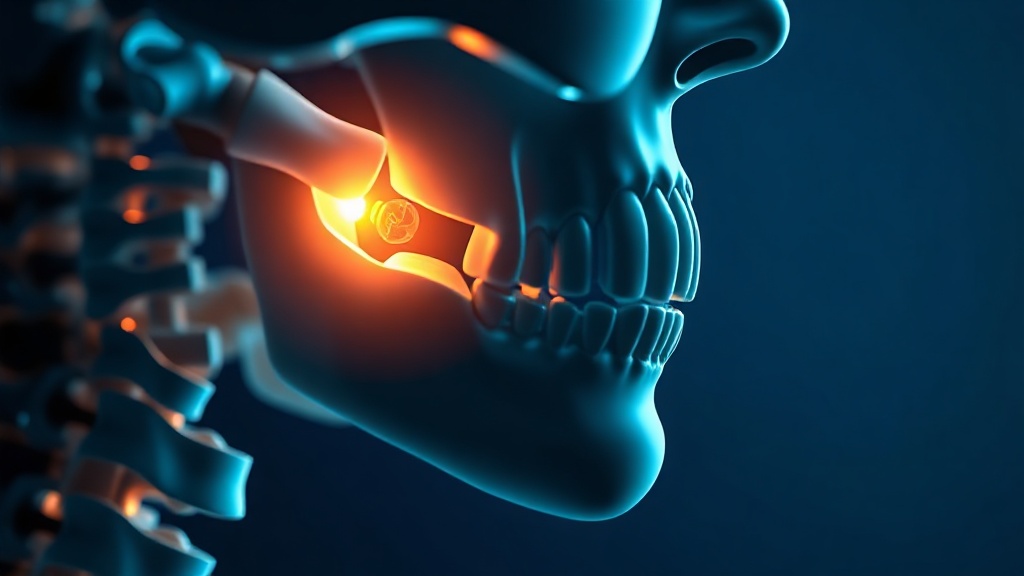
Repeated resistance chewing loads the jaw joint and can enlarge the masseter - which widens the jaw and, overdone, strains the joint.
What the research actually shows
Every claim below maps to a named, peer-reviewed source in the Sources section. According to PubMed.
| Claim | Evidence | Source |
|---|---|---|
| Resistance chewing does train the jaw muscle: four weeks of hard-gum work raised maximum bite force. | Controlled chewing-training study in 25 adults. | Kiliaridis et al., 1995 |
| But six months of chewing training changed neither masseter muscle thickness nor jaw shape - no sculpting effect. | Randomised controlled trial in 58 adults. | Jung et al., 2024 |
| A thicker masseter is linked to a wider, shorter, more square lower face - so bulking it works against a sharp jaw. | Ultrasound and facial-morphology study of 329 individuals. | Raadsheer et al., 1996 |
| To slim the lower face, cosmetic medicine shrinks the masseter with botulinum toxin, reducing width by about 5 mm - the opposite of the device. | Phase 3 randomised placebo-controlled trial. | Sun et al., 2026 |
| Ten minutes of one-sided resistance chewing raised masseter activity over a thousand per cent and fatigued the muscle in most people. | Surface EMG study of eight adults. | Christensen et al., 1996 |
The claims vs the evidence
| Claim made for jaw exercisers | What the evidence shows | Verdict |
|---|---|---|
| Sculpts a sharper, defined jawline | No trial shows resistance chewing reshapes the jaw; a 6-month chewing RCT changed neither muscle thickness nor jaw shape | Not supported |
| Builds an impressive, chiselled jaw | Heavy use can enlarge the masseter - but a bigger masseter widens and squares the face | Backfires |
| A natural alternative to surgery or injections | Cosmetic medicine slims jaws by shrinking that muscle, the exact opposite of the device | Contradictory |
| A safe daily jaw workout | Repetitive resistance chewing can fatigue the muscle and strain the jaw joint | Use caution |
| Works for everyone | It cannot touch the jawbone; genetics and body fat drive jaw definition | Overstated |
The core problem: it bulks the wrong thing
The honest issue with jaw exercisers is not that they do nothing - it is that what they do runs opposite to what buyers want. Enlarge the masseter and you widen the lower face, because that muscle sits right at the jaw angle and pushes the outline outward. Morphology studies tie a thicker masseter to a broader, squarer face, and the entire cosmetic approach to a slimmer jaw is built on shrinking this muscle: aesthetic clinics inject botulinum toxin precisely to make an overgrown masseter smaller, trimming measurable millimetres off lower-face width. A jaw exerciser is trying to do the reverse. There is also a comfort and safety angle. Repetitive heavy resistance chewing is a large load for the jaw system - one experiment saw masseter activity climb well over a thousand per cent during a short bout of one-sided chewing, with most participants reporting fatigue. Chronic jaw overload is the same pattern seen in bruxism, which is strongly associated with an enlarged masseter and jaw-joint strain. For someone prone to clenching or jaw tension, a device that encourages more forceful, repetitive biting is a poor idea. And it is worth noting there is not even solid trial evidence for shrinking an oversized masseter medically, let alone for growing one to improve looks - the evidence base this product leans on simply is not there.
Evidence you can act on.
Occasional emails — new research, new protocols, no noise.
If you are still curious, here is the honest guidance
We do not recommend a jaw exerciser as a jawline tool, but if you already own one, treat it as muscle training with real limits - not a shortcut to a sharper face.
- 1
Know what you actually bought
-It is a muscle resistance tool, not a bone-sculpting device. It can strengthen your bite. It cannot reshape your jawbone, and it will not slim your face - if anything it nudges the masseter toward bulk, which reads as wider.
- 2
Do not overdo it
a few minutes at mostIf you use it at all, keep sessions short and gentle, alternate sides evenly, and stop well before the muscle feels tired. Long, forceful, one-sided sessions are exactly the pattern most likely to fatigue and strain the jaw.
- 3
Stop at any pain, clicking or ache
immediatelyJaw pain, clicking, locking, morning soreness or headaches are red flags, not signs it is working. If any of these show up, put the device away and check in with a dentist before doing more.
- 4
Put your energy where it counts
weeks to monthsFor a genuinely more defined jaw, lower your overall body fat, fix your head-and-neck posture, and look after your skin. Those levers work with your anatomy instead of straining it, and they carry no risk of widening the jaw.
- 5
Consider returning it
-If a sharper jawline is the whole reason you bought it, the honest move is to send it back. The evidence points the other way, so the money is better spent elsewhere - or saved.

A resistance chewing ball is a real workout for the jaw muscle - but strengthening that muscle is not the same as sculpting the jaw.
If using a jaw exerciser brings on jaw pain, clicking, locking, morning soreness or headaches, stop and see a dentist or a jaw (TMJ) specialist. Jaw-muscle and joint problems are common - about a third of adults report a jaw sign or symptom, and roughly one in five clench or grind - and they are managed with gentle conservative care, not by loading the jaw harder. A device that increases forceful, repetitive biting can make a sensitive jaw worse.
Frequently asked questions
Sources
- 1.
- 2.
- 3.
- 4.
- 5.
- 6.
- 7.
- 8.
- 9.

Fix your breath at the source.
The complete science-backed protocol — engineered to eliminate volatile sulfur compounds at the biological source.
Start the Breath Protocol →Related reading
Educational purposes only. The content on this page is not medical advice and is not a substitute for consultation with a qualified dental or medical professional.
More from the library
 Guides8 min
Does Chewing Gum Help Your Jawline? An Honest, Evidence-Based Answer
Gum-chewing gets sold as a jawline hack. The evidence says it trains bite force, not bone - and pushed too far it can bulk and ache the very muscle you are trying to define.
Read →→ Guides8 min
How to Get a Sharper Jawline: What Works and What Does Not
The jawline advice online is mostly hype. Here is what genuinely changes how defined your jaw looks, what does nothing, and where the real (sometimes medical) levers are.
Read →→ Guides9 min
Does Mewing Actually Work? An Honest, Evidence-Based Breakdown
The honest, evidence-based answer to whether tongue posture can reshape an adult jaw — what the research really shows, and why forcing it can backfire.
Read →→ Reviews9 min
Does Jawzrsize Actually Work? Evidence, Results, and Alternatives
The evidence-based verdict on the viral jaw exerciser — and why bulking your jaw muscle is the wrong direction.
Read →→ Guides8 min
Jaw Relaxation Exercises: A Step-by-Step Comfort Guide
A step-by-step down-regulation routine for a tight, clenched jaw, built on gentle relaxation rather than force.
Read →→ Guides8 min
How to Unlock a Locked Jaw: Gentle Self-Relief Steps
Calm, evidence-based ways to coax a recently stuck jaw open again — and the red flags that mean it is time to get help.
Read →→