
Signs of Gingivitis
The objective, clinically observable signs of gingivitis, explained so you understand what a dentist is actually assessing.

- Signs are what a clinician can observe and measure; they differ from symptoms, which are what you feel, and they let a dentist grade gum health objectively.
- The classic clinical signs of gingivitis are redness, swelling, a glossy surface where healthy gum is stippled, and bleeding when the gum is gently probed.
- Bleeding on probing is the benchmark professional sign, because gum bleeding is the most prevalent objective indicator of periodontal disease worldwide.
- Crucially, in gingivitis there is no loss of attachment or bone; when a dentist sees those, the diagnosis has moved to periodontitis, which is not reversible.
- Because signs can be subtle and painless, a professional examination is the reliable way to confirm gingivitis and to catch any progression early.
The clinical signs of gingivitis are red, swollen gum margins, a shiny surface that has lost its healthy stippled texture, and bleeding when the gum is gently probed. A dentist confirms it by checking for these while finding no loss of bone or attachment, the line that separates reversible gingivitis from periodontitis.
Signs versus symptoms, and why the difference matters
In clinical language, a symptom is something you experience, such as tenderness or a bad taste, while a sign is something a professional can observe or measure, such as bleeding when the gum is probed. Gingivitis is diagnosed on its signs, because they can be assessed objectively and scored the same way from visit to visit. When a dentist examines your gums, they are reading the tissue for the fingerprints of inflammation. Healthy gum is firm, pale pink and has a faintly dimpled, orange-peel texture called stippling. As plaque triggers inflammation, blood vessels widen and the tissue takes on the visible signs: it reddens, the margins swell and become rounded rather than knife-edged, the surface turns glossy as the stippling is lost, and the gum bleeds readily when touched with a probe. A dentist may record these using indices, essentially standardised scores for redness, swelling and bleeding, so change over time can be tracked. The reason this objectivity matters is that gingivitis is often painless: the tissue can be clearly inflamed on examination while feeling perfectly fine to you.
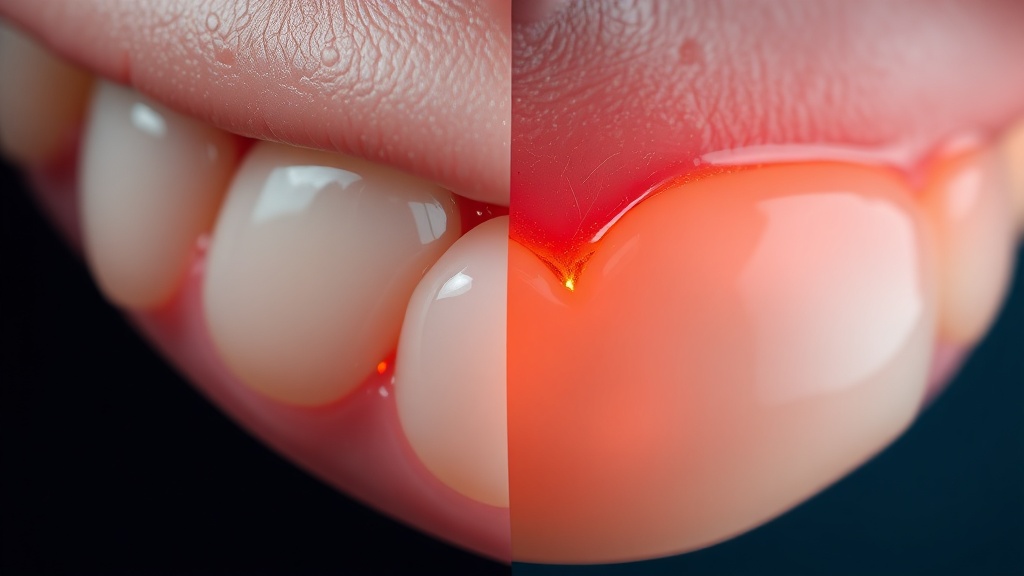
Loss of the healthy stippled texture and a rounded, glossy margin are among the objective signs a clinician reads as gum inflammation.
What the research actually shows
Every claim above maps to a named, peer-reviewed source listed in Sources. According to PubMed.
| Claim | Evidence | Source |
|---|---|---|
| Gum bleeding is the single most prevalent sign of periodontal disease worldwide, which is why bleeding on probing is a benchmark clinical indicator. | Global public-health review of periodontal disease. | Petersen & Ogawa, 2012 |
| In gingivitis, standardised indices for bleeding, gingival and plaque scores rise with plaque and return to baseline when plaque control resumes, with no attachment loss. | Experimental gingivitis clinical trial using clinical indices. | Wellappuli et al., 2017 |
| Gingivitis is reversible; the presence of lost bone and attachment marks the irreversible transition to periodontitis, a reduced periodontium. | 2017 World Workshop consensus on periodontitis. | Papapanou et al., 2017 |
| About one in three people are high responders whose gingiva over-inflames to the same plaque load, a sign flagging greater risk of progression. | Experimental gingivitis responder analysis. | Wellappuli et al., 2017 |
| Not all gingivitis progresses, and clinicians cannot reliably predict which cases will, which is the rationale for objective monitoring and universal prevention. | Review of gingivitis and periodontitis prevention. | Jin et al., 2011 |
Healthy gum signs versus gingivitis signs
| Clinical feature | Healthy gum | Gingivitis |
|---|---|---|
| Colour | Pale, uniform pink | Reddened, especially at the margins |
| Surface texture | Firm with stippled orange-peel dimpling | Smooth and glossy; stippling lost |
| Gum margin | Thin, knife-edge against the tooth | Rounded and swollen |
| Bleeding on probing | Absent | Present, often the earliest objective sign |
| Attachment and bone | Intact, no loss | Still intact, no loss (loss means periodontitis) |
The one sign that separates gingivitis from periodontitis
The most consequential thing a dentist checks is not any single sign of inflammation but whether the supporting structures have been lost. In gingivitis, all the visible signs of inflammation can be present, yet the attachment holding the tooth and the underlying bone are entirely intact. The moment a clinician measures a genuine loss of attachment, or sees bone loss on an x-ray, the picture is no longer gingivitis but periodontitis, a reduced periodontium, and that structural loss cannot be reversed. This is why a proper examination looks beyond redness and bleeding to probing depths and attachment levels. It is also why professional monitoring matters even when everything looks mild. Research shows that roughly one in three people are high responders whose gums inflame more strongly to the same plaque, and that clinicians cannot reliably predict which cases of gingivitis will progress. Reading the objective signs over time is how a dentist distinguishes stable, reversible inflammation from the early creep toward permanent loss, long before you would notice anything yourself. The signs, in other words, are an early-warning system that only a professional can fully interpret.
Evidence you can act on.
Occasional emails — new research, new protocols, no noise.
How the signs are assessed and improved
The signs of gingivitis are best assessed by a professional and improved by controlling the plaque that drives them. These habits support gum health between visits; they are not a substitute for a clinical examination.
- 1
Get a professional gum examination
at your check-upA dentist or hygienist checks colour, swelling, stippling and bleeding on probing, and measures around teeth to confirm there is no attachment loss. This is the only way to read all the signs accurately and to grade your gum health objectively.
- 2
Have hardened tartar removed
as advisedCalculus at and just below the gumline sustains the inflammation that produces the signs, and only a professional can remove it. Clearing it gives the tissue the conditions to return toward the healthy end of every index.
- 3
Lower plaque with strong daily technique
2 minutes, twice dailyAngled gumline brushing plus daily interdental cleaning reduces the plaque driving redness, swelling and bleeding. Consistent technique, not occasional intensity, is what moves the signs in the right direction.
- 4
Reduce factors that amplify the response
ongoingNot smoking and keeping conditions such as diabetes well controlled help the gums react less strongly to plaque. Smoking can also mask bleeding, hiding a sign that would otherwise prompt earlier care.
- 5
Re-check the signs over time
at follow-up visitsBecause signs can be tracked with indices, follow-up lets a clinician confirm the inflammation is settling or catch any drift toward attachment loss early. Monitoring is the point, since not all gingivitis behaves the same way.

A gentle probe is how a clinician reads bleeding on probing and confirms whether attachment is intact, the sign that defines the diagnosis.
Because the signs of gingivitis can be present without any pain, a professional examination is the dependable way to detect and confirm them. See a dentist if your gums look red or swollen or bleed when brushed, and go promptly if you notice gums receding, teeth that feel loose or have moved, deep spaces opening between teeth and gums, or any pus. Those point to loss of attachment, which means the condition may have progressed to periodontitis and needs professional treatment without delay.
Frequently asked questions
Sources
- 1.
- 2.
- 3.
- 4.
- 5.
- 6.

Fix your breath at the source.
The complete science-backed protocol — engineered to eliminate volatile sulfur compounds at the biological source.
Start the Breath Protocol →Related reading
Educational purposes only. The content on this page is not medical advice and is not a substitute for consultation with a qualified dental or medical professional.
More from the library
 Guides8 min
Gingivitis Symptoms: What Early Gum Disease Feels Like
A patient-focused rundown of the symptoms of gingivitis you can notice yourself, and what each one is telling you.
Read →→ Answers9 min
What Does Gingivitis Look Like? A Visual Guide
A plain-language visual guide to recognising what gingivitis looks like, and how to tell it from healthy gums.
Read →→ Guides9 min
Gingivitis: Causes, Symptoms and How It Is Treated
The whole picture on gingivitis in one place, from plaque and bleeding to professional treatment and everyday gum-supporting habits.
Read →→ Guides8 min
Gum Recession Treatment: Every Option, Compared
The right treatment depends on why your gums receded and how far. Here is the full ladder, with what each rung can honestly deliver.
Read →→ Guides8 min
Gum Disease Symptoms: The Early Warnings You Can Feel
The symptoms of gum disease you can feel and notice yourself, why bleeding comes first, and when a symptom means see a dentist now.
Read →→ Answers8 min
Can Receding Gums Grow Back? The Honest Answer
It is the question everyone with recession asks. The straight answer, and what you can realistically do instead.
Read →→