Masseter Tension Relief: Easing a Tight, Overworked Jaw
The masseter is the powerful cheek muscle that closes your jaw; when it is overworked it gets tight — here is how to ease it, and why training it harder backfires.
- The masseter is the thick, powerful muscle across your cheek that closes the jaw; when it is overworked it becomes tight, tender, and fatigued — a comfort problem, not usually a sign of damage.
- It is the strongest muscular driver of your bite force, which is exactly why clenching, grinding, and heavy chewing tire it out so easily.
- Here is the honest part most jaw-gadget marketing skips: working the masseter harder does not carve a sharper jaw — over-training it can enlarge the muscle, which widens and squares the lower face rather than slimming it.
- Relief comes from doing less and softening more: warmth, gentle self-massage, jaw rest, and lowering the clench — self-massage is considered simple and safe, and eased muscle pain in studies.
- Topical menthol or a warm compress can feel soothing, but that is cooling comfort rather than true muscle relaxation — and a masseter that stays painful or tight needs a professional, not a harder workout.
The masseter is the cheek muscle that closes your jaw, and it gets tight when it is overworked by clenching, grinding, or heavy chewing. Gentle warmth, self-massage, and jaw rest ease most tension. Working it harder can enlarge and widen the muscle, so relief means doing less — and persistent pain needs a professional.
Why the masseter gets tight
Slide your fingertips onto your cheek, just in front of the earlobe, and clench gently — the slab of muscle that springs up is the masseter. For its size it is one of the strongest muscles in the body, and it is the single biggest muscular contributor to how hard you can bite. That power is the whole problem. A muscle built to generate force gets tired and tight when it is asked to hold force for hours: a day of low-grade clenching, a night of grinding, or a lot of tough chewing all keep it working long past the point where it should rest. Over time, heavy repeated use does to the masseter what training does to a bicep — it can thicken. People who grind regularly are far more likely to have visibly enlarged masseters, and even a short bout of one-sided gum chewing drives the muscle activity up many-fold and leaves most people measurably fatigued. So a tight masseter is usually not injured; it is overworked, and the first move is to unload it, not to train it.

The masseter fans from the cheekbone to the jaw angle — a powerful closer that thickens when it is overworked.
What the research actually shows
Every claim below maps to a named, peer-reviewed source in the Sources section. According to PubMed.
| Claim | Evidence | Source |
|---|---|---|
| The masseter is the single strongest muscular predictor of how hard a person can bite. | Cross-sectional study of masseter thickness and bite force. | Raadsheer et al., 1999 |
| A thicker masseter is associated with a wider, shorter, more square lower face — bulking the muscle does not slim the jaw. | Study of masseter thickness and facial morphology. | Raadsheer et al., 1996 |
| A 6-month gum-chewing trial raised bite force but did not increase masseter thickness or change jaw-bone shape — extra chewing does not reliably build a jawline. | Randomized controlled trial (n=58). | Jung et al., 2024 |
| People who grind are roughly 15 times more likely to have an enlarged (hypertrophied) masseter. | Analysis of bruxism-related muscle and jaw changes. | Popescu et al., 2025 |
| Self-applied jaw massage is described as simple and safe and eases muscle pain, though it acts more slowly than a clinician handling it. | Comparative study of jaw massage. | Gebska et al., 2023 |
What tightens the masseter — and what to do
| Cause | What it does to the muscle | What actually helps |
|---|---|---|
| Clenching and grinding | Holds the muscle contracted, so it fatigues and thickens over time | Unload it: rest, warmth, and catch the clench |
| Heavy or one-sided chewing | Spikes muscle activity many-fold and causes fatigue | Spread chewing to both sides; go easy on hard gum |
| Jaw-training gadgets and hard gum | Can enlarge the muscle, widening and squaring the lower face | Skip them for slimming — they do the opposite |
| Stress | Raises resting muscle tone and how often you clench | Lower the overall load; breathe and rest the jaw |
| Topical menthol or warmth | Feels soothing through a cooling effect, not true muscle relaxation | Fine for comfort — pair it with gentle massage |
Why training your jaw backfires
There is a whole market built on the opposite advice — chew this gum, squeeze this silicone ball, and you will sculpt a chiselled jaw. The evidence points the other way. In a controlled six-month chewing trial, bite force went up but masseter thickness and jaw-bone shape did not budge, so the muscle did not bulk on cue — and where heavy use does enlarge it, as in long-term grinders, the result is a wider, more square lower face, not a slimmer one. This is why cosmetic clinics spend serious effort shrinking the masseter with muscle-relaxing injections to soften a square jaw, the exact reverse of the jaw-gadget promise. For a muscle that is already tight and sore, deliberately overworking it is the worst of both worlds: more fatigue and tension now, and potentially a broader jaw later. If your goal is comfort, unload the muscle. If your goal is a slimmer look, know that heavy chewing tends to widen it — and anything cosmetic belongs in a professional hands, not a workout routine.
Evidence you can act on.
Occasional emails — new research, new protocols, no noise.
How to release a tight masseter
The aim is to unload an overworked muscle, gently. Keep every step pain-free — pressure should feel like relief, never like a bruise. None of this treats a jaw disorder.
- 1
Warm it first
5 to 10 minutesHold a warm compress against your cheek over the muscle before you do anything else. Warmth softens a tight masseter and makes gentle massage far more comfortable, so it does more with less pressure. Never dig into a cold, guarded muscle.
- 2
Massage gently at low pressure
1 to 2 minutes each sideClench lightly to find the muscle, then relax and make slow, small circles over it with two fingers, working from the cheekbone down toward the jaw angle. Self-massage of this kind is described as simple and safe. If you feel sharp pain, ease off — this should feel like a slow release, not a workout.
- 3
Reset your resting jaw
throughout the dayKeep your lips together, teeth slightly apart, and tongue resting gently at the roof of your mouth so the masseter is not quietly holding a contraction. Catching the clench and returning to this position is the single biggest lever for keeping the muscle from tightening again.
- 4
Unload the muscle
ongoingSpread chewing across both sides, ease off very hard or chewy foods and constant gum, and skip jaw-training gadgets entirely. A muscle that is already tight needs genuine rest, not more repetitions — the extra load is what tightened it in the first place.
- 5
Soothe, do not strain
as neededA dab of topical menthol or a warm compress can feel calming, but treat that as cooling comfort rather than real muscle relaxation, and pair it with slow breathing to lower how hard you clench. Never stretch the jaw forcefully to make it let go.

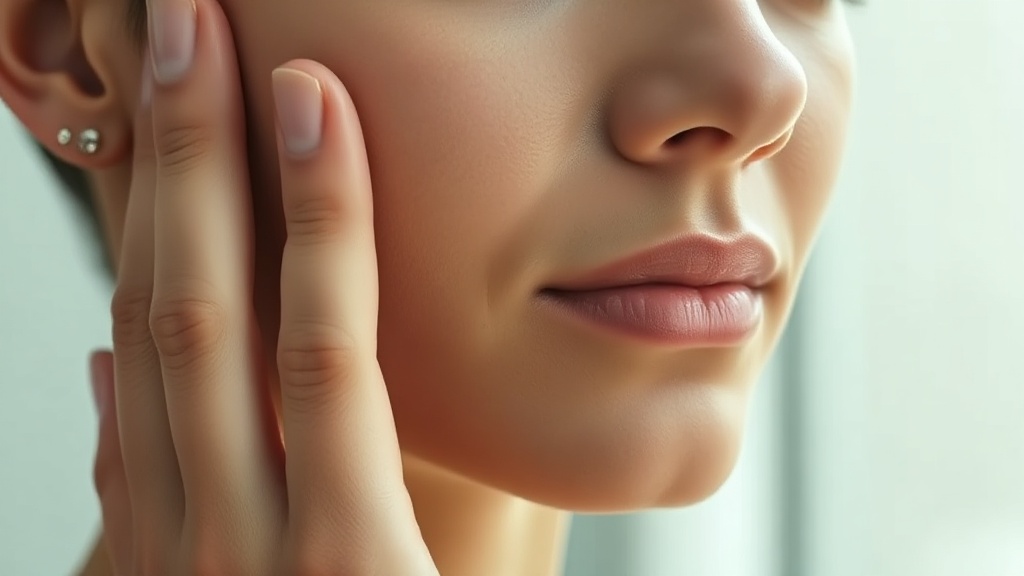
Gentle, low-pressure self-massage over the cheek muscle — warmth first, and never to the point of pain.
See a dentist or a jaw specialist if the masseter stays painful or tight despite gentle care, if your jaw locks, catches, or will not open fully, if pain is one-sided and persistent, if you notice a hard or growing lump, or if you have frequent headaches or ear pain alongside it. Sudden severe pain, swelling, or an inability to open or close your mouth needs prompt care. Self-massage and warmth are for comfort only — lasting jaw-muscle pain deserves a proper assessment rather than a harder routine.
Frequently asked questions
Sources
- 1.
- 2.
- 3.
- 4.
- 5.
- 6.
- 7.
- 8.

Fix your breath at the source.
The complete science-backed protocol — engineered to eliminate volatile sulfur compounds at the biological source.
Start the Breath Protocol →Related reading
Educational purposes only. The content on this page is not medical advice and is not a substitute for consultation with a qualified dental or medical professional.
More from the library
 Guides8 min
Masseter Massage: How to Release a Tight Jaw Muscle
How to gently massage the masseter for comfort and tension relief — pain-free pressure only, and when a tight jaw needs a pro.
Read →→ Answers8 min
How to Relax Your Jaw (Simple Techniques That Actually Help)
Quick, everyday techniques to release a tense, clenched jaw, and the simple resting cue worth remembering.
Read →→ Guides8 min
Jaw Exercises for Tension and Comfort
A calm, honest guide to jaw exercises that ease tension and improve movement, plus the honest limits of what they can and cannot change.
Read →→ Guides8 min
Deep Jaw Release Therapy: Gentle Self-Massage for a Tight Jaw
Deep jaw release is slow, gentle self-massage and stretching that helps overworked jaw muscles let go and feel more comfortable.
Read →→ Guides8 min
Jaw Relaxation Exercises: A Step-by-Step Comfort Guide
A step-by-step down-regulation routine for a tight, clenched jaw, built on gentle relaxation rather than force.
Read →→ Guides9 min
Does Mewing Actually Work? An Honest, Evidence-Based Breakdown
The honest, evidence-based answer to whether tongue posture can reshape an adult jaw — what the research really shows, and why forcing it can backfire.
Read →→