
Gum Disease Explained: From Bleeding Gums to Periodontitis
What gum disease is, how it moves from reversible bleeding to permanent bone loss, and where home care actually helps.

- Gum disease is a spectrum, not one condition: it runs from gingivitis (inflammation of the gum, fully reversible) to periodontitis (loss of the bone and attachment that hold teeth, which is not reversible).
- Bleeding gums are the single most common sign worldwide and the earliest warning — at the gingivitis stage the damage can still be completely undone with consistent plaque control.
- It is extraordinarily common: around 1.07 billion people have severe periodontitis, and roughly a third of US adults over 30 have some form of periodontitis.
- The disease strikes earlier than most people expect, with severe cases peaking around age 38 — the choices that matter most are made decades before teeth look at risk.
- Once periodontitis sets in, home care supports but cannot replace professional treatment; a toothbrush simply cannot reach the hardened calculus below the gumline that drives the disease.
Gum disease is inflammation of the gums driven by plaque bacteria. In its early stage, gingivitis, the gum is red and bleeds but nothing is permanently lost — consistent hygiene reverses it. If it advances to periodontitis, the supporting bone and attachment erode irreversibly, and professional care becomes essential to stop further loss.
What gum disease actually is
Gum disease begins with plaque — a soft, living film of bacteria that forms on teeth every day. Where plaque sits undisturbed along the gumline, the body mounts an inflammatory response, and the gum becomes red, puffy and quick to bleed. This first stage is gingivitis, and it is the most important thing to understand about the whole disease: at this point nothing structural has been lost. In the classic experimental-gingivitis studies, stopping toothbrushing produced gum inflammation within two to three weeks, and resuming plaque control returned every measure — bleeding, pocket depth, gingival and plaque indices — to baseline. Gingivitis is fully reversible. The trouble comes when inflammation persists. In susceptible people, the immune response that was meant to be protective begins to dissolve the fibres and bone anchoring the tooth. The gum detaches, a deeper pocket forms, plaque hardens into calculus below the gumline, and the process feeds itself. That stage is periodontitis — and the attachment and bone it destroys do not grow back.
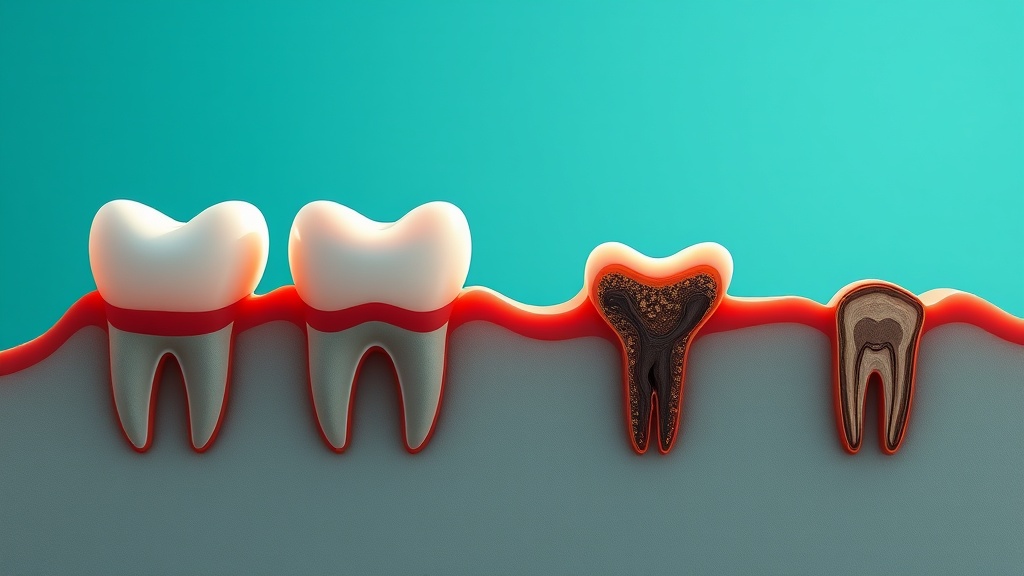
Gum disease is a continuum: reversible gingivitis on the left, irreversible bone and attachment loss on the right.
What the research actually shows
Every claim below maps to a named, peer-reviewed source in the Sources section. According to PubMed.
| Claim | Evidence | Source |
|---|---|---|
| About 1.07 billion people worldwide have severe periodontitis, and prevalence has not fallen in three decades. | Global Burden of Disease modelling of severe periodontitis and edentulism. | Nascimento et al., GBD 2021 |
| Gingivitis is reversible: in the experimental model, all clinical parameters returned to baseline once plaque control resumed. | Experimental-gingivitis clinical study. | Wellappuli et al., 2017 |
| Periodontitis is an irreversible inflammatory condition; lost attachment and bone are not regained, only controlled. | EFP consensus on prevention of periodontitis. | Chapple et al., 2015 |
| At least 35% of US adults aged 30–90 have periodontitis (about 22% mild, 13% moderate-to-severe). | US national survey of periodontal disease. | Albandar et al., NHANES III |
| Gingival bleeding is the most prevalent sign of gum disease; deep pockets over 6 mm affect only about 10–15% of adults. | Global review of periodontal disease burden. | Petersen & Ogawa, 2012 |
Gingivitis vs periodontitis at a glance
| Feature | Gingivitis | Periodontitis |
|---|---|---|
| What is affected | The gum tissue only | Gum plus the bone and fibres holding the tooth |
| Reversible? | Yes — fully, with plaque control | No — damage can be arrested but not undone |
| Typical signs | Redness, puffiness, bleeding when brushing | Receding gums, deep pockets, loose teeth, persistent bad breath |
| What it needs | Better daily hygiene, sometimes a cleaning | Professional scaling and root planing, ongoing maintenance |
| If ignored | May progress in susceptible people | Continues toward tooth loss |
Why it turns from reversible to permanent
Not everyone with gingivitis develops periodontitis — and for a long time that puzzled researchers. The answer lies less in how much plaque you have than in how your body reacts to it. Studies of the gum response show that roughly one in three people are “high responders” whose gums over-inflame to the very same plaque load that leaves others relatively unharmed. In these people, the inflammatory chemistry meant to fight bacteria also breaks down collagen and bone, and the balance tips from a reversible surface irritation to a self-sustaining destructive process. Once a pocket forms, it becomes a sheltered, low-oxygen home for the most aggressive bacteria, and calculus cements onto the root where no brush can dislodge it. Clinicians cannot reliably predict in advance who will progress, which is exactly why the sensible strategy is universal prevention: treat gingivitis seriously in everyone, because it is the one stage where the outcome is still entirely in your hands. Smoking tilts the odds hardest of all, nearly doubling the risk of progression.
Evidence you can act on.
Occasional emails — new research, new protocols, no noise.
How to protect your gums
None of the steps below treats periodontitis on its own — that requires a dental professional. What they do is control the plaque and inflammation that start and drive the disease, and support healing alongside professional care.
- 1
Disrupt plaque twice a day, gently
2 minutes, twice dailyBrush for two full minutes morning and night with a soft, end-rounded brush angled at the gumline using small movements (the Bass technique). Powered brushes remove a little more plaque, but a well-instructed manual brusher does nearly as well — technique matters more than hardware. The goal is to break up the film before it can inflame the gum.
- 2
Clean between the teeth every day
once dailyA brush only reaches about three of the five surfaces of each tooth. Interdental brushes, where they fit, tend to reduce gum bleeding more than string floss; floss or a water flosser also help. This is the step most people skip and the one gingivitis depends on.
- 3
Use a rinse as a supplement, not a substitute
as directedAn alcohol-free essential-oil rinse can reach between-teeth surfaces brushing misses. Short courses of chlorhexidine are the strongest antiseptic but stain teeth and are for defined periods only, on a dentist’s advice — never a forever habit.
- 4
Deal with the risk factors you can change
ongoingStopping smoking is the single most powerful thing you can do; former smokers’ tooth-loss risk drifts back toward that of people who never smoked. Managing blood sugar if you are diabetic, and eating a lower-sugar, anti-inflammatory diet, all measurably reduce gum bleeding.
- 5
See a dentist on schedule, not just in pain
every 6–12 monthsOnly a professional can remove calculus below the gumline and catch the shift from gingivitis to periodontitis early, while pockets are shallow and treatment is simplest. Regular maintenance is what keeps lifelong tooth loss close to zero.
Breaking up plaque at the gumline every day is the single most defensible thing you can do for your gums.
Gum disease is a genuine medical condition, and only a dentist or periodontist can diagnose its stage and remove calculus below the gumline. Book an assessment if your gums bleed regularly, look red or swollen, are pulling away from your teeth, if you notice persistent bad breath, or if any tooth feels loose. Do not rely on rinses, supplements or home remedies to “cure” gum disease — they cannot, and delay allows reversible gingivitis to become irreversible periodontitis. If you have diabetes or smoke, ask to be seen more often.
Frequently asked questions
Sources
- 1.
- 2.
- 3.
- 4.
- 5.
- 6.
- 7.
- 8.

Fix your breath at the source.
The complete science-backed protocol — engineered to eliminate volatile sulfur compounds at the biological source.
Start the Breath Protocol →Related reading
Educational purposes only. The content on this page is not medical advice and is not a substitute for consultation with a qualified dental or medical professional.
More from the library
 Guides8 min
Gum Disease Symptoms: The Early Warnings You Can Feel
The symptoms of gum disease you can feel and notice yourself, why bleeding comes first, and when a symptom means see a dentist now.
Read →→ Guides9 min
Gum Disease Treatment: The Professional Path and How Home Care Supports It
The evidence-based treatment path for gum disease, why professional care is non-negotiable, and how home habits support but never replace it.
Read →→ Answers9 min
Can Gum Disease Kill You? An Honest, Non-Alarmist Answer
A calm, evidence-based look at whether gum disease can kill you, what its links to heart disease and diabetes really mean, and why they point to a dentist.
Read →→ Guides8 min
How to Stop Receding Gums: What Actually Slows It
You cannot will your gum line back up, but you can often stop it from dropping further. Here is what the evidence supports.
Read →→ Answers8 min
Can Receding Gums Grow Back? The Honest Answer
It is the question everyone with recession asks. The straight answer, and what you can realistically do instead.
Read →→ Guides8 min
Periodontal Disease: The Full Spectrum, Explained
A clear, honest overview of periodontal disease as a spectrum: the difference between gingivitis and periodontitis, what the colloquial phrase gum disease misses, and why early bleeding is the signal to act.
Read →→