Are Tonsil Stones Contagious?
Worried you can catch or spread tonsil stones? The short answer is no — and here is exactly why, backed by what the research shows.
- Tonsil stones are not contagious — there is nothing to catch and nothing to pass on, because a stone forms from your own trapped debris inside your own tonsil crypts.
- The bacteria inside them are the ordinary resident anaerobes of the mouth and throat that everyone already carries, not an infection acquired from someone else.
- Kissing, sharing drinks or utensils, and close contact do not transmit tonsil stones — the worry is understandable but unfounded.
- They are extremely common and become more common with age (about 1 in 3 CT scans), which is one reason a couple or family members may both have them — shared tendency and coincidence, not transmission.
- What others may occasionally notice is the odour, not the stone itself — a breath concern that responds to gentle clearing, not a sign you have spread anything.
No — tonsil stones are not contagious. You cannot catch them or pass them on by kissing, sharing drinks or close contact. A stone is simply your own trapped debris colonised by the ordinary bacteria everyone already carries, assembled into a biofilm inside your tonsil's natural pockets. Only the odour, not the stone, is ever noticeable to others.
Why tonsil stones cannot be caught or passed on
To be contagious, something has to travel from one person and take hold in another — the way a cold virus does. A tonsil stone works nothing like that. It is a self-assembled pile of your own material: dead cells shed from your mouth, mucus from the back of your nose, tiny food particles, and the bacteria that already live on all of it, packed into the natural folds of your tonsils called crypts. Researchers who examined tonsil stones under the microscope found them to be a living biofilm — an organised bacterial community with its own internal chemistry — built in place rather than delivered from outside. Crucially, the bacteria doing the building are not exotic invaders. They are the same resident anaerobes that populate every healthy mouth and throat. So even in the closest possible contact, there is nothing transmissible to hand over: your partner already carries the same background flora, and whether they form stones depends on their own crypt shape, not on anything you could give them.
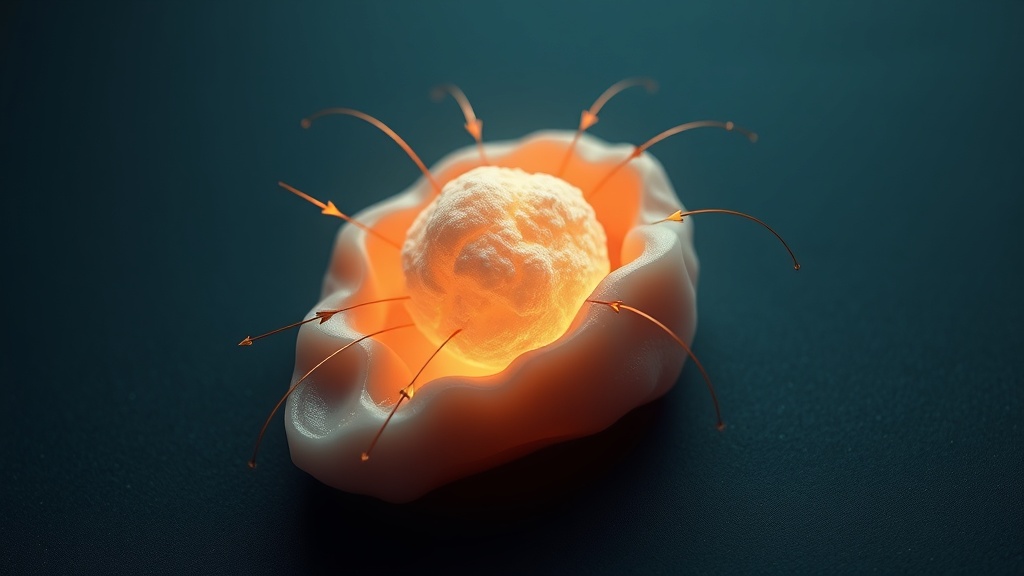
A stone builds in place from your own shed cells, mucus and resident bacteria — there is no incoming source to catch it from.
What the research actually shows
Every claim below maps to a named, peer-reviewed source in the Sources section. According to PubMed.
| Claim | Evidence | Source |
|---|---|---|
| A tonsil stone is a living biofilm built from your own trapped debris, with its own internal chemistry — it forms in place rather than being transmitted. | Confocal microscopy and microelectrode study of 16 adults. | Stoodley et al., 2009 |
| The bacteria inside tonsil stones are ordinary resident anaerobes of the mouth and throat (such as Fusobacterium and Prevotella) — the normal flora everyone carries, not an outside infection. | 16S rDNA analysis of tonsillolith specimens. | Tsuneishi et al., 2006 |
| Actinomyces, often found in tonsil stones, routinely colonises normal healthy tonsils too and is not the primary driver — underscoring that these are resident organisms, not acquired ones. | Specimen comparison, n=134. | Arvisais-Anhalt et al., 2020 |
| Tonsil stones are extremely common — found on about 30.3% of CT scans, averaging 2.7 per person — and become more common with age, a normal anatomical finding rather than an outbreak. | Largest CT prevalence series (n=3,886). | Kim et al., 2018 |
| A stone raises the chance of noticeable breath odour roughly 10-fold — present in 75% of the abnormal-breath group versus 6% of the normal group — but the odour, not the stone, is what others may notice. | Halitometry study, n=49. | Dal Rio et al., 2007 |
Contagious or not: clearing up the confusion
| The worry | The reality | Why |
|---|---|---|
| Can I catch tonsil stones from someone? | No | They form from your own crypt debris; there is nothing to transmit |
| Can I give them to a partner by kissing? | No | The bacteria involved are ordinary residents everyone already carries |
| Are they a sign of an infection I passed on? | No | A stone is trapped debris in a natural pocket, not an infectious disease |
| Can someone smell them on me? | Sometimes | The odour can be noticeable — that is a breath concern, not contagion |
So why do a couple or family members both get them?
If tonsil stones cannot spread, why do partners sometimes both have them, or why do they seem to run in a family? Two ordinary explanations cover it, and neither is contagion. First, sheer commonness: stones show up on roughly a third of CT scans, so two people sharing a home overlapping is more coincidence than clue. Second, and more interesting, is shared anatomy. Whether you form stones is driven mainly by how deep and branched your tonsil crypts are, and crypt architecture has a strong hereditary component — so relatives can inherit a similar tendency to trap debris, just as they might inherit a jaw shape or a hair type. That looks like something being passed around, but what is actually shared is a predisposition, not an organism. It is the same reason two siblings might both be prone to earwax build-up: not an infection travelling between them, but similar plumbing responding to the same everyday debris.
Evidence you can act on.
Occasional emails — new research, new protocols, no noise.
What actually helps (since catching them isn't the issue)
Because there is nothing to catch, the useful work is simply keeping your own crypts clear and your breath fresh. None of this treats a disease — it manages debris and odour.
- 1
Clear the crypts gently and regularly
under a minute dailyA low-pressure water rinse aimed at the tonsil area is the most sensible tool for loosening debris before it organises into a stone. Keep the pressure low — forceful jets can bruise or bleed the delicate tissue, and there is no need to be aggressive.
- 2
Keep the overall bacterial load down
twice dailyThorough brushing, flossing and an alcohol-free rinse lower the general population of odour-producing bacteria in the mouth. This supports fresher breath overall, though it works alongside gentle crypt clearing rather than reaching inside the crypt itself.
- 3
Stay hydrated and protect your saliva
all daySaliva is the mouth's natural rinse; a dry mouth lets debris and its odour sit and build. Sip water through the day and breathe through your nose where you can, which is also why stones and their smell often feel worst first thing in the morning.
- 4
Reassure, do not sterilise
ongoingThere is no need to throw out shared cups, avoid kissing, or treat a partner. Because the bacteria are ordinary residents everyone carries, deep-cleaning your household or your relationship changes nothing about whether stones form — only gentle clearing does.

You do not need to avoid kissing or shared cups — there is no organism being handed over, only your own resident flora on each side.
Contagion is not the concern, but a few things still deserve an in-person look. Book an assessment if one tonsil stays visibly larger than the other and does not settle, if you have repeated throat infections, ongoing pain or difficulty swallowing, persistent ear pain, or any bleeding. A lasting one-sided enlargement in particular should always be checked by an ENT rather than self-managed, because a persistent asymmetry is something a professional should rule out.
Frequently asked questions
Sources
- 1.
- 2.
- 3.
- 4.
- 5.
- 6.
- 7.

Fix your breath at the source.
The complete science-backed protocol — engineered to eliminate volatile sulfur compounds at the biological source.
Start the Breath Protocol →Related reading
Educational purposes only. The content on this page is not medical advice and is not a substitute for consultation with a qualified dental or medical professional.
More from the library
 Answers8 min
What Are Tonsil Stones Made Of? The Real Composition, Explained
A look at what tonsil stones are actually built from: the debris, the biofilm, and the slow calcification, grounded in what the research shows.
Read →→ Causes8 min
How Do Tonsil Stones Form? The Biology, Honestly Explained
The unglamorous truth about what a tonsil stone is, how it builds up in the folds of your tonsils, and why the crypts that make them are simply part of your anatomy.
Read →→ Answers9 min
Are Tonsil Stones Normal? The Honest, Reassuring Answer
Why tonsil stones are one of the most common things people are quietly embarrassed about - and how to tell an ordinary stone from the rare sign worth checking.
Read →→ Answers8 min
Can Tonsil Stones Cause Bad Breath? What the Evidence Says
Why a small stone in the throat can create an outsized smell, and how to know if it is yours.
Read →→ Answers8 min
Can Tonsil Stones Make You Sick? An Honest Look
A calm, honest look at whether tonsil stones can actually make you unwell, the local nuisances they do cause, and the red flags worth taking seriously.
Read →→ Answers8 min
Can a Dentist Remove Tonsil Stones? Your Professional Options
Who actually removes tonsil stones, the in-office options from simple expression to crypt reshaping, and how to know when a professional is worth it.
Read →→