Are Tonsil Stones Dangerous?
Why tonsil stones are almost never dangerous, the rare signs that deserve a professional, and how to tell the difference calmly.

- For the overwhelming majority of people, tonsil stones are harmless. They are trapped debris and bacteria, not a growth or an infection, and are usually managed at home.
- They are extremely common, appearing on a large share of CT scans, and most are small, silent and never cause a problem beyond bad breath or a foul taste.
- The body tends to deal with them itself: most stones that move drift toward the throat and are swallowed or coughed out, and some disappear entirely.
- There is one honest exception worth knowing: a lump or enlargement on one tonsil that does not go away should be examined in person rather than assumed to be a stone.
- Reassurance has a limit. A serious throat infection does not always cause a fever, so severe, worsening or one-sided symptoms deserve care regardless of temperature.
Almost never. Tonsil stones are trapped debris and bacteria, not a disease, and for the vast majority of people they are completely harmless. The body usually clears them on its own. The one honest exception is a lasting, one-sided tonsil enlargement, which should always be checked by a professional rather than assumed to be a stone.
Why tonsil stones are almost never dangerous
It helps to be clear about what a tonsil stone actually is. Your tonsils are folded into deep pockets called crypts, and a tonsil stone is nothing more than everyday debris, dead cells, food particles, mucus and bacteria, that has collected in one of those pockets and slowly organised into a firm cluster. Under a microscope it behaves like a living biofilm, an organised bacterial community, rather than a tumour or an inert mineral. That distinction matters, because it explains why stones are a cosmetic and comfort problem far more often than a medical one: they are made of the same material the mouth handles every day, simply left in place long enough to gather and harden. Authoritative reviews describe small tonsil stones as common findings that are managed expectantly, watched and cleared rather than urgently treated, with intervention reserved for the rare stone too large to pass on its own. The body is also on your side here. On repeat imaging, most stones that shift travel toward the throat opening, where they are quietly swallowed or coughed out, and a meaningful share vanish without any intervention at all.
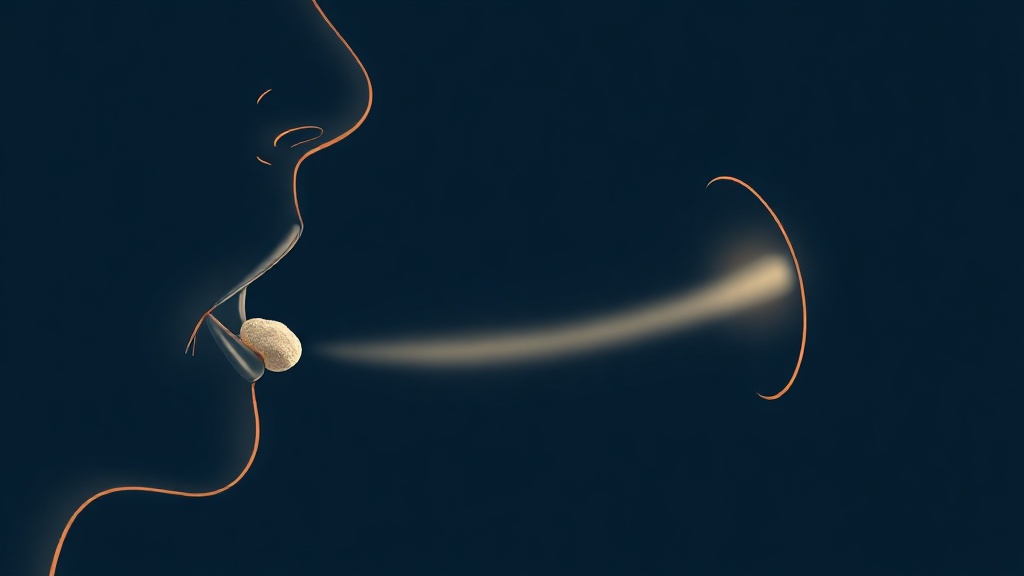
Most tonsil stones are small and self-resolving. The body tends to move them toward the throat, where they clear on their own.
What the research actually shows
Every claim below maps to a named, peer-reviewed source in the Sources section. According to PubMed.
| Claim | Evidence | Source |
|---|---|---|
| Small tonsil stones are common findings that are usually managed expectantly, with surgery reserved for the rare stone too large to pass on its own. | Clinical review in American Family Physician. | Smith et al., 2023 |
| Tonsil stones appear on roughly 30% of CT scans and average about 2.7 per person, extraordinarily common, and mostly small and silent. | Largest CT prevalence series (n=3,886). | Kim et al., 2018 |
| The body tends to expel them: 92% of stones that moved on repeat scans travelled toward the throat, and about 1 in 8 disappeared. | Follow-up CT of 326 scan pairs. | Yamashita et al., 2021 |
| Persistent one-sided tonsil enlargement warrants in-person assessment: in a surgical series of such cases, nearly a quarter had a cause other than a simple stone. | Surgical series of unilateral tonsillar enlargement. | Spinou et al., 2005 |
| Absence of fever is not reassurance: most patients with a peritonsillar abscess in one study presented without a fever. | Case series of peritonsillar abscess (82.7% afebrile). | Hathi et al., 2022 |
Reading the situation calmly
| Situation | What it usually means | Sensible action |
|---|---|---|
| Recurring stones with bad breath | A cosmetic and comfort issue, not a danger | Clear gently and keep up daily habits |
| A stone you can see or feel | Normal trapped debris in a crypt | Dislodge gently or let it work loose |
| One tonsil staying larger than the other | Needs a cause to be ruled out in person | See a dentist or ENT, do not self-treat |
| Severe pain, trouble swallowing or breathing, drooling | Possible infection needing prompt care | Seek medical care promptly, fever or not |
The honest exceptions: when to take it seriously
Being reassuring should never mean being dismissive, so here is the honest other half. The single most important sign to respect is asymmetry that lasts: if one tonsil stays visibly larger than the other for weeks, that is not something to write off as a stone. In a surgical series of people operated on for one-sided tonsil enlargement, a significant proportion turned out to have a cause other than a tonsillolith, which is exactly why a lasting one-sided lump should be examined by a professional who can look properly, not self-managed at home. The second thing worth knowing is that the throat can become seriously inflamed without the usual warning of a fever; in one study of peritonsillar abscess, most patients arrived with no fever at all. So the absence of a temperature is not proof that everything is fine. Finally, the tonsil bed bleeds easily, which is why aggressive self-removal is its own small hazard, the biggest avoidable risk a harmless stone poses is usually the injury from digging at it. None of this makes tonsil stones dangerous in general. It simply means a few specific signs, lasting asymmetry, severe or worsening pain, trouble swallowing or breathing, deserve a real assessment rather than another home remedy.
Evidence you can act on.
Occasional emails — new research, new protocols, no noise.
How to stay calm and handle them sensibly
Because tonsil stones are almost always harmless, the sensible approach is light, regular care plus a clear idea of the few signs that change the plan. None of this treats a disease; it keeps the pockets tidy and your mind at ease.
- 1
Clear them gently, not forcefully
under a minute dailyA low-pressure water rinse aimed at the tonsils dislodges debris before it builds up, and has been shown to lower the sulfur gases behind the smell. Keep the pressure gentle; the tonsil bed bleeds readily, so forceful jets or rigid tools do more harm than good.
- 2
Let the body do its part
ongoingMost stones work loose and clear on their own, drifting toward the throat to be swallowed or coughed out. You rarely need to chase a stone that is not bothering you, patience plus light daily habits is often all that is required.
- 3
Support fresh breath cosmetically
twice dailyBrushing, tongue cleaning and an alcohol-free rinse lower the general odour-producing bacterial load. This freshens breath and supports the whole mouth environment, though it works alongside gentle crypt clearing rather than replacing it.
- 4
Know your personal baseline
occasionalGlance at your tonsils in a mirror now and then so you know what normal looks like for you. That way a genuine change, a lump on one side that stays, for instance, is something you will actually notice rather than second-guess.
- 5
Act on the red flags without panic
as neededIf you notice lasting one-sided enlargement, severe or worsening pain, trouble swallowing or breathing, or drooling, stop home care and get assessed. These are uncommon, but they are the moments where a professional look matters, and a calm, prompt visit beats waiting and worrying.

The one honest exception: lasting enlargement of a single tonsil should be assessed in person rather than assumed to be a stone.
Tonsil stones themselves are not dangerous, but a few signs deserve an in-person assessment: one tonsil staying larger than the other, a lump or sore that does not heal, severe or one-sided pain, ongoing trouble swallowing, or any difficulty breathing or drooling. Do not wait for a fever, because serious throat infections often arrive without one. Seeing a dentist or ENT for these is about ruling things out calmly, not cause for alarm.
Frequently asked questions
Sources
- 1.
- 2.
- 3.
- 4.
- 5.
- 6.
- 7.
- 8.

Fix your breath at the source.
The complete science-backed protocol — engineered to eliminate volatile sulfur compounds at the biological source.
Start the Breath Protocol →Related reading
Educational purposes only. The content on this page is not medical advice and is not a substitute for consultation with a qualified dental or medical professional.
More from the library
 Answers9 min
Are Tonsil Stones Normal? The Honest, Reassuring Answer
Why tonsil stones are one of the most common things people are quietly embarrassed about - and how to tell an ordinary stone from the rare sign worth checking.
Read →→ Answers8 min
Can Tonsil Stones Make You Sick? An Honest Look
A calm, honest look at whether tonsil stones can actually make you unwell, the local nuisances they do cause, and the red flags worth taking seriously.
Read →→ Answers8 min
Do Tonsil Stones Go Away on Their Own? What the Imaging Shows
The reassuring, evidence-based answer to whether tonsil stones resolve by themselves, drawn from studies that scanned the same people twice.
Read →→ Answers8 min
ENT Specialist for Tonsil Stones: When You Actually Need One
The honest guide to when a tonsil stone is a job for an ear, nose and throat specialist — and the red flags you should never sit on.
Read →→ Causes8 min
How Do Tonsil Stones Form? The Biology, Honestly Explained
The unglamorous truth about what a tonsil stone is, how it builds up in the folds of your tonsils, and why the crypts that make them are simply part of your anatomy.
Read →→ Answers8 min
Can a Dentist Remove Tonsil Stones? Your Professional Options
Who actually removes tonsil stones, the in-office options from simple expression to crypt reshaping, and how to know when a professional is worth it.
Read →→